

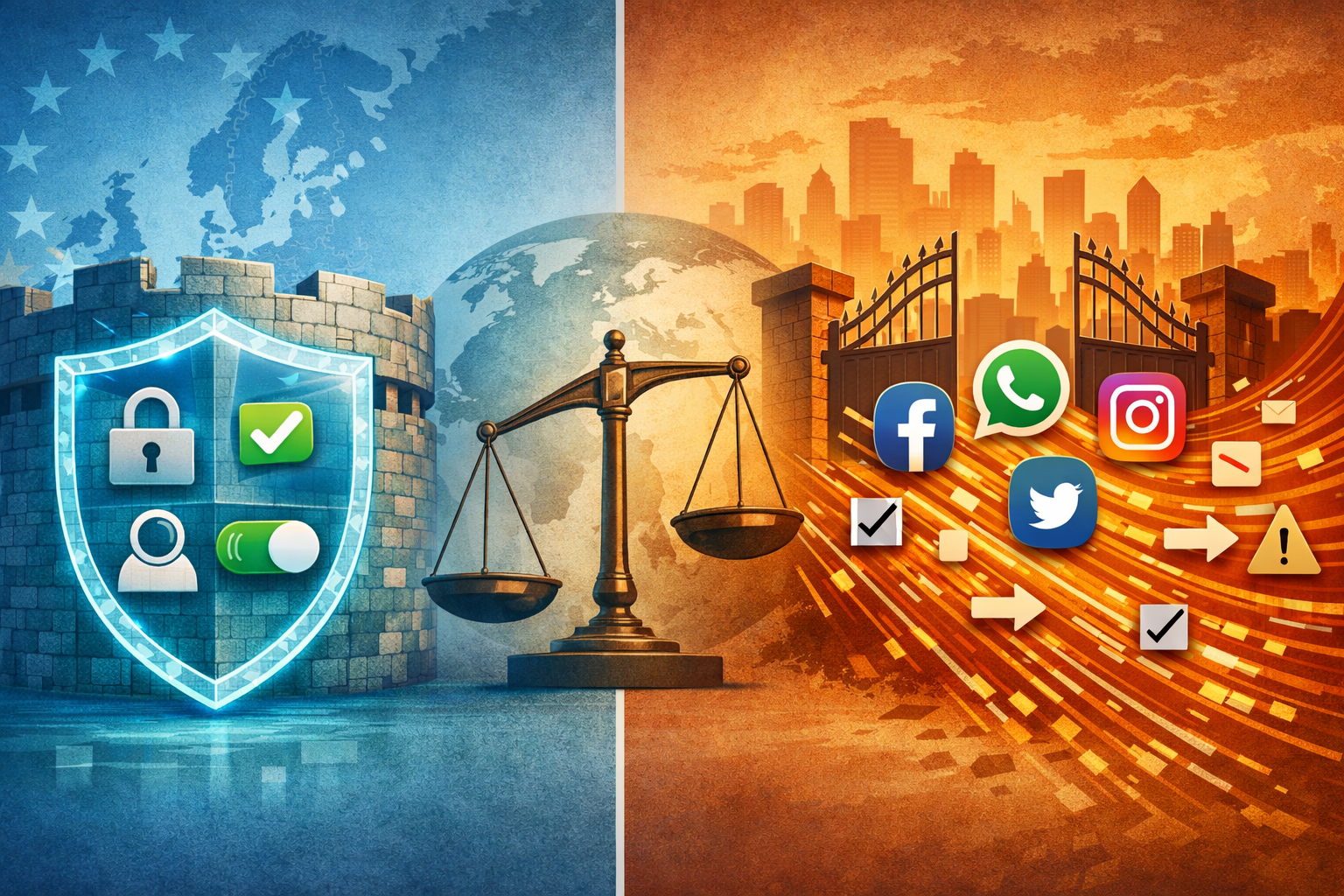
| Feature | Europe: Opt-in / GDPR Protected | India: Forced Consent / Data Shared |
| Legal Basis | Strictly regulated; allows specific user objections. | “Take-it-or-leave-it” framework. |
| Data Sharing | Scrutinized by EDPB; AI integration delayed. | Mandatory sharing with Meta subsidiaries. |
| User Autonomy | Codified rights to access and erasure. | Opt-out called “too technical” and “cleverly crafted”. |
| Market Position | High oversight on leveraging messaging dominance. | Monopoly used to “manufacture consent”. |
| Transparency | Clear disclosures required for AI. | Terms buried in complex language. |
The air inside the Supreme Court of India on February 3, 2026, was thick with the weight of a constitutional reckoning. As Chief Justice of India (CJI) Surya Kant addressed the counsel for Meta and WhatsApp, his words echoed far beyond the courtroom: “You cannot play with the right of privacy of this country… If you don’t agree, leave India. You opt out of the country”. This was no mere procedural hearing; it was a definitive line in the sand against the digital colonization of the world’s most populous democracy.
The bench—which included Justices Joymalya Bagchi and Vipul Pancholi—was hearing Meta’s appeal against a ₹213.14 crore penalty imposed by the Competition Commission of India (CCI) for abusing its market dominance. The Court’s description of Meta’s data-sharing model was a surgical strike: “A decent way of committing theft of private information”. For a judiciary that has guarded the fundamental right to privacy since the landmark Puttaswamy judgment, Meta’s 2021 policy update appeared as a mockery of Indian constitutionalism.
A Line in the Sand
For years, Silicon Valley has treated India as a vast “data farm,” harvesting behavioral trends to refine advertising engines while offering skeletal protections compared to Western users. On February 3, the Supreme Court finally challenged this transactional impunity. By linking the right to operate in the Indian market with the obligation to respect Article 21, the Court signaled that digital convenience cannot be purchased at the cost of the citizenry’s constitutional soul.
The “Double Standard”
The core of the Court’s ire is the glaring disparity between privacy rights in Europe and India. Under the GDPR, European users enjoy granular controls and explicit opt-ins. In India, Meta deployed a digital ultimatum: accept mandatory data sharing across Facebook and Instagram, or lose access to WhatsApp entirely. This “Data Apartheid” treats European privacy as a protected right while reducing Indian privacy to a commercial asset.
Justice Joymalya Bagchi noted that while European rules consider both privacy and the commercial value of data, India’s Digital Personal Data Protection (DPDP) Act focuses primarily on data “sanctity,” leaving a vacuum regarding its monetization. This regulatory gap has allowed Meta to operate a “forced consent” model in India that would be legally untenable in the West.
The “Monopoly” Argument
The Court identified WhatsApp as an essential social infrastructure rather than a mere application. With over 500 million users, the “network effect” creates an inescapable trap. CJI Surya Kant described the agreement as a “deal between a lion and a lamb,” where the choice to walk away is illusory because “everybody uses it”.
In a market where exiting the platform means losing vital economic and social connections, “consent” is not freely given—it is manufactured through addiction and necessity. Meta’s integration of metadata across its ecosystem ensures that even non-Facebook users have “shadow profiles” enriched by their WhatsApp activity, a closed loop that stifles competition and treats the Indian digital ecosystem as proprietary soil.

The “Silent User” Defense
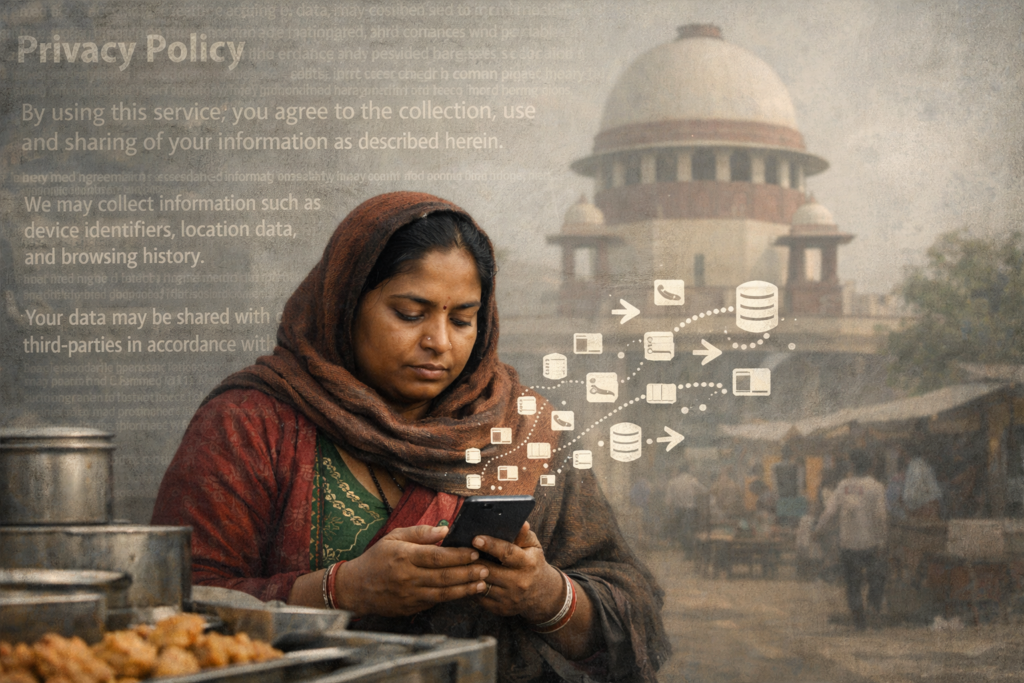
The Court’s most poignant intervention focused on the “silent user”—the street vendor or domestic help who cannot navigate “cleverly crafted” policies running dozens of pages. “Will a poor woman selling fruits on the street understand your policy?” the CJI asked. By positioning itself as the guardian of the digitally unorganized, the Court shifted the debate from technical law to social justice.
The bench dismissed Meta’s claim of an “opt-out” mechanism as a technicality that fails in practice. Justice Bagchi highlighted that while platforms send in-app messages for features, they rely on “newspaper ads” for opt-out notices—a medium the target demographic rarely accesses. This information imbalance, the Court argued, allows for the “theft” of private information from those unable to give informed consent.
Behavioral Trends
The Court’s use of the term “theft” reflects a sophisticated understanding of metadata monetization. CJI Surya Kant shared a personal anecdote of receiving targeted medical ads moments after messaging a doctor on WhatsApp. Justice Bagchi’s focus on “rent-sharing” suggests a new legal frontier: if user behavioral patterns are being used to train AI models or refine advertising, those “silos of data” have quantifiable value that Meta currently extracts for free.
The Solicitor General, Tushar Mehta, reinforced this, stating that Indian users are being treated as “products” rather than consumers. The Court’s interim direction to stop sharing even a “single digit” of data is a direct challenge to the “AI-first” pivot that relies on this extraction process.
The Stakes for February 9
The Supreme Court has set a hard deadline for February 9. Unless Meta and WhatsApp provide a categorical undertaking from their management to stop utilizing user data for commercial advertising, the Court may dismiss their appeals entirely.
This is a historic moment of “constitutional redemption”. If Meta complies, it must decouple its messaging service from its data-harvesting engine. If it refuses, it faces a total exit from its largest market. The message is clear: the Constitution of India is the only contract that truly matters, and no multinational corporation is too big to be governed by it.
READ OUR OTHER ARTICLES
- ओडिशा का दीपक पहुंचा बेंगलुरु, Hardik Pandya की उदारता ने मचाया तहलका
 भारत में क्रिकेट केवल एक खेल नहीं, बल्कि एक गहरी सामाजिक भावना है जहाँ खिलाड़ी भगवान की तरह पूजे जाते हैं और प्रशंसक उनके प्रति अटूट स्नेह प्रदर्शित करते हैं. … Read more
 - Iran’s Darkest Day: Screams for Revenge and a Missing Leader
 On Sunday, July 5, 2026, Iran entered the tense and highly charged Khamenei funeral Day 2. This marked a critical moment in a six-day state funeral meant to show the … Read more
 - अजीत कुमार: प्रेरणादायक सफर और वैश्विक उपलब्धियों का महाकाव्य
 भारतीय सिनेमा के परिदृश्य में कुछ ऐसे व्यक्तित्व होते हैं जो पर्दे की चकाचौंध से परे जाकर समाज और संस्कृति पर अपनी अमिट छाप छोड़ते हैं। दक्षिण भारतीय सिनेमा के … Read more
 - Coachella 2026: Highlights and History-Making Moments You Missed!
 The 25th anniversary of the Coachella Valley Music and Arts Festival just wrapped up, and it was absolutely legendary! From April 10–12 and April 17–19, 2026, the Empire Polo Club … Read more
 - वैभव सूर्यवंशी का टीम इंडिया में चयन हो चुका है?
 भारतीय क्रिकेट के इतिहास में कुछ क्षण ऐसे आते हैं जो केवल खेल के आंकड़ों को नहीं बदलते, बल्कि पूरे देश की खेल भावना और भविष्य की दिशा को पुनर्परिभाषित … Read more