

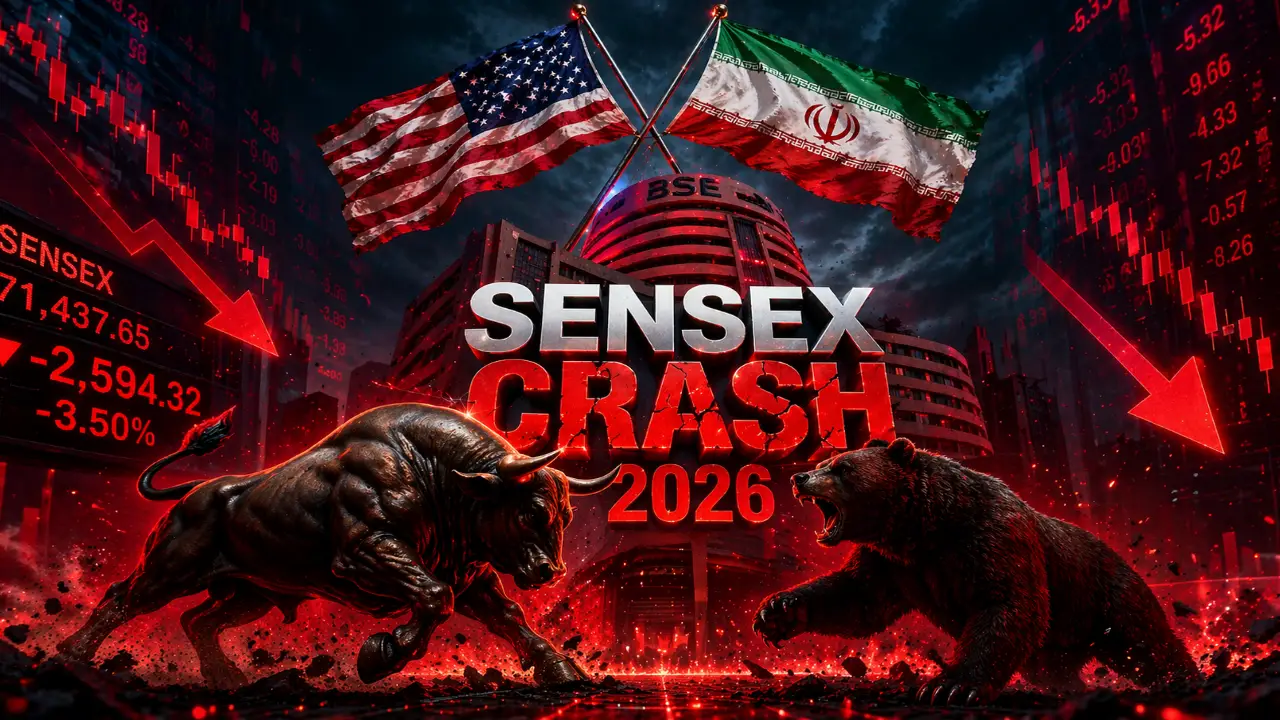
If you opened your trading app this Monday and felt a knot in your stomach, you aren’t alone. The Indian stock market is currently going through one of its toughest times in years. In what people are already calling “Black Monday,” the Sensex crashed by nearly 2,500 points, landing in the 74,000 range. The Nifty 50 didn’t fare much better, sliding past the 23,100 mark.
To put this in perspective, in just one day of trading, investors lost over ₹11 Lakh Crore. That is a massive amount of wealth simply vanishing into thin air. But why is this happening? While the Indian economy itself is doing okay, a “perfect storm” of bad news from around the world—specifically a growing war in the Middle East—has hit Dalal Street like a freight train.
The Geopolitical Trigger
In this post, we’ll break down exactly why the markets are bleeding, which sectors are in the line of fire, and most importantly, what you should do as a retail investor to keep your head above water.
The biggest reason for this crash isn’t happening in Mumbai or Delhi; it’s happening in the Middle East. Over the weekend in Islamabad, top officials from the US and Iran tried to reach a peace deal. Unfortunately, those talks failed.
When diplomacy fails, markets panic. Immediately after the talks collapsed, the situation escalated. Fears are now peaking that the Strait of Hormuz—a tiny but vital strip of water in the Middle East—could be completely blocked.
Why should an Indian investor care about a waterway thousands of miles away? Think of the Strait of Hormuz as the world’s main “energy pipe.” About 21% of all the world’s oil flows through this one narrow passage. If it gets blocked, oil can’t get out of the Middle East. For a country like India, which imports about 85% to 90% of its oil, this is a nightmare scenario.
The Crude Oil Crisis
Because of the war fears, the price of Brent Crude oil has jumped by over 25%, trading above $116 per barrel. This isn’t just a number on a screen; it’s a direct threat to India’s financial health.
When oil prices go up, a “domino effect” begins:
- The “National Bill”: Since we buy most of our oil from other countries, our national “bill” (called the Current Account Deficit) gets much more expensive.
- Inflation: Everything in India moves on trucks and ships. If diesel and petrol get expensive, the price of milk, vegetables, and clothes also goes up. This is called inflation.
- The RBI Factor: If inflation stays too high (above 6%), the Reserve Bank of India (RBI) might be forced to raise interest rates. Higher interest rates mean higher EMIs for your home and car loans, which leaves less money for people to spend or invest.
Experts suggest that for every $10 increase in oil prices, India’s trade gap widens by about 0.3% to 0.4% of our GDP. At $116 per barrel, the pressure is immense.
The “Big Players” are Leaving
Another reason for the red screens is that Foreign Institutional Investors (FIIs)—the big global funds—are pulling their money out of India at a record pace. In March alone, they sold off over ₹1.14 Lakh Crore worth of Indian stocks.
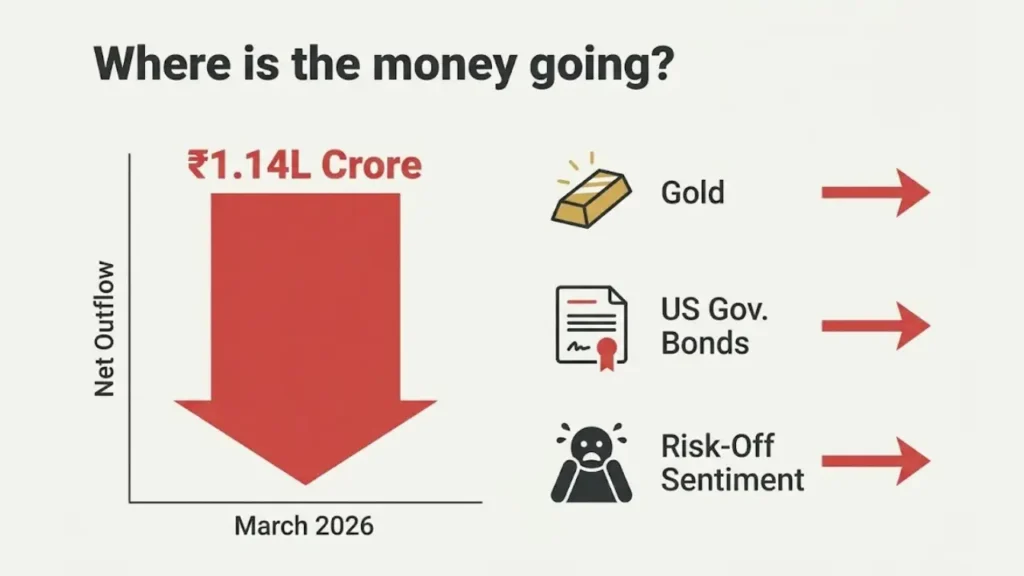
Why are they selling?
When there is a war, big investors get scared. They move their money out of “risky” markets like India and put it into “safe” places like Gold or US Government Bonds.
There’s also a new trend called the “AI Trade.” Many global investors are moving their money to countries like Taiwan and South Korea because those countries make the chips used for Artificial Intelligence. Since India is seen more as a “user” of AI rather than a “maker” of the hardware, FIIs are shifting their cash elsewhere.
The Rupee Under Pressure
As FIIs sell their Indian stocks, they trade their Rupees for Dollars to take their money back home. This high demand for Dollars has caused the Indian Rupee to fall to a record low of around 92.3 to 93.3 against the US Dollar.
A weak Rupee makes our oil imports even more expensive, creating a vicious cycle that further fuels inflation. It’s a tough spot for the RBI, which is now using its “emergency reserves” to try and stop the Rupee from falling too far.
Who Wins and Who Loses?
The market crash hasn’t hit everyone the same way. Let’s look at the different “rooms” of the market:
The Losers:
- Paint Stocks: To make paint, you need chemicals derived from oil. When oil hits $116, the cost of making paint skyrockets. Companies like Asian Paints and Berger Paints are seeing their profit margins shrink because they can’t easily pass these high costs to customers.
- Aviation: For airlines like IndiGo or SpiceJet, fuel is their biggest expense (nearly 40% of their costs). With fuel prices rising, ticket prices will likely go up, and fewer people may travel.
The Under Pressure:
- IT Stocks: The Nifty IT index has fallen by about 22% in the last few months. Between war fears and the US Federal Reserve keeping interest rates “higher for longer,” global companies are spending less on tech projects.
- Banking: Large banks like HDFC Bank have been under pressure because as interest rates rise, the cost of funds goes up, and people might struggle to pay back loans if the economy slows down.
The “Safe” Bets:
- Pharma: Indian medicine companies are doing relatively well. Since people need medicine regardless of the war, exports to the US and Europe remain steady.
- Oil Producers: Companies like ONGC actually benefit from high oil prices because the oil they produce domestically is now worth much more.
The Psychology of the Crash
It is human nature to be afraid when you see your hard-earned money disappearing. This is called “Loss Aversion”—the pain of losing ₹1,000 feels much worse than the joy of gaining ₹1,000.
When you see everyone else selling (the “Herd Mentality”), you feel an urge to sell too, just to make the “pain” stop. But remember: you only lock in a loss if you actually click that “Sell” button. Historically, every major market crash—from 2008 to the 2020 pandemic—has eventually been followed by a recovery.
What Should a Retail Investor Do?
Instead of panicking, use this as a time to review your strategy. Here are three simple paths you can take:
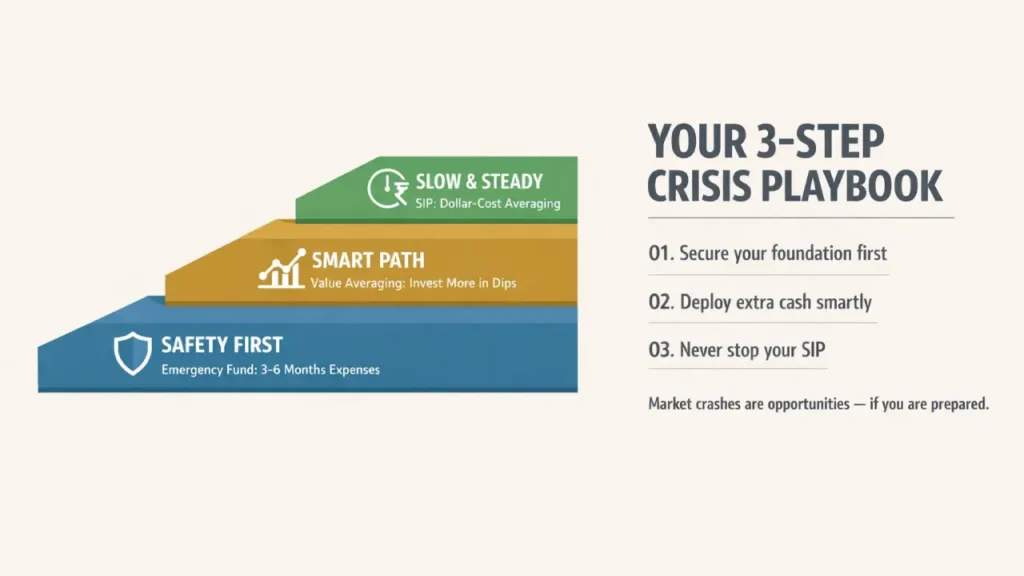
A. The “Slow and Steady” Path
Don’t try to guess when the market will hit the “bottom”—not even the pros can do that. Instead, keep your SIPs (Systematic Investment Plans) running. By investing a fixed amount every month, you naturally buy more shares when prices are low and fewer when prices are high. This lowers your “average cost” over time.
B. The “Smart” Path
This is a slightly more advanced version of the SIP. In this strategy, you invest more when the market crashes and less when it’s at an all-time high. If you have extra cash sitting in your bank, now might be the time to add a little extra to your “quality” stocks or mutual funds.
C. The “Safety First” Path
Make sure you have an “emergency fund” that can cover at least 3 to 6 months of your expenses. You should never be in a position where you are forced to sell your stocks at a loss just to pay your electricity bill.
The Bottom Line
The April 2026 crash is a reminder that the world is connected. A conflict in the Middle East can and will affect your portfolio in India. However, India’s long-term story remains strong. We have massive foreign exchange reserves ($700 Billion) to protect our currency, and domestic investors are still pouring money into the market through SIPs.
The Golden Rule: Don’t watch the “noise” of the daily news. Focus on the “signal” of long-term growth. If you own good companies, stay the course. The storm will pass, and those who stayed patient will be the ones who profit during the recovery.
| Quick Fact Sheet | Value / Level | Why it Matters |
|---|---|---|
| Sensex | 74,000 range | Losing 2,500 points is a huge “risk” signal. |
| Brent Crude Oil | $116+ | High oil = High inflation in India. |
| USD to INR | 92.3 – 93.3 | Makes imports very expensive. |
| FII Selling | ₹1.14 Lakh Cr | Global money is leaving for “safer” places. |
| India VIX | 26.27 | High number means investors are very scared. |
Advice for today: Close your trading app, take a deep breath, and remember that you are an investor, not a gambler. Time in the market is always more important than timing the market.
READ OUR OTHER ARTICLES
- ओडिशा का दीपक पहुंचा बेंगलुरु, Hardik Pandya की उदारता ने मचाया तहलका
 भारत में क्रिकेट केवल एक खेल नहीं, बल्कि एक गहरी सामाजिक भावना है जहाँ खिलाड़ी भगवान की तरह पूजे जाते हैं और प्रशंसक उनके प्रति अटूट स्नेह प्रदर्शित करते हैं. … Read more
 - Iran’s Darkest Day: Screams for Revenge and a Missing Leader
 On Sunday, July 5, 2026, Iran entered the tense and highly charged Khamenei funeral Day 2. This marked a critical moment in a six-day state funeral meant to show the … Read more
 - अजीत कुमार: प्रेरणादायक सफर और वैश्विक उपलब्धियों का महाकाव्य
 भारतीय सिनेमा के परिदृश्य में कुछ ऐसे व्यक्तित्व होते हैं जो पर्दे की चकाचौंध से परे जाकर समाज और संस्कृति पर अपनी अमिट छाप छोड़ते हैं। दक्षिण भारतीय सिनेमा के … Read more
 - Coachella 2026: Highlights and History-Making Moments You Missed!
 The 25th anniversary of the Coachella Valley Music and Arts Festival just wrapped up, and it was absolutely legendary! From April 10–12 and April 17–19, 2026, the Empire Polo Club … Read more
 - वैभव सूर्यवंशी का टीम इंडिया में चयन हो चुका है?
 भारतीय क्रिकेट के इतिहास में कुछ क्षण ऐसे आते हैं जो केवल खेल के आंकड़ों को नहीं बदलते, बल्कि पूरे देश की खेल भावना और भविष्य की दिशा को पुनर्परिभाषित … Read more