

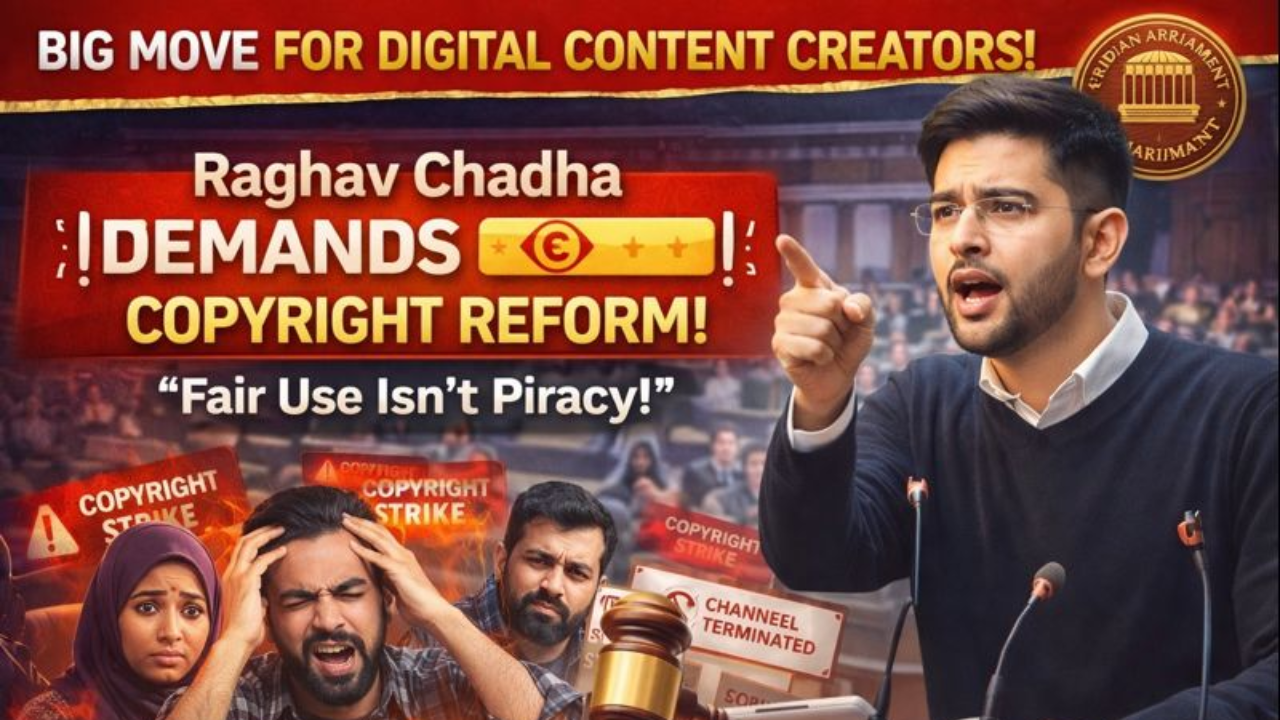
In a significant move for India’s digital content creators, Aam Aadmi Party (AAP) Rajya Sabha MP Raghav Chadha raised a crucial issue in Parliament this week, calling for urgent reforms in the Copyright Act, 1957 to better protect the rights and livelihoods of online creators. His remarks, delivered during a session in the Upper House, have triggered widespread discussion about how copyright enforcement affects millions of Indians working in the creator economy.
Chadha emphasised that the current law is outdated and does not reflect the realities of the modern digital age, where content creators rely on platforms like YouTube, Instagram, and other social networks to earn a living. He warned that automated copyright strikes — often triggered by algorithms rather than legal processes — are putting creators at risk of losing years of hard work in minutes.
“Fair Use Isn’t Piracy” — The Core Argument
Chadha’s central message was clear: fair use should not be treated as piracy. He argued that creators often use short clips or excerpts for valid reasons such as:
- Commentary
- Criticism
- Education
- News reporting
- Satire
These uses fall under what many creators believe should be considered fair use, even though the existing Indian Copyright Act uses the term “fair dealing”, which is narrower and often does not account for digital formats and online content.
“Most digital channels are not hobbies,” Chadha told Parliament. “They are economic assets built over years of effort. Yet, they can be wiped out overnight by automated strikes that don’t recognise the context or purpose of the use.”
Key Reforms Proposed by Chadha
During his speech, Chadha outlined three major reforms he believes are essential to bring India’s copyright law in line with modern content creation:
- Clearly define digital fair use
The law must explicitly protect transformative and incidental use — including clips used for commentary, critique, or education — so that creators are not penalised for legitimate online content. - Introduce a doctrine of proportionality
Minor use of copyrighted material should not trigger severe penalties like strikes or channel termination. Penalties must be proportional to the nature and extent of use. - Ensure due process before takedowns
Content should not be removed or monetisation blocked without a clear legal process that allows creators to respond or challenge claims before they lose their reach or revenue.
Growing Concern Among Digital Creators
Chadha’s remarks come amid a wider debate in India’s creator community about the misuse of copyright strikes, especially on platforms like YouTube, where automated enforcement tools often treat brief snippets of copyrighted material as infringements without considering context. Many creators have reported losing monetisation or facing channel strikes after using brief clips for legitimate purposes.
Digital creators argue that such practices penalise even those who follow responsible content creation standards — embedding clips only to explain, educate, or critique — and that the law must evolve to protect such usage instead of treating it as piracy by default.
Why This Matters
India’s creator economy has grown rapidly, with millions of creators now earning revenue and building audiences through digital platforms. Yet, the legal framework governing copyright enforcement has remained largely unchanged since 1957, a time long before the internet existed.
Creators argue that:
- The current Act doesn’t reflect digital challenges
- “Fair dealing” alone isn’t enough in modern contexts
- Automated copyright systems operate without judicial oversight
- Creators face disproportionate penalties
Without reform, creators fear continued job insecurity, algorithm-driven takedowns, and unclear legal protections.
Final Thoughts
Raghav Chadha’s intervention in Parliament has sparked an important conversation at the intersection of law, technology, and creativity. By stressing that fair use is not piracy, and urging that copyright law be updated for the digital era, he has given voice to millions of Indian content creators. The Parliament debate now raises a crucial question: will the law adapt to protect India’s growing digital economy, or will creators continue to operate under outdated rules?
SCROLL DOWN: READ OUR LATEST ARTICLE
- ओडिशा का दीपक पहुंचा बेंगलुरु, Hardik Pandya की उदारता ने मचाया तहलका
 भारत में क्रिकेट केवल एक खेल नहीं, बल्कि एक गहरी सामाजिक भावना है जहाँ खिलाड़ी भगवान की तरह पूजे जाते हैं और प्रशंसक उनके प्रति अटूट स्नेह प्रदर्शित करते हैं. … Read more
 - Iran’s Darkest Day: Screams for Revenge and a Missing Leader
 On Sunday, July 5, 2026, Iran entered the tense and highly charged Khamenei funeral Day 2. This marked a critical moment in a six-day state funeral meant to show the … Read more
 - अजीत कुमार: प्रेरणादायक सफर और वैश्विक उपलब्धियों का महाकाव्य
 भारतीय सिनेमा के परिदृश्य में कुछ ऐसे व्यक्तित्व होते हैं जो पर्दे की चकाचौंध से परे जाकर समाज और संस्कृति पर अपनी अमिट छाप छोड़ते हैं। दक्षिण भारतीय सिनेमा के … Read more
 - Coachella 2026: Highlights and History-Making Moments You Missed!
 The 25th anniversary of the Coachella Valley Music and Arts Festival just wrapped up, and it was absolutely legendary! From April 10–12 and April 17–19, 2026, the Empire Polo Club … Read more
 - वैभव सूर्यवंशी का टीम इंडिया में चयन हो चुका है?
 भारतीय क्रिकेट के इतिहास में कुछ क्षण ऐसे आते हैं जो केवल खेल के आंकड़ों को नहीं बदलते, बल्कि पूरे देश की खेल भावना और भविष्य की दिशा को पुनर्परिभाषित … Read more