

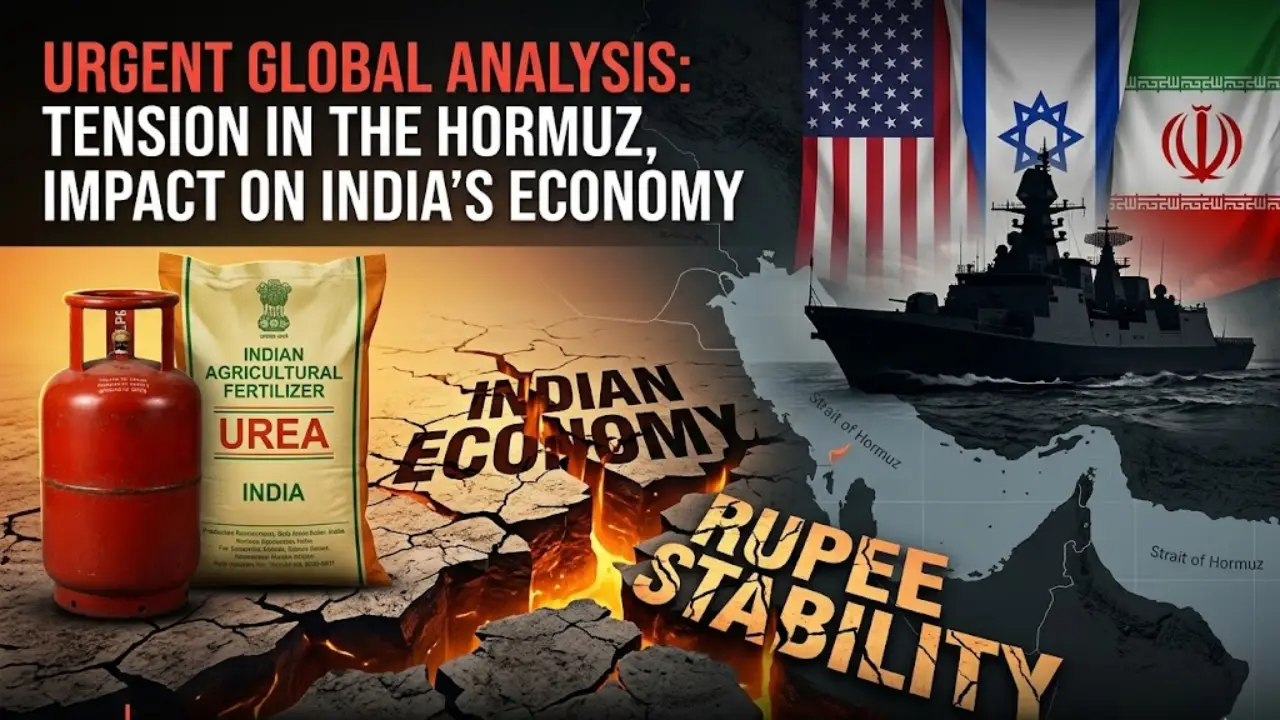
The US-Israel-Iran conflict that began in March 2026 has quickly turned from a distant fight into a major problem for India’s economy. Since the fighting started on February 28, 2026, the two most important sea routes for world trade, the Strait of Hormuz and the Red Sea have been mostly blocked. This is a huge problem for India because we buy over 80% of our oil from other countries and rely on these routes to sell $400 billion worth of goods to the world. While many people are worried about the shortage of cooking gas (LPG), the “domino effect” of this war is reaching into every corner of Indian life, from the food on our plates to the price of our phones.
The Shipping Crisis
The biggest blow to India’s economy comes from the fact that ships can no longer safely pass through the Suez Canal or the Strait of Hormuz. By early March 2026, the number of ships passing through the Strait of Hormuz dropped by 90%. On one day, only four ships made it through on March 3, 2026, compared to a historical daily average of 138 ships.
The “19-Day Penalty”
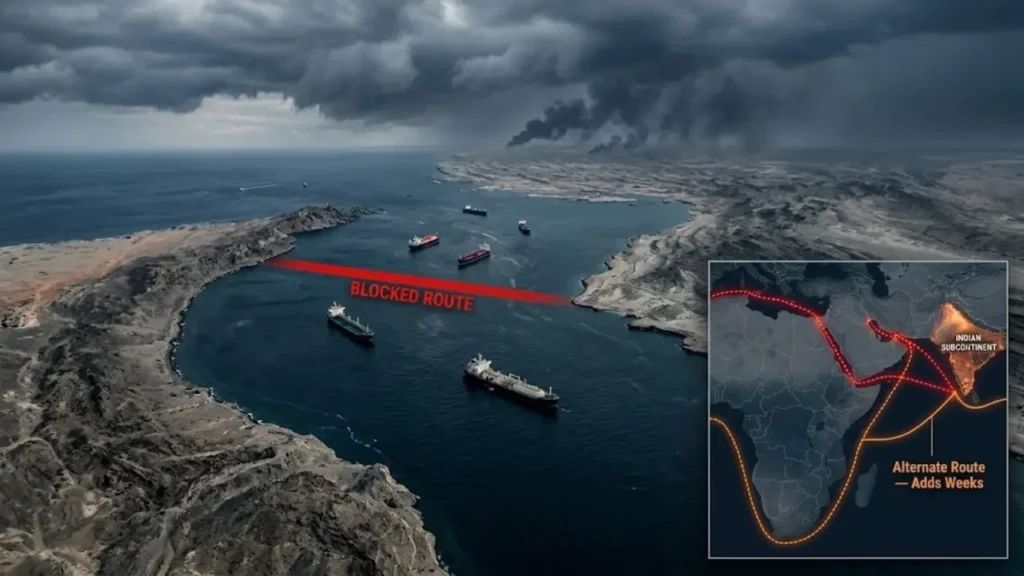
Major global shipping companies, including Maersk, CMA CGM, Hapag-Lloyd, and MSC, have left the Red Sea and Hormuz corridors and are now sending their ships all the way around the bottom of Africa (the Cape of Good Hope). This adds approximately 15 to 20 days to westbound transits specifically affecting India’s trade with Europe and the United States East Coast and approximately 7 days to eastbound movements. This delay is like a “hidden tax” on everything India buys and sells.
The extended transit time effectively reduces global annual cargo capacity by 10% to 15%. Because a container vessel requires a fixed amount of daily operational expenditure, estimated between $20,000 and $40,000 regardless of utilization. When a ship takes 20 days longer to travel, it can make fewer trips per year. This means there is less space available to move goods, which makes prices go up. Shipping experts say this detour is costing the world economy $2 billion to $3 billion every single week.
Shipping Costs: March 2026
| Metric | Usual Route (Suez) | New Route (Africa) | Why it Matters |
| Time to Europe | 25 – 30 Days | 40 – 50 Days | 15 – 20 Day Delay |
| Extra Fuel Cost | Normal | +200 Tons per Voyage | Huge extra expense |
| Shipping Rate | $1,200 – $1,800 | $3,500 – $4,500 | Prices nearly tripled |
| Emergency Fees | None | $2,000 per Container | Added “war fee” per box |
On top of the extra time, insurance for these ships has become incredibly expensive. Many insurance companies have simply canceled their coverage for ships going near the war zone. This has left many Indian exporters stuck with goods they cannot ship because no one will insure the cargo.
Oil Prices and Your Pocket
India’s energy security is at high risk because of US-Israel-Iran conflict. The India meets approximately 88% of its crude oil requirements through imports, consuming nearly 5.8 million barrels per day. Traditionally, 2.5 to 2.7 million barrels of this supply pass through the Strait of Hormuz from producers like Saudi Arabia, Iraq, and the UAE.
Crude Oil at $90
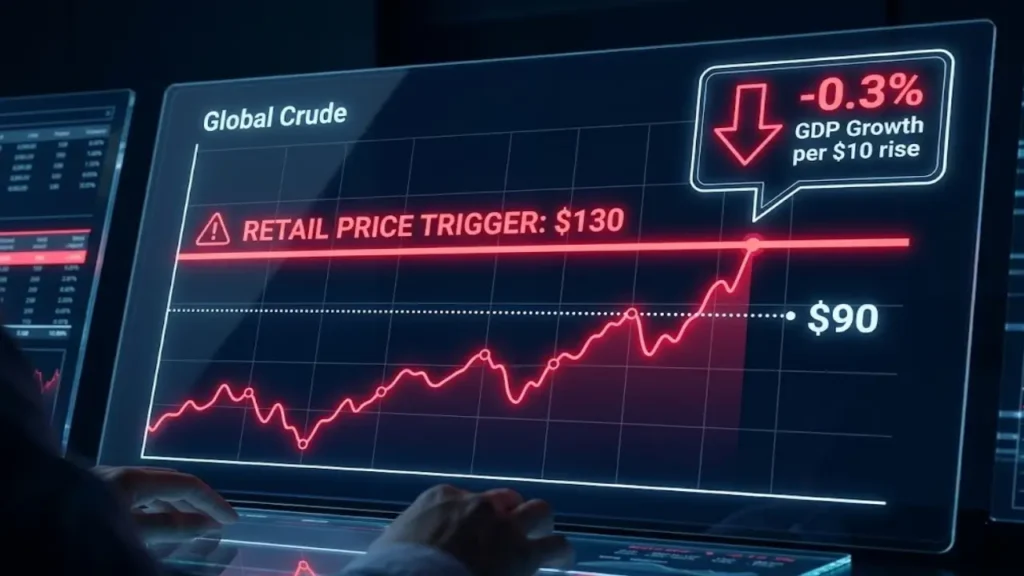
In mid-March 2026, the price of Brent Crude oil jumped past $90 a barrel, reflecting a war-risk premium of $20 to $40 per barrel. Analysts warn that every $10 increase in oil prices reduces India’s GDP growth. If oil stays at $90 or higher, India’s bill for buying oil from other countries will explode from $100 billion to nearly $145 billion.
Right now, petrol and diesel prices in Indian metros have remained frozen as of March 11, 2026. For example, petrol in New Delhi continues to be priced at ₹94.77 per litre, while Mumbai sees ₹103.49 per litre. This price stability is a result of state-run Oil Marketing Companies (OMCs), Indian Oil, BPCL, and HPCL. These government-owned oil companies are “absorbing” the extra cost to protect people from high prices. However, these companies are losing money every day. If the price of oil reaches $130 a barrel, the government may be forced to let petrol and diesel prices jump up sharply.
The Export Crisis
The shipping delays and high costs are devastating Indian businesses that sell goods to other countries. Total Indian exports to West Asia were valued at $58.8 billion in 2024-25, a market that has effectively shut off overnight.
Basmati Rice
India is the world’s top seller of Basmati rice, and most of it goes to the Middle East. As of March 10, 2026, about 400,000 tonnes of rice are stuck. Half of it is stuck on ships at sea, and the other half is piled up at Indian ports because shipping has become too expensive.
The cost to send a container of rice has tripled from $1,200 to $4,500. Because exporters can’t sell their rice abroad, they are selling it for cheap inside India just to survive. This “distress selling” is causing farmers and traders to lose massive amounts of money.
Textiles
The textile hub of Tirupur, accounting for 68% of India’s knitwear exports, was already fragile after US tariffs imposed in 2025. While a tariff rollback from 50% to 18% in February 2026 offered hope, the maritime conflict has blocked the recovery. The 15-to-20-day delay in shipping to the US and Europe is a disaster for fashion brands that need their clothes quickly. Many buyers in the US are now canceling their orders because the clothes won’t arrive on time. About 40% of the factories in Tirupur are at risk of closing down again.
Car Components
The Automotive Component Manufacturers Association of India (ACMA) has sent an emergency SOS to the Ministry of Heavy Industries. Their shipping costs have gone up by 40%. Lead times for deliveries to European OEMs (Original Equipment Manufacturers) have increased by up to four weeks, leading to order postponements and warehouse congestion. It is also taking much longer to get raw materials like synthetic rubber and aluminum, which are needed to build cars.

Everyday Inflation
The Indian consumer is feeling the US-Israel-Iran Conflict impact on India through a phenomenon known as “shrinkflation”. You might notice that the price of daily items like soap, biscuits, and chips is going up, or the packs are getting smaller. FMCG (Fast-Moving Consumer Goods) companies are struggling with the cost of petrochemical derivatives used in packaging and raw materials.
Packaging and Derivative Costs
Packaging alone accounts for 15% to 20% of total FMCG costs. Polymers like polypropylene and polyethylene, derived from crude oil, are essential for everything from biscuit wrappers to shampoo sachets. With crude oil prices 2026 surging, companies like Parle Products have indicated they will reduce the “grammage” or weight of product packs while keeping prices constant, a move designed to protect margins without alienating price-sensitive rural consumers.
| FMCG Input | Source/Mechanism | Impact in March 2026 |
| Polymers | Gulf Region / Crude Derivatives | Shift to China/Thailand; 15%+ cost rise |
| Linear Alkyl Benzene (LAB) | Detergent Feedstock | 50% of raw material cost; price spike |
| Surfactants | Petroleum Derivatives | Margin pressure on soaps and shampoos |
| Sunflower Oil | Black Sea / Russia / Ukraine | 51% import drop in Feb; price rise |
| Electronics | SE Asia Components | Transit time up to 49 days; inventory cost up |
In the electronics sector, most parts come from Southeast Asia. Because ships are taking longer routes, it now takes 49 days to get these parts instead of 30 days. This means companies have to spend more money on storage and interest, which leads to higher prices for smartphones and electronics in India.
The Farming Crisis
A major hidden danger is a shortage of fertilizer. India is the world’s second-largest user of fertilizer and buys a lot of it from the Middle East. As farmers get ready for the “Kharif” (monsoon) planting season, they need a fertilizer called Muriate of Potash (MoP). India produces almost none of this at home and gets 42% of its supply from Saudi Arabia. With the sea routes blocked, these shipments are not arriving. Also, making urea (another common fertilizer) requires natural gas. Because gas supplies from countries like Qatar have been cut off, Indian fertilizer factories are running at low capacity or shutting down.
The Rupee and Stock Market
Investors are worried about the war, so they are taking their money out of the Indian stock market. In just one week, foreign investors pulled out $2 billion.
The Indian Rupee fell to an all-time low of 92.3 against the US dollar. To stop the Rupee from crashing completely, the Reserve Bank of India (RBI) spent about $12 billion in early March 2026 to stabilize the currency. While India has a lot of savings (reserves) to handle this, a weak Rupee makes everything we import, like oil and electronics, even more expensive.

What the Government is Doing
The Indian government has activated a multi-layered response to shield the economy from the US-Israel-Iran Conflict 2026.
The Inter-Ministerial Group (IMG)
The Indian government is working hard to protect the economy. In March 2026, the Ministry of Commerce operationalized an Inter-Ministerial Group (IMG) for Supply Chain Resilience. This group meets daily to:
- Monitor global developments affecting supply chains.
- Assess sector-wise export and critical import vulnerabilities.
- Coordinate between the Ministries of Shipping, Petroleum, and Finance to mitigate disruptions.
Energy Diversification and Russian Oil
To mitigate the energy shock, Indian refiners have aggressively moved towards Russian crude. Imports of Russian oil surged by 50% in March 2026, rising to 1.5 million barrels per day compared to 1.04 million in February. This was facilitated by a 30-day US waiver allowing India to purchase 30 million barrels of unsold Russian crude already stuck at sea. Refiners like Reliance and IOCL moved quickly to secure these cargoes at premiums of $2 to $8 over London’s Dated Brent.
Conclusion
The March 2026 war in US-Israel-Iran has shown how much India depends on stable sea routes. While the government and the RBI are doing their best to help, the reality is that everything is becoming more expensive. For the Indian farmer waiting for fertilizer or the shopkeeper seeing higher prices, the war is not a distant event, it is a direct hit to their wallet. Moving forward, India will need to find new ways to get its energy and sell its goods to avoid being so vulnerable to conflicts in other parts of the world.
READ OUR OTHER ARTICLES
- ओडिशा का दीपक पहुंचा बेंगलुरु, Hardik Pandya की उदारता ने मचाया तहलका
 भारत में क्रिकेट केवल एक खेल नहीं, बल्कि एक गहरी सामाजिक भावना है जहाँ खिलाड़ी भगवान की तरह पूजे जाते हैं और प्रशंसक उनके प्रति अटूट स्नेह प्रदर्शित करते हैं. … Read more
 - Iran’s Darkest Day: Screams for Revenge and a Missing Leader
 On Sunday, July 5, 2026, Iran entered the tense and highly charged Khamenei funeral Day 2. This marked a critical moment in a six-day state funeral meant to show the … Read more
 - अजीत कुमार: प्रेरणादायक सफर और वैश्विक उपलब्धियों का महाकाव्य
 भारतीय सिनेमा के परिदृश्य में कुछ ऐसे व्यक्तित्व होते हैं जो पर्दे की चकाचौंध से परे जाकर समाज और संस्कृति पर अपनी अमिट छाप छोड़ते हैं। दक्षिण भारतीय सिनेमा के … Read more
 - Coachella 2026: Highlights and History-Making Moments You Missed!
 The 25th anniversary of the Coachella Valley Music and Arts Festival just wrapped up, and it was absolutely legendary! From April 10–12 and April 17–19, 2026, the Empire Polo Club … Read more
 - वैभव सूर्यवंशी का टीम इंडिया में चयन हो चुका है?
 भारतीय क्रिकेट के इतिहास में कुछ क्षण ऐसे आते हैं जो केवल खेल के आंकड़ों को नहीं बदलते, बल्कि पूरे देश की खेल भावना और भविष्य की दिशा को पुनर्परिभाषित … Read more