

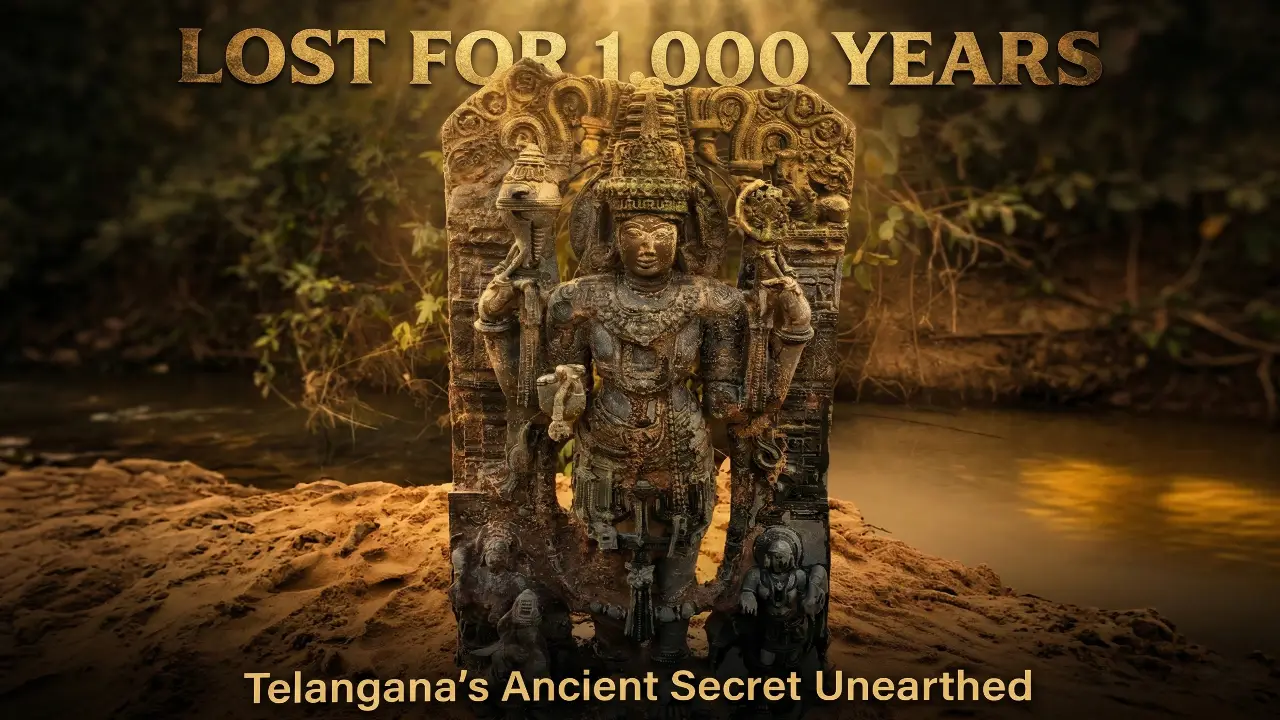
The quiet forests of the Jayashankar Bhupalpally district in Telangana recently gave up a secret they had been keeping for a thousand years. In March 2026, as the summer heat began to dry up the landscape, the water levels in the Peddavaagu stream started to drop. As the water receded, it slowly pulled back a blanket of sand that had covered a piece of history for centuries.
What emerged was a stunning sight: the crown and shoulders of a massive stone god rising from the riverbed. This incredible Telangana archaeological discovery has since been identified as a 1,000-year-old Vishnu idol. Carved from a single block of black granite, this five-foot-tall masterpiece is a shining example of the Kakatiya dynasty sculpture that once flourished in this region.
The Thrill of the Discovery
The Peddavaagu stream winds through the Kataram mandal and is usually a quiet spot used by local farmers. However, on a Monday in early March 2026, the stream became the center of world-wide attention. Local villagers from Madaram, Chinthakani, and Jaggaiahpalli noticed a strange shape in the sand. While some locals had seen the top of the idol’s head during droughts as far back as 2023, it was the power of social media that finally brought it to light.
After videos of the idol went viral, a heritage lover from Hyderabad traveled to the site to help. Together with the villagers, they carefully pulled the five-foot-tall black granite statue from the heavy sands. It was a moment of pure joy and connection to the past. As the mud was washed away, the sheer beauty and detail of the Bhupalpally Vishnu statue were revealed for everyone to see.
Decoding the Artifact
While some early rumors suggested the idol might be from the Chola period, experts quickly cleared up the mystery. This statue belongs to the 12th-century Kakatiya period. The Kakatiya dynasty ruled over Telangana and Andhra Pradesh between the 10th and 14th centuries. They are famous for building grand temples and using advanced engineering that allowed their structures to survive for hundreds of years.
The artistry of this 1000 year old Vishnu idol shows the peak of ancient craftsmanship. The Kakatiyas preferred black granite, a stone so hard that it required special tools and great skill to carve. Unlike softer stones used by other dynasties, this granite allowed for deep, sharp carvings that still look fresh today. The result is a figure that looks both strong and graceful at the same time.
The Beauty of Chennakesava Swamy
The idol depicts Lord Vishnu in the “Chennakesava Swamy” form. In the old language, “Chenna” means beautiful, and “Kesava” refers to someone with long, lovely hair. This name perfectly describes the serene and handsome look of the statue. Several features help experts date the idol to the 12th century:
- The Ornate Crown: The deity wears a tall, highly decorated crown called a Kirita. It features intricate patterns that show the high status of the god.
- The Four Hands: The statue has four arms, which once held the traditional symbols of Vishnu: the conch shell, the discus, the mace, and the lotus.
- The Serene Smile: One of the most beautiful parts of the statue is the gentle smile on its face, which was carved to show divine peace and kindness.
How Did It Get There?
Finding such a magnificent idol in a remote forest stream raises a big question: how did it end up buried in the sand? Historians have two main theories. The first is that the idol was hidden on purpose to protect it from invaders. During the 14th century, the Tughlaq dynasty from Delhi attacked the region, destroying many temples and looting their riches. It was common for priests to bury their most sacred statues in riverbeds or forests to keep them safe from being destroyed.
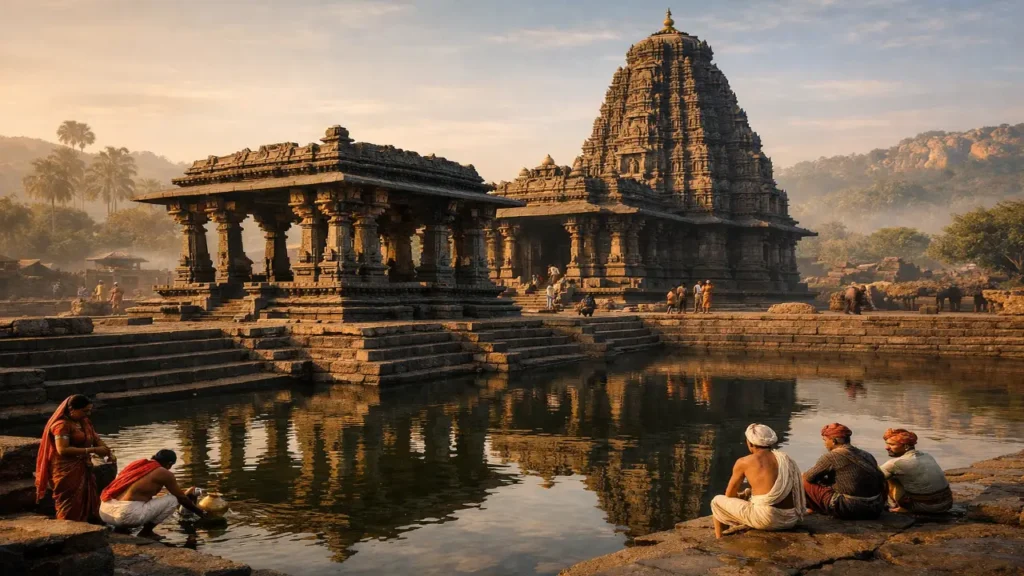
The second theory is that the idol belongs to a long-lost temple that once stood on the banks of the Peddavaagu stream. The Kakatiyas had a famous policy of building a “Tank, Temple, and Town” together. They built water reservoirs to help farmers and placed temples nearby. Over time, the river might have changed its course, or the temple might have collapsed, leaving the heavy granite idol to be swallowed by the shifting sands.
Religious Importance
For the local people, finding the idol is a spiritual event, but it has also caused a bit of a disagreement. According to the rules of Agama Shastra (ancient religious laws), a damaged or “mutilated” idol cannot be used for regular worship in a temple. The Bhupalpally statue has minor damage to its nose and fingers, likely caused by people looking for hidden treasure or the natural movement of the water.
Despite the damage, the neighboring villages are all eager to host the deity. The people of Jaggaiahpalli want to take the statue to their village, while a farmer from Madaram has offered to donate his own land to build a new temple right where it was found. This shows that even after a thousand years, these ancient statues are still seen as a living divine presence by the people of Telangana.
Preservation and Next Steps
The Telangana State Archaeology and Heritage Department has been informed about the find. Experts are expected to visit the site soon to decide whether to move the idol to a museum or keep it in the village. It is very important that the government acts quickly to document and protect this piece of history.
Now that the idol is out of the water and exposed to the air, it needs professional cleaning to stop things like moss or lichen from growing on the stone. Whether it ends up in a grand museum or a local temple, the focus must be on keeping it safe for future generations to admire.
A Legacy That Lives On
The discovery of the 1,000-year-old Vishnu idol in the Peddavaagu stream is more than just a lucky find. It is a powerful reminder of the incredible skill of the Kakatiya artisans and the rich history of the Deccan plateau. This five-foot granite masterpiece has survived wars, floods, and the test of time to show us the beauty of the 12th century.
READ OUR OTHER ARTICLES
- ओडिशा का दीपक पहुंचा बेंगलुरु, Hardik Pandya की उदारता ने मचाया तहलका
 भारत में क्रिकेट केवल एक खेल नहीं, बल्कि एक गहरी सामाजिक भावना है जहाँ खिलाड़ी भगवान की तरह पूजे जाते हैं और प्रशंसक उनके प्रति अटूट स्नेह प्रदर्शित करते हैं. … Read more
 - Iran’s Darkest Day: Screams for Revenge and a Missing Leader
 On Sunday, July 5, 2026, Iran entered the tense and highly charged Khamenei funeral Day 2. This marked a critical moment in a six-day state funeral meant to show the … Read more
 - अजीत कुमार: प्रेरणादायक सफर और वैश्विक उपलब्धियों का महाकाव्य
 भारतीय सिनेमा के परिदृश्य में कुछ ऐसे व्यक्तित्व होते हैं जो पर्दे की चकाचौंध से परे जाकर समाज और संस्कृति पर अपनी अमिट छाप छोड़ते हैं। दक्षिण भारतीय सिनेमा के … Read more
 - Coachella 2026: Highlights and History-Making Moments You Missed!
 The 25th anniversary of the Coachella Valley Music and Arts Festival just wrapped up, and it was absolutely legendary! From April 10–12 and April 17–19, 2026, the Empire Polo Club … Read more
 - वैभव सूर्यवंशी का टीम इंडिया में चयन हो चुका है?
 भारतीय क्रिकेट के इतिहास में कुछ क्षण ऐसे आते हैं जो केवल खेल के आंकड़ों को नहीं बदलते, बल्कि पूरे देश की खेल भावना और भविष्य की दिशा को पुनर्परिभाषित … Read more