

The Morning of Learning Turned Survival
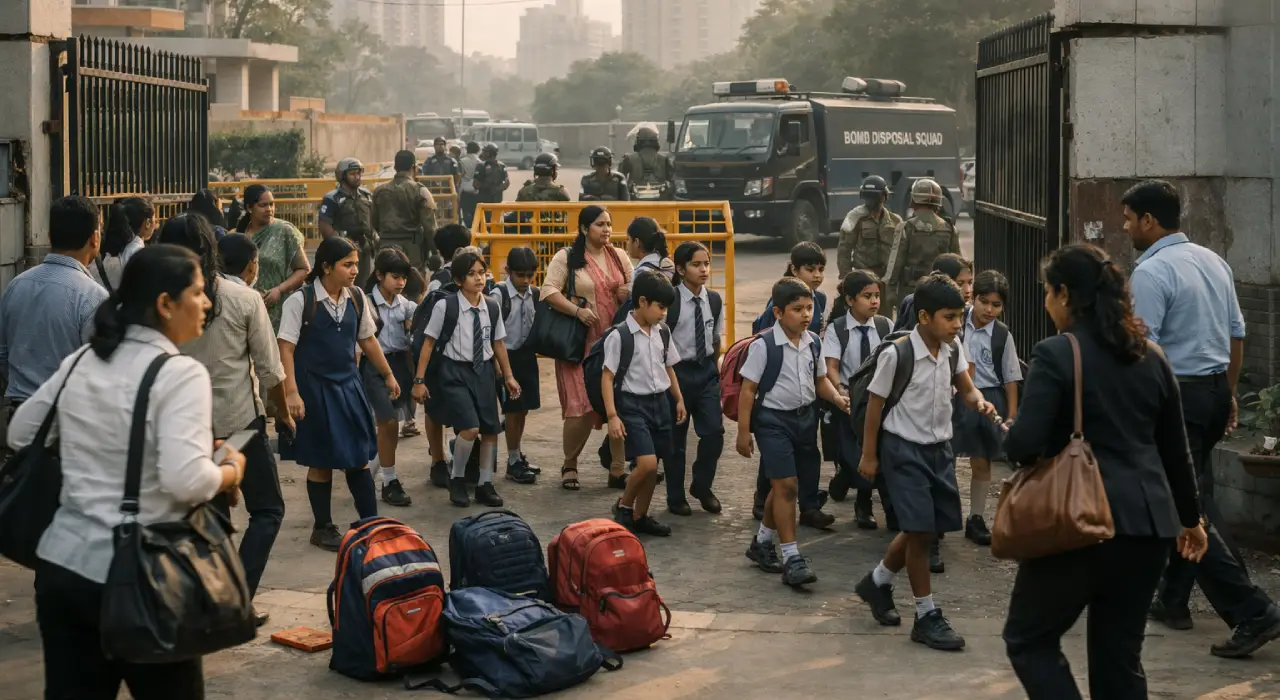
The transition from a routine Monday morning to a state of high-alert emergency began not with a siren, but with a silent notification. Across the sprawling urban landscapes of Ahmedabad and Vadodara, administrative inboxes at over 40 elite institutions were flooded with a coordinated threat that would soon bring the state’s education system to a grinding halt. By 9:00 AM on February 16, 2026, the digital breadcrumbs of a sophisticated psychological operation had been laid, forcing the abrupt evacuation of thousands of children.
The scenes at school gates were defined by panic. Mothers, many still in their work attire, abandoned vehicles in the middle of the road to reach the gates of institutions like DAV International and Asia School. The air was thick with the sound of phone calls and the heavy thud of school bags being dropped as students were ordered to leave everything behind. What began as a day of final revisions for the most critical examinations of their young lives—the CBSE Board Exams 2026—rapidly devolved into a morning where the primary objective was no longer academic excellence, but basic survival.
The Anatomy of a Coordinated Chaos
The scale of the disruption was unusual. In Ahmedabad, District Education Officer Rohit Chaudhary confirmed that more than 21 schools received the menacing email. Simultaneously, in Vadodara, Police Commissioner Narasimha Komar reported that 19 schools were targeted, including residential hubs like Urmi School, where even the hostel residents were forced onto the streets. The threat was not a localized prank; it was a synchronized strike against the psychological stability of Gujarat’s future.
The list of primary targets read like a directory of the region’s elite academic centers. In Ahmedabad, the evacuations hit DAV International School in Makarba, which serves a massive student body from primary to higher secondary levels, alongside Asia School, Ankur International, and Sant Kabir School . In Vadodara, the terror touched historical landmarks like Baroda High School and D.R. Amin Memorial, as well as the sprawling campus of Don Bosco . Urmi School, a key co-educational and residential institution on Sama-Savli Road, faced a particularly complex evacuation as staff had to coordinate safety for hundreds of boarders.
The threat itself was explicit and chilling: the email warned that bombs had been planted in classrooms and, most cruelly, within the very school buses that many children were currently riding or scheduled to board later that day . The detonation time was set for exactly 1:11 PM, a timestamp that kept parents and police in a state of excruciating suspense for over four hours.
The Cruelty of Timing
To understand the full impact of this Gujarat School Bomb Threat, one must look at the calendar. The threats arrived on Monday, February 16, exactly 24 hours before the CBSE Board Exams 2026 for both Class 10 and Class 12 were scheduled to commence on Tuesday, February 17.
The psychological warfare was aimed at the most vulnerable point of the student-parent relationship: exam anxiety. Clinical data suggests that test anxiety already impacts between 10% and 40% of students, often inhibiting their ability to perform to their potential . For Class 10 students facing the Mathematics Standard and Basic papers, and Class 12 students preparing for Biotechnology and Entrepreneurship, the timing was devastating. The Vadodara Parents Association (VPA) correctly identified this as a “severe psychological and operational toll,” noting that repeated evacuations during exams jeopardize academic performance and cause logistical chaos.
How It Was Done
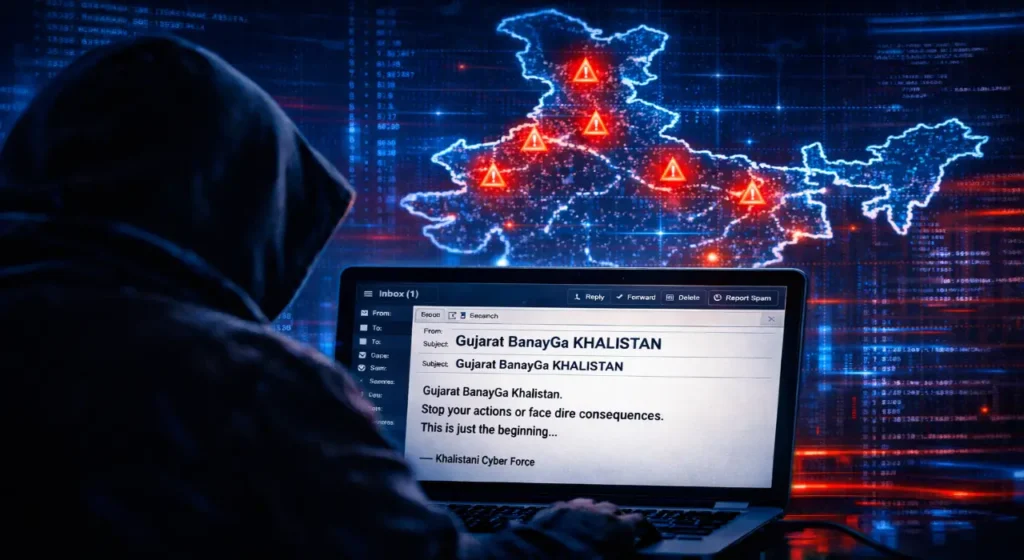
The emails were sent from IDs like SarinaLorenzo@gmail.com, a Western-sounding pseudonym often used in cyber-terrorism to mask local affiliations while keeping the content virulently regional . The subject line was a direct provocation: “Gujarat BanayGa KHALISTAN” . The body warned institutions against hoisting the Indian tricolor (Tiranga) and labelled national leadership as “enemies of Khalistan”. This phrasing mirrors threats earlier released by designated terrorist entities threatening unrest ahead of Republic Day.
The police response was massive and immediate. The Gujarat Police BDDS (Bomb Detection and Disposal Squad), Dog Squads, and Special Operations Group (SOG) sanitized the campuses, inspecting every locker and vehicle while fire brigade teams remained on standby.
The Ripple Effect
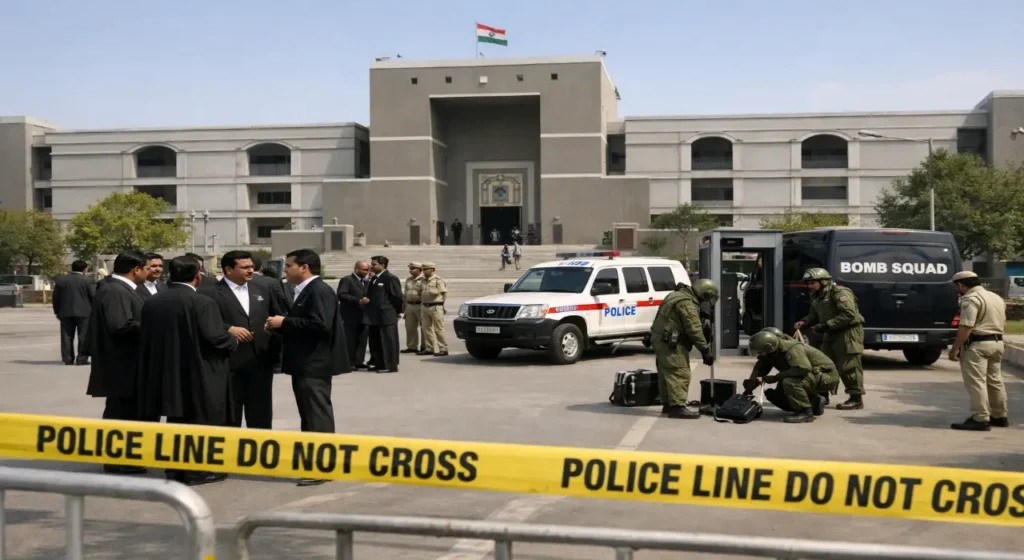
The terror did not stop at the school gates. On Tuesday, February 17, as students were sitting for their first board exam papers, the threat migrated to the judicial system. Six district courts across Gujarat, including those in Ahmedabad, Vadodara, Valsad, Rajkot, Gandhinagar, and Mehsana, received identical threat emails.
The specifics of these threats were designed to maximize operational paralysis. In Vadodara, the email claimed 19 bombs were planted and specifically criticized a previous judgment from a Tamil Nadu court. In Valsad, Superintendent of Police Yuvrajsinh Jadeja oversaw the evacuation of 19 courtrooms after an email warned of IEDs detonating before afternoon prayers. While the Ahmedabad rural court continued proceedings despite an early-morning threat of RDX and IED blasts, other districts like Mehsana saw total evacuations later in the afternoon.
The Cyber Hunt
Cyber Crime units are now tracking VPNs and IP addresses that frequently route through international servers to evade domestic tracking . The investigation is further complicated by the rise of “agentic AI” in late 2025 and early 2026, which allows autonomous attackers to automate the entire lifecycle of a mass-threat campaign at machine speed.
This strategy represents “zero-cost terror.” Planting real explosives requires logistics and risk, but a Khalistan Hoax Email costs nothing while achieving the same result: mass panic and the diversion of state resources . Gujarat now faces the challenge of maintaining academic normalcy. The Vadodara Parents Association has called for a high-level probe by the NIA and a dedicated school security SOP . While the bombs were fake, the memory of students standing in common areas, barred from taking their books for the most important tests of their lives, remains a very real scar.
Conclusion
The coordinated campaign targeted over 40 elite educational institutions across Ahmedabad and Vadodara, alongside 6 district courts throughout the state. The primary method involved spoofed cyber-emails sent from the address SarinaLorenzo@gmail.com, utilizing the inflammatory subject line “Gujarat BanayGa KHALISTAN.” While the claimed motive was pro-Khalistan extremism and a warning against hoisting the Indian tricolor, the actual status was confirmed by authorities as a sophisticated act of asymmetric psychological warfare designed to paralyze civic infrastructure.
READ OUR OTHER ARTICLES
- ओडिशा का दीपक पहुंचा बेंगलुरु, Hardik Pandya की उदारता ने मचाया तहलका
 भारत में क्रिकेट केवल एक खेल नहीं, बल्कि एक गहरी सामाजिक भावना है जहाँ खिलाड़ी भगवान की तरह पूजे जाते हैं और प्रशंसक उनके प्रति अटूट स्नेह प्रदर्शित करते हैं. … Read more
 - Iran’s Darkest Day: Screams for Revenge and a Missing Leader
 On Sunday, July 5, 2026, Iran entered the tense and highly charged Khamenei funeral Day 2. This marked a critical moment in a six-day state funeral meant to show the … Read more
 - अजीत कुमार: प्रेरणादायक सफर और वैश्विक उपलब्धियों का महाकाव्य
 भारतीय सिनेमा के परिदृश्य में कुछ ऐसे व्यक्तित्व होते हैं जो पर्दे की चकाचौंध से परे जाकर समाज और संस्कृति पर अपनी अमिट छाप छोड़ते हैं। दक्षिण भारतीय सिनेमा के … Read more
 - Coachella 2026: Highlights and History-Making Moments You Missed!
 The 25th anniversary of the Coachella Valley Music and Arts Festival just wrapped up, and it was absolutely legendary! From April 10–12 and April 17–19, 2026, the Empire Polo Club … Read more
 - वैभव सूर्यवंशी का टीम इंडिया में चयन हो चुका है?
 भारतीय क्रिकेट के इतिहास में कुछ क्षण ऐसे आते हैं जो केवल खेल के आंकड़ों को नहीं बदलते, बल्कि पूरे देश की खेल भावना और भविष्य की दिशा को पुनर्परिभाषित … Read more