

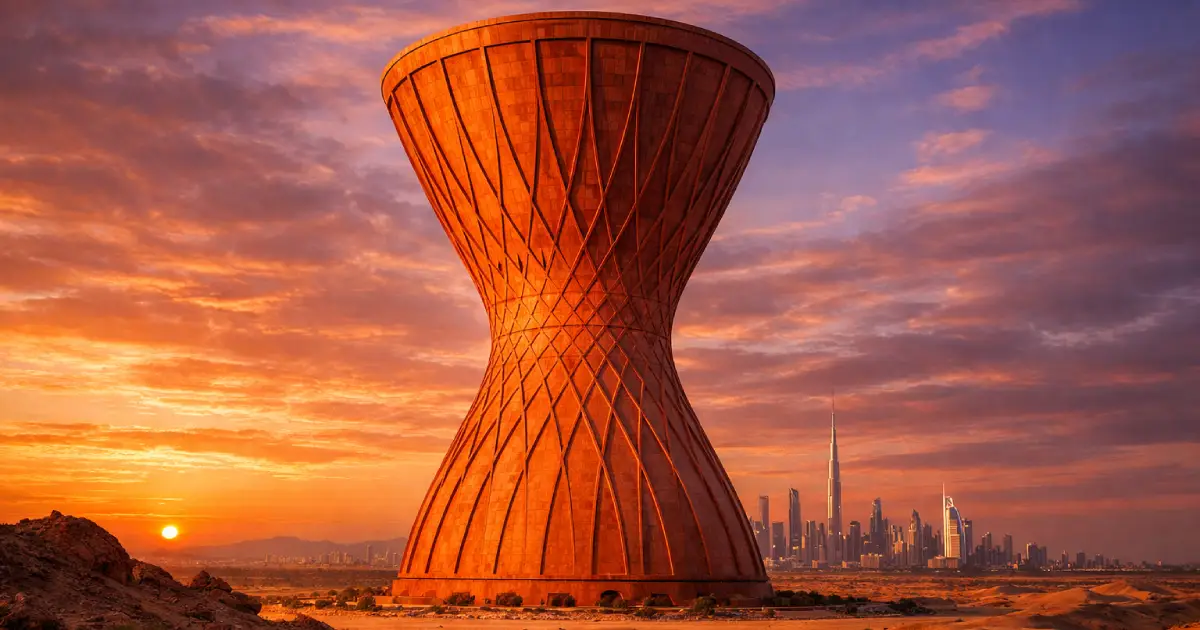
Standing as a beacon of Sanatan heritage amidst the hyper-modernity of the United Arab Emirates, the newly unveiled Maha Damru project is a ₹500 Crore (approx. $60.2 Million USD) masterpiece of cultural statecraft. This 108-meter architectural wonder, located in Dubai’s Jebel Ali district, takes the profound form of an hourglass—a direct geometric mirror of Lord Shiva’s sacred drum, the Damru. This is far more than a structure of stone and steel; it is a monumental instrument of the heavens, engineered with a sophisticated network of 0.72 mm SUS stainless steel wires designed to catch the persistent desert winds and resonate with the primordial sound of “Om”. Clad entirely in vibrant Jodhpur Red Sandstone sourced from the historic quarries of Rajasthan, the monument represents a strategic marriage of ancient Vedic symbolism and the cutting-edge structural integrity required to grace the Dubai horizon.
A New Architectural Rhythm
The skyline of Dubai has long been defined by the vertical audacity of glass-and-steel monoliths that compete for the title of “tallest” or “most futuristic.” Yet, rising from the golden dunes is a silhouette that feels both startlingly modern and anciently familiar. It is not another skyscraper; it is a drum of the Gods. This massive tower, dedicated to the philosophical depths of Sanatan Dharma, stands as a sentinel of cultural diplomacy in the heart of the Middle East. At a height of 108 meters—a sacred Vedic number representing cosmic wholeness—the structure commands the sky, its curves echoing the movement of the Nataraja during his celestial dance.
The visual impact of the Maha Damru is immediate and visceral. The terracotta hues of the Rajasthan sandstone absorb the intense Arabian sunlight, causing the building to glow with an inner fire at sunset, a phenomenon that mirrors the spiritual illumination associated with the deity it honors. This choice of material ensures the structure feels grounded in the earth, even as its apex reaches toward the heavens. Beyond its physical presence, the building acts as a living, breathing entity. Through a masterclass in wind engineering, the tower interacts with the natural world to produce the “Sound of Creation,” reinforcing the belief that the universe is a symphony of rhythms.
Engineering the Sacred
Building a 108-meter hyperboloid structure in a region known for extreme desert winds and seismic potential requires a radical approach to civil engineering. The project utilizes a “buttressed core” system, a design philosophy famously refined during the construction of the Burj Khalifa to prevent structural twisting under high wind loads. The central “waist” of the structure—its narrowest point—is reinforced with high-tension steel cables that pull the weight toward the center, mirroring the way a drummer grips the instrument. Over 900 tonnes of steel and 6,000 cubic meters of concrete form the skeleton, ensuring the monument can withstand both the shifting sands and potential tectonic activity.
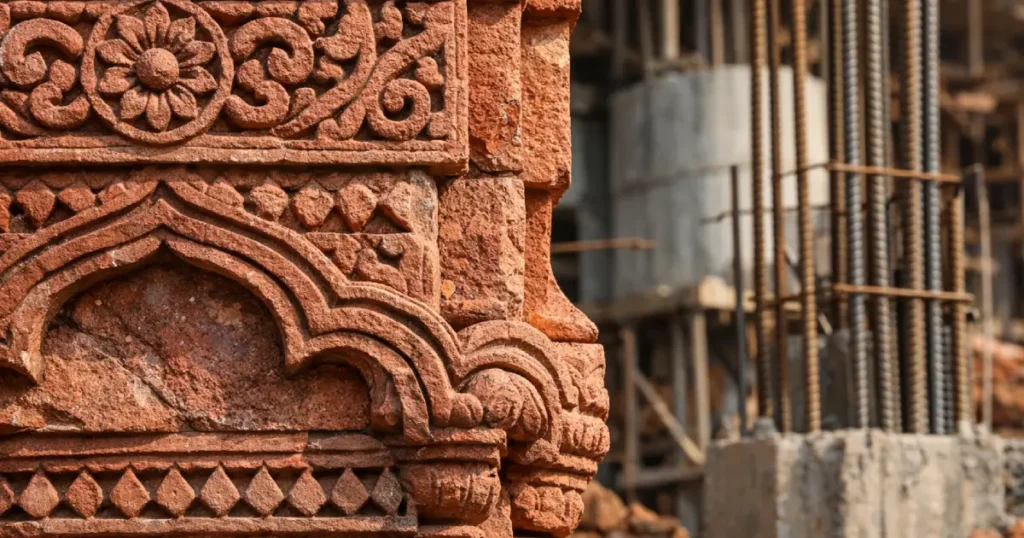
The selection of Jodhpur Red Sandstone was a result of exhaustive technical evaluations. This sedimentary rock is prized for its high compressive strength and low water absorption—properties essential for enduring the UAE’s humid coastal cycles. The iron oxide within the stone provides a natural resistance to UV degradation, ensuring its vibrant colour remains intact for generations. The density of the stone, measured at 2.6 g/cm3, provides a high thermal mass that naturally cools the interior chambers. This project required over 20,000 tonnes of premium stone, which was hand-carved by artisans in India before being shipped to Dubai, ensuring that every square meter of the facade tells a story of heritage.
Acoustic Engineering and the “Om” Resonance
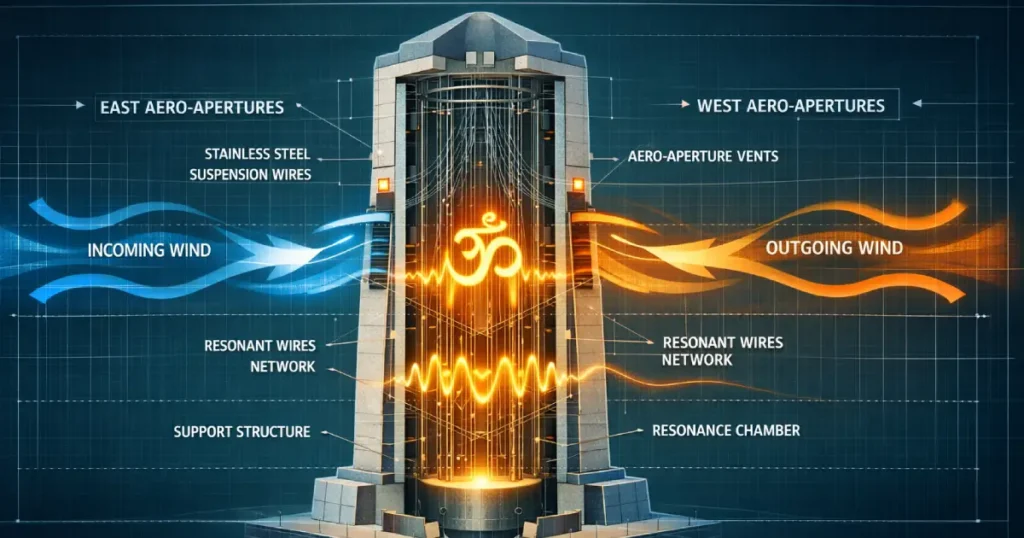
The most ambitious feature of the Maha Damru is its identity as an Aeolian monument. In Sanatan Dharma, the sound of the Damru—known as “Nada”—is the inaugural vibration that birthed the universe. To recreate this “Sound of Creation,” engineers collaborated with sound artisans to install a network of 0.72 mm SUS stainless steel wires within internal aero-apertures. As air flows through these precisely positioned vents on the east and west sides, it creates an alternating series of vortices known as the von Kármán Vortex Street effect, causing the wires to vibrate at specific resonant frequencies.
The physics of this acoustic output is governed by the relationship between the tension of the wires, the length of the resonating columns, and the velocity of the wind. The fundamental frequency (f ) of these vibrations is calculated using the following formula:
Where is the length of the wire, is the tension, and μ is the linear mass density. By varying these parameters across hundreds of wires, the building is tuned to produce a harmonic drone that mimics the sacred syllable “Om”. The sound is amplified by the tower’s vaulted domes, which act as natural acoustic resonators, filtering out environmental noise and focusing the harmonic frequencies toward the central “Bindu” or observation gallery. This engineering feat allows the structure to “sing” in different modes: a deep resonance during powerful desert gusts and a gentle, meditative hum in quieter moments.
Sanatan Dharma on a Global Stage
The Maha Damru project is far more than a religious symbol; it is a monument to Universal Rhythm and Creation. In Hindu mythology, the Damru’s hourglass shape represents the cyclic nature of time—creation and destruction meeting at a single point of oneness. By hosting this symbol, Dubai is continuing its unprecedented streak of religious tolerance, following the historic BAPS Hindu Mandir in Abu Dhabi. This shift, guided by the UAE’s Ministry of Tolerance, positions the Emirate as a global crossroads where civilizations meet in mutual respect.
For the 3.5 million-strong Indian diaspora in the UAE, the unveiling of the Maha Damru marks a definitive “India Moment”. The sight of their culture celebrated with such grand scale promotes India’s soft power and reinforces the Comprehensive Economic Partnership Agreement (CEPA) between the two nations. Prime Minister Narendra Modi has often hailed the India-UAE friendship as a “model for the world,” and projects like the Maha Damru—equipped with over 300 high-tech sensors to monitor structural health—are seen as realizations of his vision for a “New India” that is technologically advanced yet deeply rooted in tradition.
Conclusion
As the desert wind passes through the sandstone vents and the SUS wires sing the primordial “Om,” the Maha Damru reminds every visitor that the universe is in constant motion. It is a place where the “Sound of Creation” is no longer a mythological metaphor but a tangible, auditory reality. In the heart of Dubai, this ₹500 Crore masterpiece shakes the world’s perception of cultural harmony, proving that the ancient rhythms of existence remain a powerful force in our modern age. The Maha Damru is a bridge, a symphony, and an eternal testament to the power of faith and friendship in a changing world.
READ OUR OTHER ARTICLES
- ओडिशा का दीपक पहुंचा बेंगलुरु, Hardik Pandya की उदारता ने मचाया तहलका
 भारत में क्रिकेट केवल एक खेल नहीं, बल्कि एक गहरी सामाजिक भावना है जहाँ खिलाड़ी भगवान की तरह पूजे जाते हैं और प्रशंसक उनके प्रति अटूट स्नेह प्रदर्शित करते हैं. … Read more
 - Iran’s Darkest Day: Screams for Revenge and a Missing Leader
 On Sunday, July 5, 2026, Iran entered the tense and highly charged Khamenei funeral Day 2. This marked a critical moment in a six-day state funeral meant to show the … Read more
 - अजीत कुमार: प्रेरणादायक सफर और वैश्विक उपलब्धियों का महाकाव्य
 भारतीय सिनेमा के परिदृश्य में कुछ ऐसे व्यक्तित्व होते हैं जो पर्दे की चकाचौंध से परे जाकर समाज और संस्कृति पर अपनी अमिट छाप छोड़ते हैं। दक्षिण भारतीय सिनेमा के … Read more
 - Coachella 2026: Highlights and History-Making Moments You Missed!
 The 25th anniversary of the Coachella Valley Music and Arts Festival just wrapped up, and it was absolutely legendary! From April 10–12 and April 17–19, 2026, the Empire Polo Club … Read more
 - वैभव सूर्यवंशी का टीम इंडिया में चयन हो चुका है?
 भारतीय क्रिकेट के इतिहास में कुछ क्षण ऐसे आते हैं जो केवल खेल के आंकड़ों को नहीं बदलते, बल्कि पूरे देश की खेल भावना और भविष्य की दिशा को पुनर्परिभाषित … Read more