

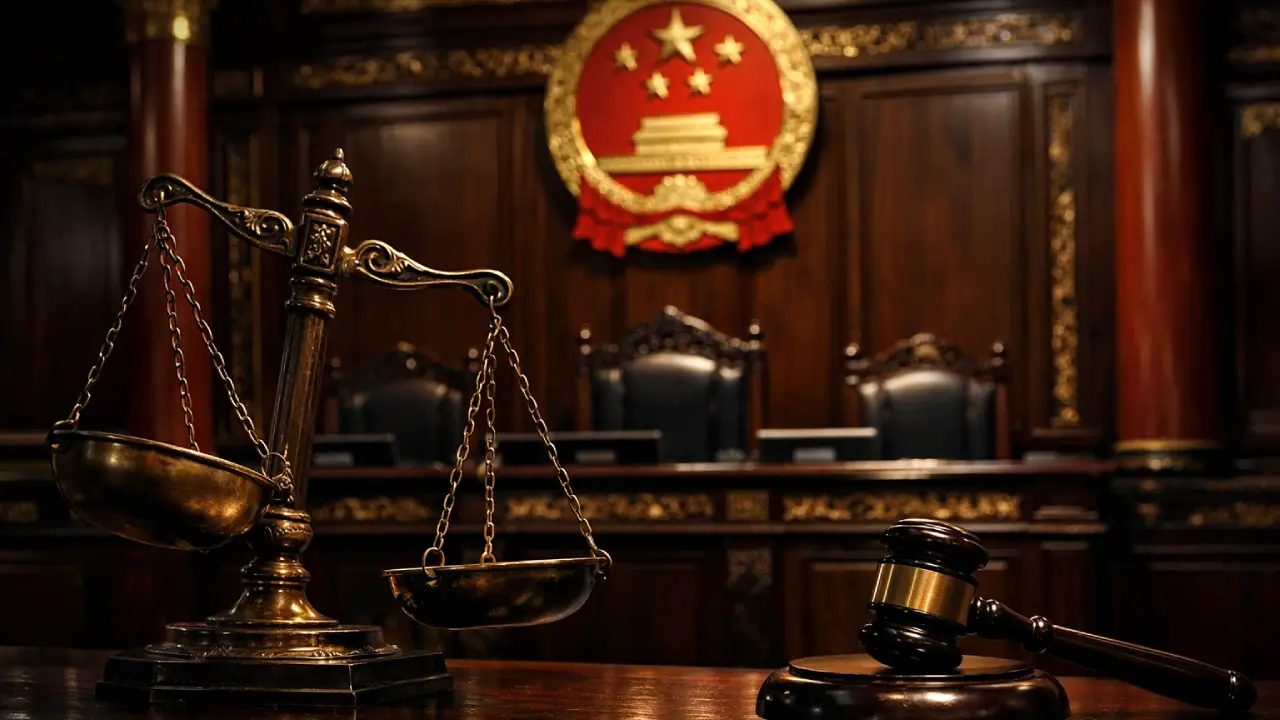
As the winter chill gripped Beijing in February 2026, the Supreme People’s Court (SPC) issued a mandate that effectively signaled the end of judicial leniency for the nation’s most reviled criminals. This was not a change to the constitution, but a powerful Supreme People’s Court 2026 Judicial Interpretation—a “Child Protection Mandate” that streamlines the path to the execution chamber for child abusers.
While much of the world moves toward restorative justice, China is doubling down on the finality of the state-sanctioned bullet. To illustrate the extremity of this shift, the following table compares China’s new directive against global standards:
| Jurisdiction | Primary Aggravated Penalty | Legal Philosophy |
| China | Immediate Execution (No Reprieve) | Retribution & Maximum Deterrence |
| USA | Life Imprisonment / Civil Commitment | Incapacitation & Risk Management |
| Europe | Prison + Rehabilitation | Reintegration & Human Rights |
No Room for Reprieve
The February 2026 directive targets three specific categories under Article 236 Criminal Law: teachers or guardians who betray a position of trust, digital predators using “Internet Luring” via platforms like WeChat or QQ, and repeat offenders. The SPC’s stance is unwavering: “Those who harm children challenge the bottom line of humanity”.
Lower courts have been instructed to hand down death sentences without the traditional two-year reprieve in cases where circumstances are “flagrant”. This removes the possibility of a sentence being commuted to life imprisonment, ensuring that the Immediate Execution is carried out shortly after the top court’s approval.
The Cases of Zhao, Wang, and Chen
This judicial tightening was fueled by a series of high-profile cases that ignited national fury. In 2025, the state executed three men whose crimes became the face of the “Zero Tolerance” campaign.
Zhao, an instructor at an illegal education centre, was executed for the systematic abuse of dozens of students. He collaborated with others to detain minors, subjecting them to forced labour and psychological control while repeatedly raping eight female students . The detail that Zhao forced victims to take long-term contraceptives, causing permanent gynaecological damage, became a focal point of public outrage.
Parallel to Zhao was Wang, a digital predator who posed as a movie director to lure elementary school girls into sharing indecent photos. Once he possessed the images, he used them for blackmail, coercing nine children into physical meetings and filming the subsequent assaults to ensure a cycle of abuse. Finally, there was Chen, a repeat offender who joined over 20 student messaging groups to groom victims. His case underscored the state’s argument that certain predators are beyond rehabilitation, especially after he organized the gang-rape of a 14-year-old girl for profit.

The Weibo Echo Chamber
On platforms like Weibo and Douyin, the state’s “Zero Tolerance” policy enjoys massive, vocal support. Announcements of executions frequently garner millions of likes and comments ranging from “Well done” to “Devils deserve hell”. This populist surge creates a “Swift Justice” environment where the judiciary acts as a direct responder to public bloodlust.
This domestic consensus stands in stark contrast to the silence or critique of Western human rights groups. Organizations like Amnesty International often warn that “Swift Justice” can come at the cost of due process, citing the lack of transparency in China’s 99% conviction rate. However, in the court of Chinese public opinion, the rights of the victim—the child—entirely supersede those of the perpetrator.
Why China Chose Death
The directive explicitly distances China from the “medical” approach seen in other Asian nations. While South Korea and Kazakhstan have implemented mandatory chemical castration to reduce recidivism, Chinese legal experts have dismissed such measures as “too lenient”.
Proponents of chemical castration argue it diminishes sexual desire through hormone treatment. However, the SPC views child abuse not as a treatable pathology, but as a moral transgression of “execrable circumstances”. In the Chinese view, chemical castration leaves the predator alive and capable of other forms of violence, whereas Immediate Execution provides a terminal solution to the risk.
Transparency and Risk
The primary international criticism of the 2026 Mandate is the potential for wrongful conviction. Human rights advocates point to the Egypt precedent, where calls for “Swift Justice” led to expedited trials with serious due process shortcomings . In China, where cases involving minors are often closed to the public to protect the victims, the evidence against men like Zhao or Wang is rarely subjected to independent scrutiny.
Furthermore, criminologists worry about “displacement”—the theory that if the penalty for abuse is identical to that of murder, predators may be incentivized to kill their victims to eliminate witnesses .
Conclusion
As China enters this deadly new phase of child protection, the state is betting that the fear of the firing squad will drive the “devils” out of the digital and physical shadows. The Supreme People’s Court 2026 directive is more than a legal update; it is a sociological statement that China will prioritize its future—its children—over any international norm regarding the “Right to Life”.
Whether this terminal deterrent will stop the crimes or simply drive them deeper into the unregulated corners of the “left-behind” rural heartlands remains the chilling question of this new era . For now, the message from Beijing is clear: the state has run out of mercy.
READ OUR OTHER ARTICLES
- ओडिशा का दीपक पहुंचा बेंगलुरु, Hardik Pandya की उदारता ने मचाया तहलका
 भारत में क्रिकेट केवल एक खेल नहीं, बल्कि एक गहरी सामाजिक भावना है जहाँ खिलाड़ी भगवान की तरह पूजे जाते हैं और प्रशंसक उनके प्रति अटूट स्नेह प्रदर्शित करते हैं. … Read more
 - Iran’s Darkest Day: Screams for Revenge and a Missing Leader
 On Sunday, July 5, 2026, Iran entered the tense and highly charged Khamenei funeral Day 2. This marked a critical moment in a six-day state funeral meant to show the … Read more
 - अजीत कुमार: प्रेरणादायक सफर और वैश्विक उपलब्धियों का महाकाव्य
 भारतीय सिनेमा के परिदृश्य में कुछ ऐसे व्यक्तित्व होते हैं जो पर्दे की चकाचौंध से परे जाकर समाज और संस्कृति पर अपनी अमिट छाप छोड़ते हैं। दक्षिण भारतीय सिनेमा के … Read more
 - Coachella 2026: Highlights and History-Making Moments You Missed!
 The 25th anniversary of the Coachella Valley Music and Arts Festival just wrapped up, and it was absolutely legendary! From April 10–12 and April 17–19, 2026, the Empire Polo Club … Read more
 - वैभव सूर्यवंशी का टीम इंडिया में चयन हो चुका है?
 भारतीय क्रिकेट के इतिहास में कुछ क्षण ऐसे आते हैं जो केवल खेल के आंकड़ों को नहीं बदलते, बल्कि पूरे देश की खेल भावना और भविष्य की दिशा को पुनर्परिभाषित … Read more