

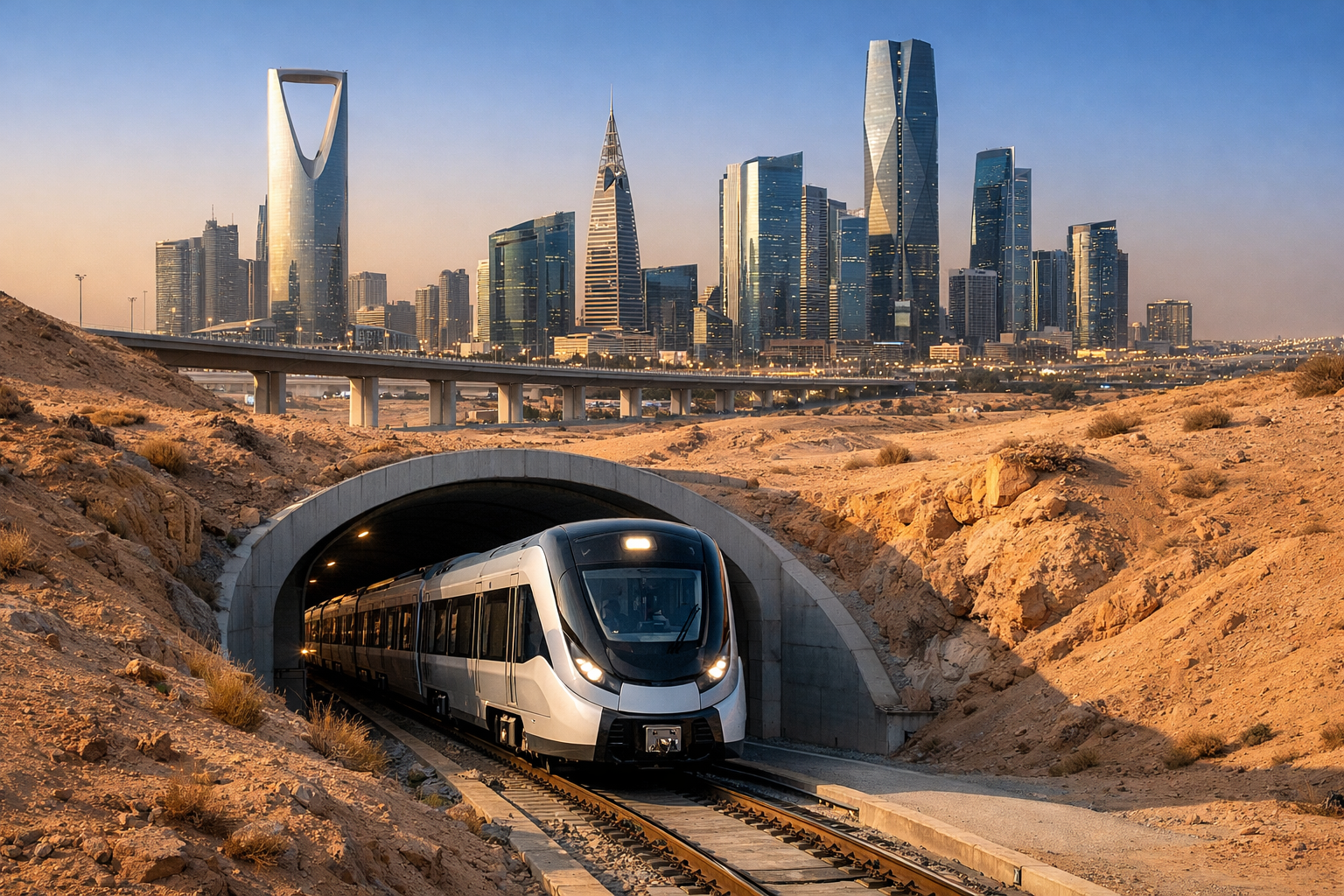
Riyadh Metro Red Line Expansion
| Project Parameter | Details and Specifications |
|---|---|
| Project Name | Riyadh Metro Red Line (Line 2) Extension |
| Contract Classification | Major Order (₹5,000 Cr – ₹10,000 Cr) |
| Consortium Partners | Webuild (Italy), L&T (India), Nesma (Saudi), Alstom (France) |
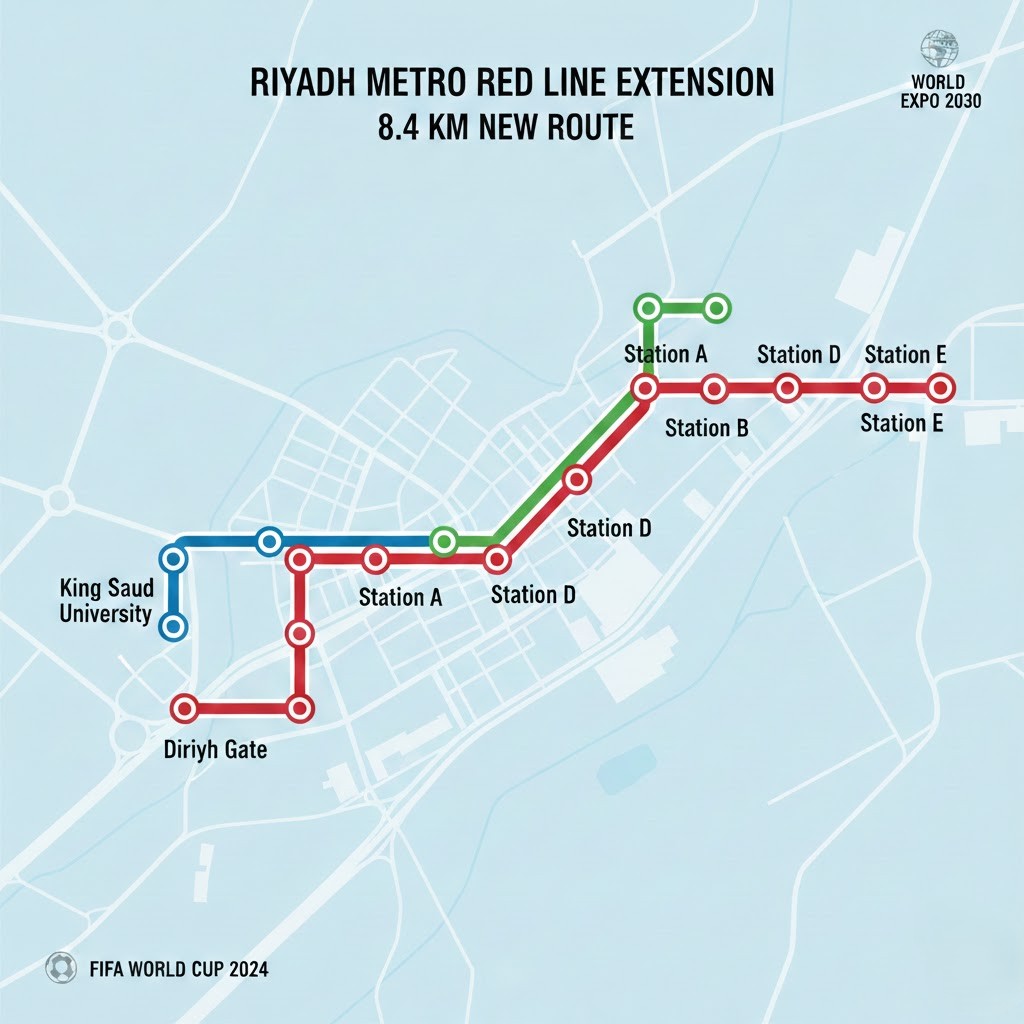
| Total Length | 8.4 Kilometers (7.1 km Tunnel / 1.3 km Viaduct) |
| Stations | 5 New Stations (3 Underground / 2 Above-ground) |
| Strategic Catalysts | Saudi Vision 2030, World Expo 2030, FIFA World Cup 2034 |
| Total Consortium Value | Approximately $2.75 Billion (₹23,000 Cr+) |
The ‘Make in India’: Build for the World
The engineering corridors of Mumbai and the burgeoning construction sites of the Arabian Peninsula converged with historic precision on January 28, 2026, as Larsen & Toubro (L&T) announced its latest conquest in the Middle East. The Heavy Civil Infrastructure vertical of the Indian engineering behemoth secured a “Major” contract—valued between ₹5,000 crore and ₹10,000 crore—for the turnkey construction of the Riyadh Metro Red Line extension.
L&T shares jumped ~1% on the news, reaching the ₹3,820 mark, as the market recognized this win as more than just a balance sheet entry. It represents the maturation of the “Make in India” philosophy into a high-tech export of engineering excellence. For decades, Indian firms were viewed as suppliers of labor; today, they are preferred partners for the world’s most ambitious infrastructure giga-projects. By integrating this new 8.4-kilometer corridor, Riyadh is physically bridging its academic future at King Saud University with its ancestral soul at the Diriyah Gate heritage site. This victory proves that L&T has moved from being a participant to a “Consortium Leader” in the global “Champions League” of infrastructure.
The “Cost per Km” Analysis
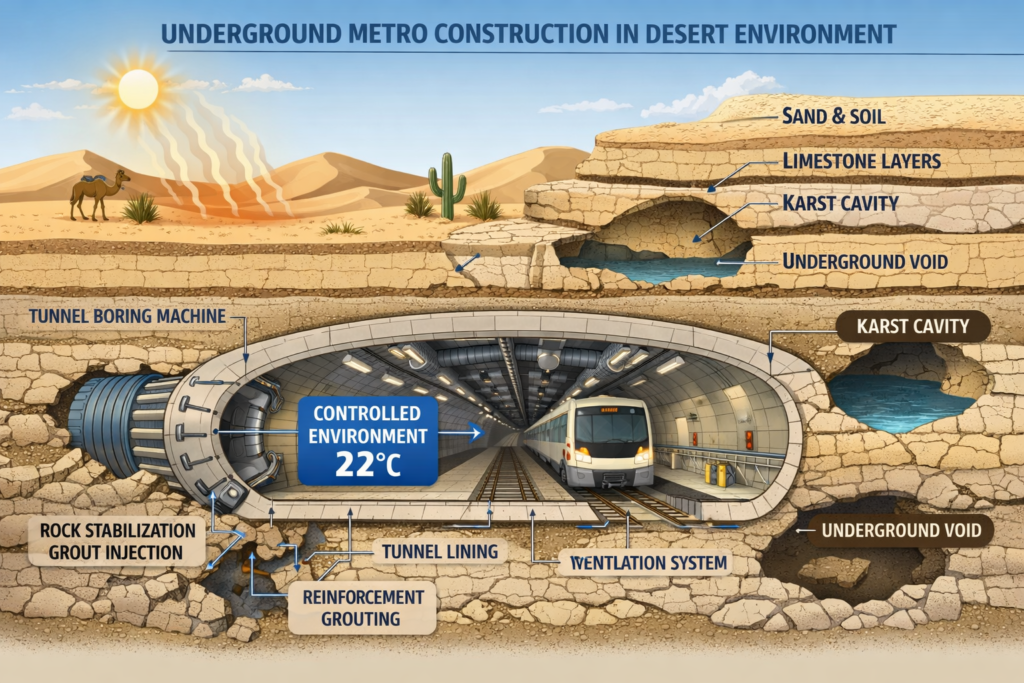
A critical question for investors is the project’s valuation: why does an 8.4 km extension command a consortium value of over ₹23,000 crore? The answer lies in the extreme complexity of underground tunneling in a dense, hyper-modern desert city. The project demands 7.1 kilometers of deep underground tunnels to be excavated using high-performance Tunnel Boring Machines (TBMs) through the unpredictable karstic limestone of the Arabian Shield.
In Riyadh, “karst cavities”—naturally occurring voids—can swallow equipment or cause surface sinkholes, requiring multi-technique geophysical surveys and “probe drilling” ahead of the TBM cutterhead. Furthermore, the “Cost per Km” includes the total climate isolation of the ecosystem. In a city where summer temperatures hit 55, the metro requires industrial-scale HVAC systems to maintain a constant 22 for both passenger comfort and the sensitive electronics of the driverless signaling systems. L&T’s ability to price and manage these geological and thermal risks, honed during Riyadh Metro Phase 1, gave them the competitive edge over international rivals.
The Saudi Strategy
The Riyadh Metro expansion is the physical manifestation of Saudi Arabia’s Vision 2030. The Kingdom is currently in the midst of a “construction super-cycle” fueled by two massive catalysts: the 2030 World Expo and the 2034 FIFA World Cup. Riyadh expects to host 40 million visitors for the Expo alone, and the Red Line extension to the UNESCO-listed Diriyah Gate is essential for managing those passenger loads.
For L&T, the alignment with this vision provides a reliable, multi-decade pipeline. The Royal Commission for Riyadh City (RCRC) is transitioning from a cost-driven procurement model to a “trust-and-track-record” framework. Having successfully delivered the 41.6-kilometer Orange Line (Line 3) in Phase 1, the Webuild-L&T consortium became the “safe pair of hands” for the critical Diriyah connection. With the Expo just four years away from the project’s target completion, there is zero margin for error; L&T’s entrenched presence in Saudi Arabia makes it an indispensable architect of the Kingdom’s urban transformation.
Stock Outlook
For the financial markets, L&T remains the ultimate proxy for the infrastructure theme. As of January 2026, L&T’s consolidated order book has surpassed a staggering ₹7.33 lakh crore, with international projects contributing nearly 49% of that volume. Analysts at Jefferies and Motilal Oswal maintain a “Buy” rating, with target prices reaching as high as ₹4,715, citing the company’s ability to deliver high-margin growth while improving Return on Equity (ROE) toward their 18% “Lakshya” target.
The “Major” order for the Red Line extension reinforces the narrative that L&T is the only Indian contractor with the balance sheet “heft” and technical expertise to handle the multi-billion dollar wave in the Middle East. Its captive design centers in Chennai and Mumbai perform the high-end structural analysis and digital twin creation, allowing L&T to export white-collar engineering dominance at a competitive cost structure.
Conclusion
The Riyadh Metro win is a watershed moment for Indian engineering. We are no longer observing a company that merely executes orders; we are watching a firm that co-authors the growth story of a G20 nation. By delivering a turnkey solution that connects the future of Saudi education to the heart of its history, L&T has proven that ‘Make in India’ is now a global gold standard. As Riyadh prepares for the global spotlight of the World Cup, L&T’s ₹7.3 lakh crore backlog suggests its march toward the ₹5,000 share price level is well-supported by fundamental execution. Indian engineering has finally arrived at the head of the table.
READ OUR OTHER ARTICLES
- Iran’s Darkest Day: Screams for Revenge and a Missing Leader
 On Sunday, July 5, 2026, Iran entered the tense and highly charged Khamenei funeral Day 2. This marked a critical moment in a six-day state funeral meant to show the … Read more
 - अजीत कुमार: प्रेरणादायक सफर और वैश्विक उपलब्धियों का महाकाव्य
 भारतीय सिनेमा के परिदृश्य में कुछ ऐसे व्यक्तित्व होते हैं जो पर्दे की चकाचौंध से परे जाकर समाज और संस्कृति पर अपनी अमिट छाप छोड़ते हैं। दक्षिण भारतीय सिनेमा के … Read more
 - Coachella 2026: Highlights and History-Making Moments You Missed!
 The 25th anniversary of the Coachella Valley Music and Arts Festival just wrapped up, and it was absolutely legendary! From April 10–12 and April 17–19, 2026, the Empire Polo Club … Read more
 - वैभव सूर्यवंशी का टीम इंडिया में चयन हो चुका है?
 भारतीय क्रिकेट के इतिहास में कुछ क्षण ऐसे आते हैं जो केवल खेल के आंकड़ों को नहीं बदलते, बल्कि पूरे देश की खेल भावना और भविष्य की दिशा को पुनर्परिभाषित … Read more
 - US-Iran War Alert: Massive Stock Market and Sensex Crash
 If you opened your trading app this Monday and felt a knot in your stomach, you aren’t alone. The Indian stock market is currently going through one of its toughest … Read more