


The following table provides an immediate clarification to the rumors circulating in early 2026 regarding property rights.
| Rumor / Viral Claim | Legal Reality (Jan/Feb 2026) |
| Total Ban: “Muslims are now prohibited from buying land from Hindus.” | DC Permission Required: There is no ban; inter-faith sales require mandatory District Commissioner (DC) and Police verification. |
| Applies Everywhere: “New restrictions apply to all property deals in Rajasthan.” | Zonal Application: Restrictions apply only to specifically notified ‘Disturbed Areas’ designated by the state. |
| Religious Segregation: “The state is mandating separate neighborhoods by law.” | Anti-Distress Sale Mechanism: The law targets ‘distress sales’ and ‘improper clustering’ in sensitive zones. |
| National Law: “This is a new central law across India.” | State-Specific SOPs: These are individual measures taken by state cabinets in Assam, Rajasthan, and Gujarat. |
The Fact Check
The most critical distinction for any legal audit is between a total prohibition and a regulatory hurdle. A categorical ban on land sales based on the religion of the buyer or seller would be a clear Article 15 Violation. The Constitution of India prohibits discrimination on the grounds of religion, race, caste, or sex. Any law explicitly barring a Muslim from buying Hindu land would be struck down ab initio for violating the Basic Structure of the Constitution.
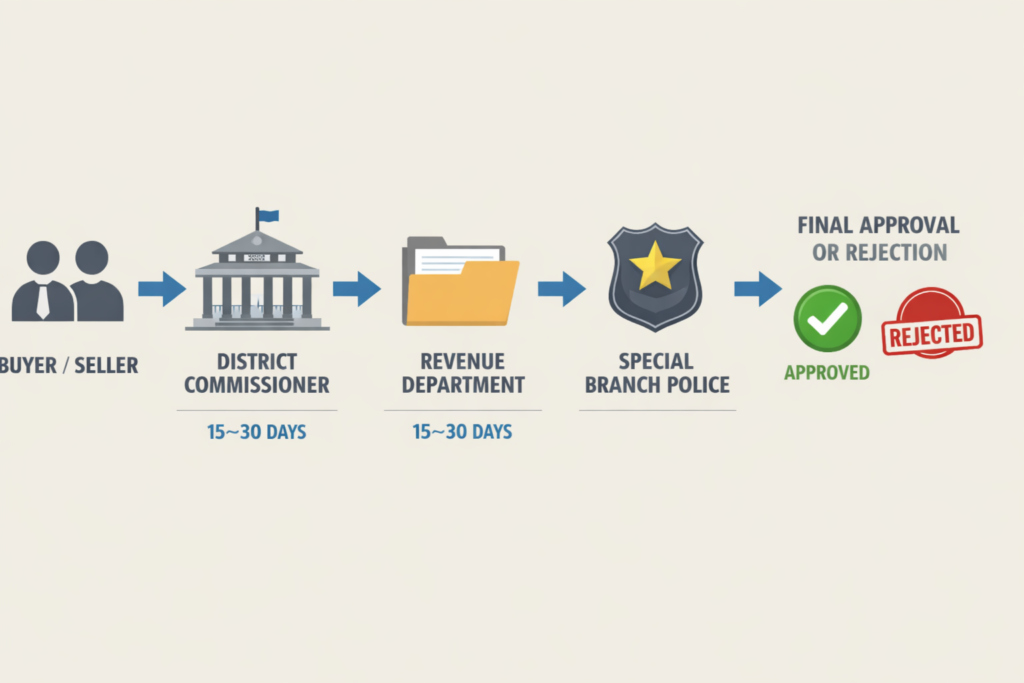
What we are witnessing in 2026 is the implementation of new administrative checkpoints. In Assam, the government has introduced a Standard Operating Procedure (SOP) that mandates multi-tier scrutiny. It does not “ban” sales; instead, it requires the District Commissioner to verify the transaction. The goal, according to the state, is to check for “coercion” or “communal tension” before the deal is registered.
In Rajasthan, the Cabinet approved the Rajasthan Disturbed Areas Bill 2026 on January 21, 2026. This bill mirrors the Gujarat model, where property transfers in “riot-prone” or “sensitive” zones require prior state permission to ensure the seller is not being forced out.
Finally, a crucial judicial reality check came from the Gujarat High Court Ruling on January 18, 2026. The court stayed efforts by authorities to block 13 sale deeds, ruling that the state cannot block a sale just because the parties are of different religions if there is “free consent” and “fair value.” This confirms that the law is intended to prevent distress sales, not to institutionalize segregation.
The Narrative Reality
From WhatsApp Panic to Administrative Friction
The panic currently flooding WhatsApp groups—”Is India banning inter-faith land sales?”—is rooted in a grain of truth surrounded by a desert of hyperbole. The short answer is No. The long answer is that in specific states, the paperwork for inter-faith deals has moved from a routine registry to a high-friction administrative gauntlet.
For residents in Assam or those in designated zones in Rajasthan, buying a house from someone of a different faith now involves more than just a checkbook; it involves a police inquiry. The state is no longer a neutral registrar of deeds but an active surveyor of demographic shifts.
Assam’s “SOP” Explained
Chief Minister Himanta Biswa Sarma has argued that in a state with Assam’s unique demographic sensitivities, land transfers must be handled “very, very carefully.” The logic provided is the prevention of “Land Jihad”—a term used by the government to describe perceived forced demographic changes or “improper clustering.”
Under the new SOP, any inter-religious land transfer proposal must be submitted to the District Commissioner. The proposal is then vetted by the Revenue Department and, most controversially, the Special Branch (SB) of the Assam Police. The police must investigate:
- Whether the transfer involves fraud or coercion.
- Whether the sale could disturb communal harmony.
- Whether there is a threat to national security.
Critics, including the AIUDF, argue this is “Bureaucratic Ghettoization,” where the sheer wait for a police NOC (No Objection Certificate) discourages sellers from looking for buyers outside their own community.
The “Disturbed Area” Trap in Rajasthan & Gujarat
The Rajasthan Disturbed Areas Bill 2026 introduces a different mechanism. If an area is declared “disturbed” due to communal tension, you cannot sell your property to anyone—Hindu or Muslim—without the Collector’s NOC. In practice, this often functions as a “red tape” law. While it protects against distress sales, it gives the state sweeping powers to decide who gets to live where.
In Gujarat, where this model originated, the state government has recently been accused of using the law to prevent “improper clustering.” However, as highlighted by the January 18 stay, the judiciary has stepped in to clarify that the Collector’s only role is to verify that the sale is voluntary. If consent is free, the state has no authority to block the transaction on demographic grounds.
The Legal Battle: Article 19(1)(e)
Legal experts are currently preparing to challenge these SOPs in the Supreme Court. The primary argument rests on Article 19(1)(e)—the right to reside and settle in any part of the territory of India. By making it administratively difficult for certain communities to buy property in certain areas, the state may be infringing on this fundamental freedom. Furthermore, Article 300A protects the right to property, and experts argue that “indefinite delays” through police verification amount to a deprivation of that right.

Conclusion: Verification, Not Prohibition
The verdict of early 2026 is clear: you can still buy land, but the state now wants to know exactly why you are buying it. The viral rumors of a total “Muslim ban” are false, but the reality of “bureaucratic friction” is very real. Whether these measures survive the coming judicial scrutiny depends on whether the courts view them as a shield against coercion or a sword used for social engineering.
READ OUR OTHER ARTICLES
- ओडिशा का दीपक पहुंचा बेंगलुरु, Hardik Pandya की उदारता ने मचाया तहलका
 भारत में क्रिकेट केवल एक खेल नहीं, बल्कि एक गहरी सामाजिक भावना है जहाँ खिलाड़ी भगवान की तरह पूजे जाते हैं और प्रशंसक उनके प्रति अटूट स्नेह प्रदर्शित करते हैं. … Read more
 - Iran’s Darkest Day: Screams for Revenge and a Missing Leader
 On Sunday, July 5, 2026, Iran entered the tense and highly charged Khamenei funeral Day 2. This marked a critical moment in a six-day state funeral meant to show the … Read more
 - अजीत कुमार: प्रेरणादायक सफर और वैश्विक उपलब्धियों का महाकाव्य
 भारतीय सिनेमा के परिदृश्य में कुछ ऐसे व्यक्तित्व होते हैं जो पर्दे की चकाचौंध से परे जाकर समाज और संस्कृति पर अपनी अमिट छाप छोड़ते हैं। दक्षिण भारतीय सिनेमा के … Read more
 - Coachella 2026: Highlights and History-Making Moments You Missed!
 The 25th anniversary of the Coachella Valley Music and Arts Festival just wrapped up, and it was absolutely legendary! From April 10–12 and April 17–19, 2026, the Empire Polo Club … Read more
 - वैभव सूर्यवंशी का टीम इंडिया में चयन हो चुका है?
 भारतीय क्रिकेट के इतिहास में कुछ क्षण ऐसे आते हैं जो केवल खेल के आंकड़ों को नहीं बदलते, बल्कि पूरे देश की खेल भावना और भविष्य की दिशा को पुनर्परिभाषित … Read more