

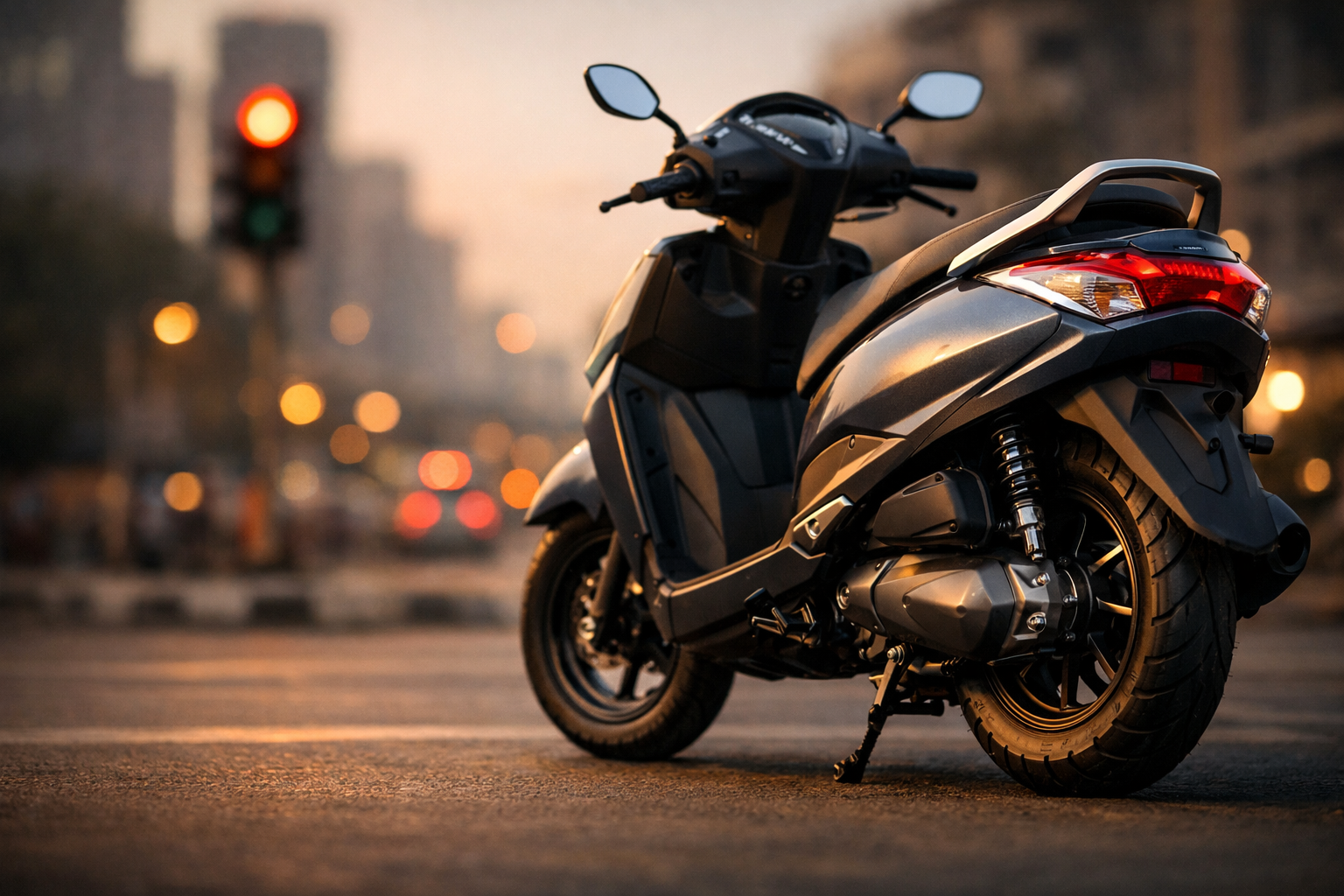
Honda Activa 6G vs. Activa 7G vs. TVS Jupiter 125
| Feature | Honda Activa 6G | Honda Activa 7G (2026) | TVS Jupiter 125 |
| Engine | 109.51cc | 109.51cc (Hybrid Assist) | 124.8cc |
| Emission | BS6 Phase 2 | OBD-2 Compliant (2B) | BS6 Phase 2 |
| Power/Torque | 7.84 PS / 9.05 Nm | 8.3 HP / 10.3 Nm | 8.15 PS / 10.5 Nm |
| Console | Analog | Digital (TFT + BT) | Semi-Digital |
| Rear Wheel | 10-inch Steel | 12-inch Alloy | 12-inch Alloy |
| Boot Space | 18 Liters | 22 Liters (Enhanced) | 33 Liters |
| Key Tech | Physical / H-Smart | H-Smart Standard | Standard Key |
| Real Mileage | 47-50 kmpl | 55-60 kmpl (Claimed) | 50-57 kmpl |
| Base Price | ₹75,433 | ₹82,000 | ₹75,950 |
The Return of the King
The arrival of the Honda Activa 7G on January 30, 2026, is a definitive strategic statement in an era dominated by the shadow of electrification. For over two decades, the Activa has been the backbone of Indian mobility, and with this launch, Honda is doubling down on a calculated gamble: that millions of Indians are still not ready to trade the convenience of petrol for the infrastructure woes of the EV segment. While electric two-wheelers reached a record 1.28 million units in 2025, they remain a 6.3% slice of a market still overwhelmingly powered by internal combustion. The 7G isn’t a relic; it is a refined fortress designed to protect Honda’s 88% ICE market share. By addressing long-standing hardware gaps—specifically the archaic analog meters and stability-limiting 10-inch rear wheels—Honda is betting that reliability, not a charging plug, remains the ultimate luxury for the Indian family.
H-Smart and the Digital Shift
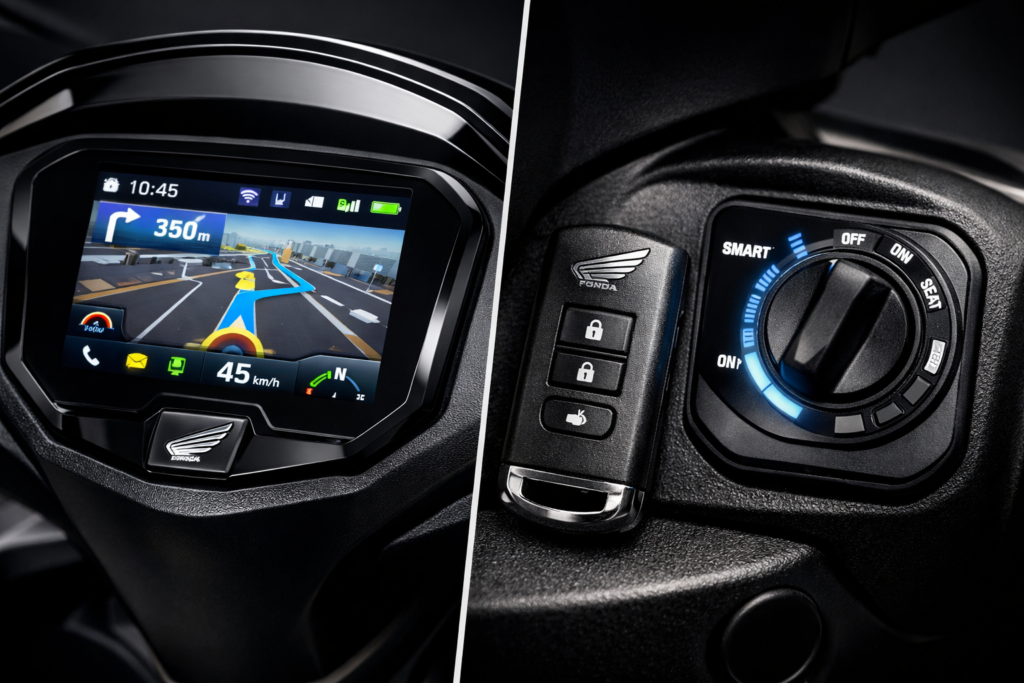
To lure tech-savvy Gen-Z buyers who are often swayed by the gadgetry of Ather or Ola, Honda has finally ditched the analog needle for a sophisticated 4.2-inch color TFT console on the higher variants. This Digital Console features Bluetooth connectivity via Honda RoadSync, bringing turn-by-turn navigation and call/SMS alerts directly to the dashboard. It successfully mimics the “tech feel” of an EV without the inherent battery anxiety.
Standardized on top variants is the H-Smart Technology, a keyless entry system that employs 128-bit encryption to prevent signal hacking. The suite includes Smart Find to locate the scooter in crowded lots, Smart Unlock for hands-free access to the seat and fuel cap, and Smart Safe, which activates an engine immobilizer the moment the key fob moves beyond a two-meter radius. By integrating these features, Honda offers the psychological comfort of modern electronics paired with a platform that can be refueled in sixty seconds at any corner of the country.
Refinement and the Mileage Claim: 60 kmpl Realistic?
Mechanically, the 7G retains the 109.51cc displacement but undergoes a total internal overhaul to meet OBD-2B Compliant regulations. The headline innovation is the “Hybrid Assist” motor, a re-engineered ACG silent start system that provides an auxiliary torque pulse during the 0-40 kmph acceleration window. This bumps peak torque to a respectable 10.3 Nm, compensating for the natural lag of a small-capacity engine.
Honda’s Real-World Mileage claim of 55-60 kmpl is bold. While skeptics will point to laboratory conditions, the 7G utilizes a more granular PGM-FI sensor array and an optimized Idling Stop System that shuts the engine off after just three seconds of static traffic. In stop-and-go metro traffic, these hardware refinements should realistically translate to a 10-12% efficiency gain over the 6G, keeping the Activa’s running cost at an unbeatable ₹1.7 per kilometer—a vital metric as petrol prices hover near the ₹100 mark.
The Jupiter Rivalry
The Activa 7G finally addresses its biggest dynamic flaw: the skittish handling caused by the old 10-inch rear wheel. The shift to a 12-inch rear alloy significantly increases the gyroscopic moment of inertia, making the 7G feel far more “planted” on patchy urban tarmac and stable at 60+ kmph. The suspension has also been revised with a 3-step adjustable rear monoshock to better soak up monsoon-ravaged roads.
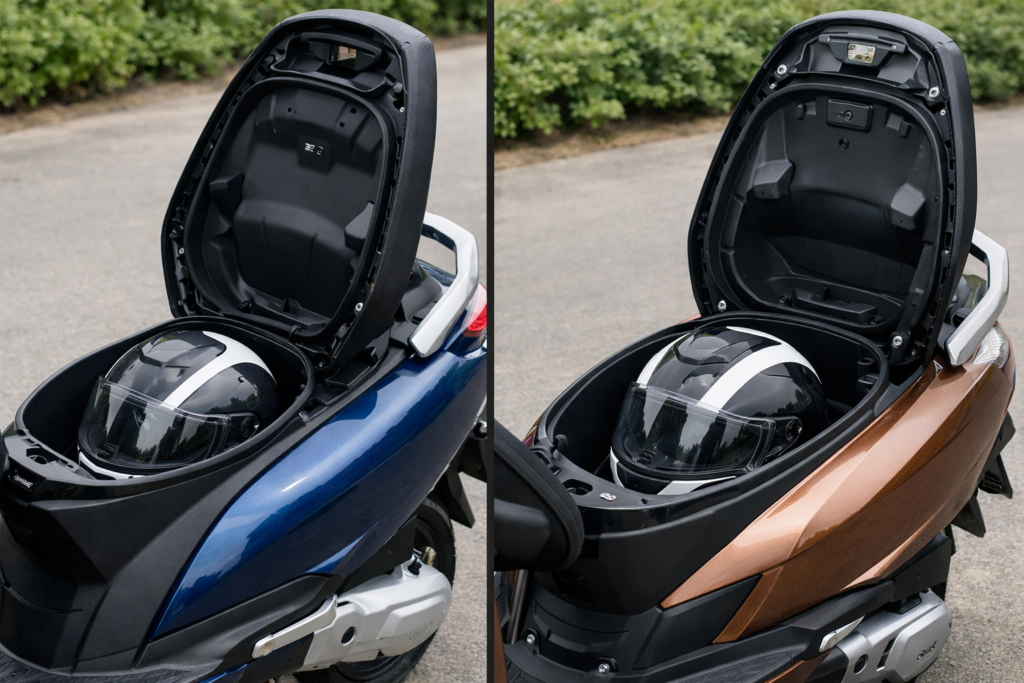
However, the TVS Jupiter 125 remains a formidable practical rival. While Honda has expanded the 7G’s boot to 22 liters, it still cannot compete with the Jupiter’s cavernous 33-liter “double helmet” storage. Furthermore, TVS’s floorboard-mounted fuel tank allows for a front apron filler cap, which remains more ergonomic than Honda’s rear-mounted external cap. Where the Activa 7G wins is in engine silkiness; the Honda unit remains the benchmark for vibration-free cruising, whereas the Jupiter’s engine can feel strained at high RPMs.
Verdict: Is Petrol Still Worth It?
With a pricing strategy of ₹79,000 to ₹90,000, the Activa 7G is arguably the most expensive 110cc scooter in India. It sits dangerously close to entry-level EVs, yet it offers a value proposition no electric rival can match: bulletproof resale value and a service network that reaches every village in India.
Who is it for? The college student will appreciate the TFT console and navigation, while the family man will value the metal body and legendary reliability. As we stand in 2026, the Activa 7G is the smarter, sharper, and safer choice for those not yet ready to gamble on the lithium-ion future. It is not just an update; it is Honda’s final petrol masterpiece.
READ OUR OTHER ARTICLES
- ओडिशा का दीपक पहुंचा बेंगलुरु, Hardik Pandya की उदारता ने मचाया तहलका
 भारत में क्रिकेट केवल एक खेल नहीं, बल्कि एक गहरी सामाजिक भावना है जहाँ खिलाड़ी भगवान की तरह पूजे जाते हैं और प्रशंसक उनके प्रति अटूट स्नेह प्रदर्शित करते हैं. … Read more
 - Iran’s Darkest Day: Screams for Revenge and a Missing Leader
 On Sunday, July 5, 2026, Iran entered the tense and highly charged Khamenei funeral Day 2. This marked a critical moment in a six-day state funeral meant to show the … Read more
 - अजीत कुमार: प्रेरणादायक सफर और वैश्विक उपलब्धियों का महाकाव्य
 भारतीय सिनेमा के परिदृश्य में कुछ ऐसे व्यक्तित्व होते हैं जो पर्दे की चकाचौंध से परे जाकर समाज और संस्कृति पर अपनी अमिट छाप छोड़ते हैं। दक्षिण भारतीय सिनेमा के … Read more
 - Coachella 2026: Highlights and History-Making Moments You Missed!
 The 25th anniversary of the Coachella Valley Music and Arts Festival just wrapped up, and it was absolutely legendary! From April 10–12 and April 17–19, 2026, the Empire Polo Club … Read more
 - वैभव सूर्यवंशी का टीम इंडिया में चयन हो चुका है?
 भारतीय क्रिकेट के इतिहास में कुछ क्षण ऐसे आते हैं जो केवल खेल के आंकड़ों को नहीं बदलते, बल्कि पूरे देश की खेल भावना और भविष्य की दिशा को पुनर्परिभाषित … Read more