

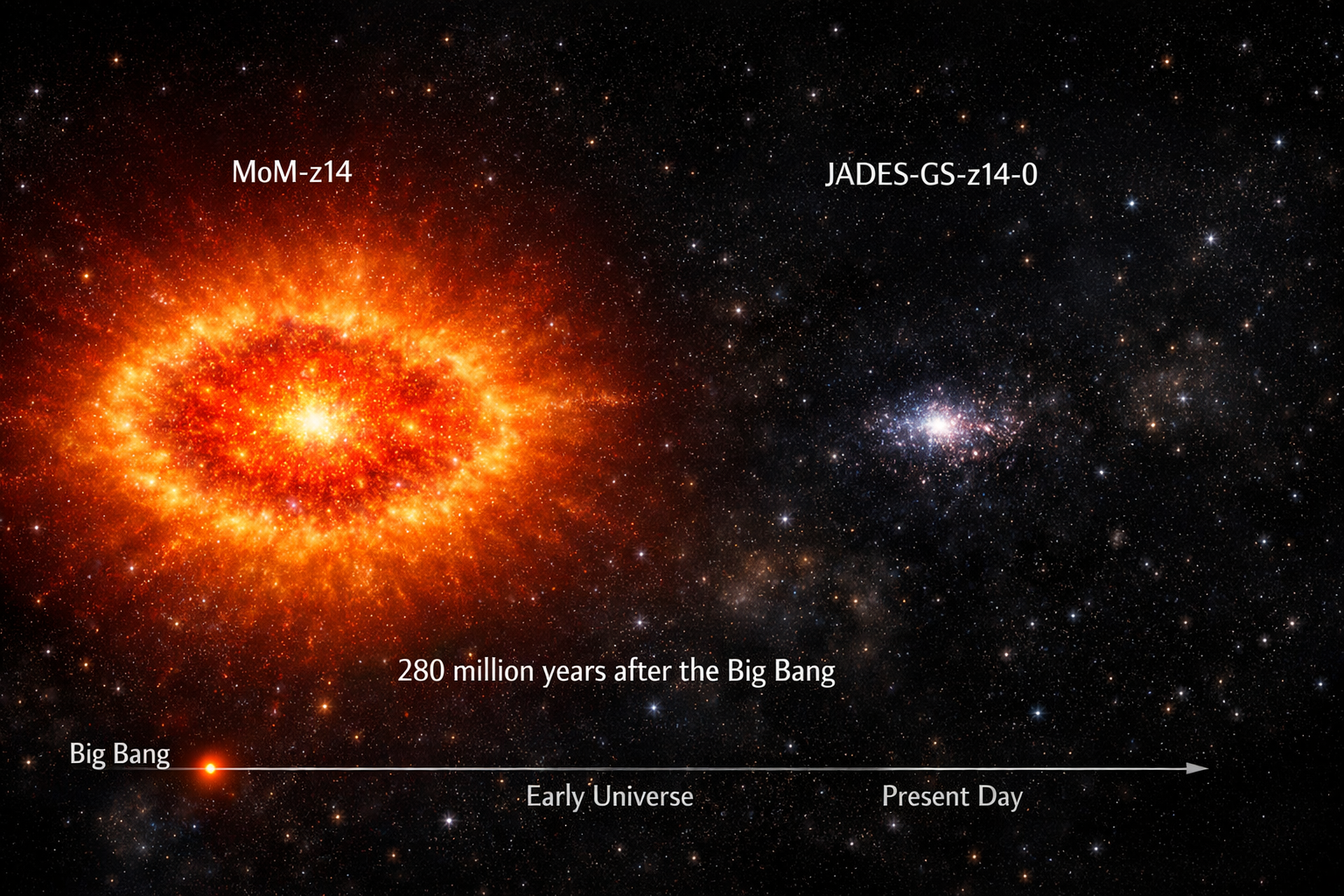
The history of the cosmos is being rewritten in the infrared. For decades, the “Cosmic Dawn” was theorized as a slow, quiet assembly where the first stars ignited only after hundreds of millions of years of gravitational labor. But the January 2026 confirmation of the galaxy MoM-z14 has shattered this narrative. By peering back 13.5 billion years, the James Webb Space Telescope (JWST) has identified an object that defies the fundamental physics of the Standard Cosmological Model.
MoM-z14 is not just a record-breaker; it is a “miracle” that threatens to “break” the timeline of the universe. Detected at a record-shattering Redshift, its light left the source just 280 million years after the Big Bang—when the universe was only 2% of its current age. Instead of the dim, pristine hydrogen clouds predicted by theory, astronomers found a galaxy that is shockingly bright and chemically mature.
MoM-z14 vs. JADES-GS-z14-0
| Feature | MoM-z14 (“Mirage or Miracle”) | JADES-GS-z14-0 (Previous Record) |
| Confirmed Redshift () | 14.44  0.02 0.02 | 14.32 |
| Cosmic Age (Post-Big Bang) | 280 Million Years | ~300 Million Years |
| Absolute UV Magnitude () | -20.2 | -20.8 |
| Chemical Signature | Significant Nitrogen Enrichment | Strong Oxygen and Hydrogen |
| Instrument for Confirmation | JWST NIRSpec (Prism) | JWST NIRSpec & ALMA |
| Discovery Field | COSMOS Legacy Field | GOODS-South Field |
The Mirage or Miracle Survey
The name “MoM” originates from the “Mirage or Miracle” survey led by Dr. Rohan Naidu. The program was designed to distinguish between “miracles”—genuine high-redshift galaxies—and “mirages”—lower-redshift objects that appear deceptively red due to cosmic dust. Identified within the COSMOS Legacy Field, MoM-z14 stood out as a robust “dropout,” completely invisible in shorter wavelengths but glowing intensely in the mid-infrared.
The Nitrogen Problem: Chemical Fingerprints of Monster Stars
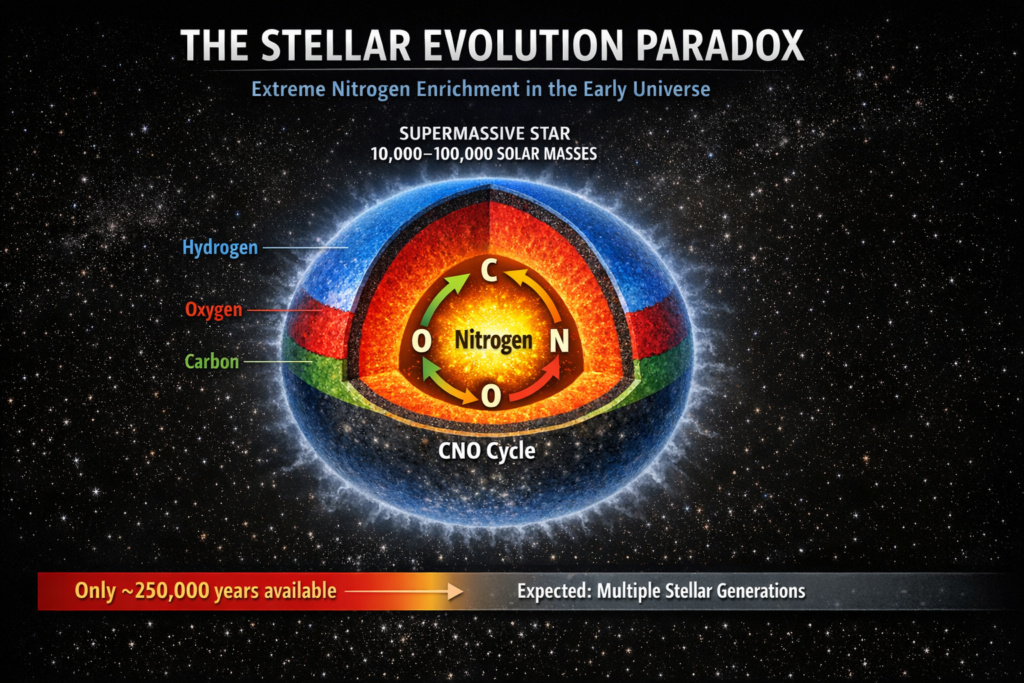
The core scientific enigma of MoM-z14 is its chemical composition. Standard models suggest that the first stars, or Population III Stars, were formed from pristine hydrogen and helium. Complex elements like nitrogen usually require multiple generations of stars to live and die through the CNO (Carbon-Nitrogen-Oxygen) cycle.
However, spectroscopy of MoM-z14 reveals a nitrogen-to-carbon ratio higher than that of our own Sun. Just 280 million years after the Big Bang, there simply was not enough time for multiple stellar generations to enrich the environment. This implies the existence of primordial “Supermassive Stars”—stellar behemoths weighing between 1,000 and 10,000 . Unlike any stars today, these giants could have burned through their fuel in just 250,000 years, producing vast quantities of nitrogen through a unique process where carbon from the core leaks into a hydrogen-burning shell. MoM-z14 suggests that the chemical maturation of the universe occurred at a frantic pace far beyond current theoretical limits.
The Crisis in Cosmology: Tension at the Dawn of Time
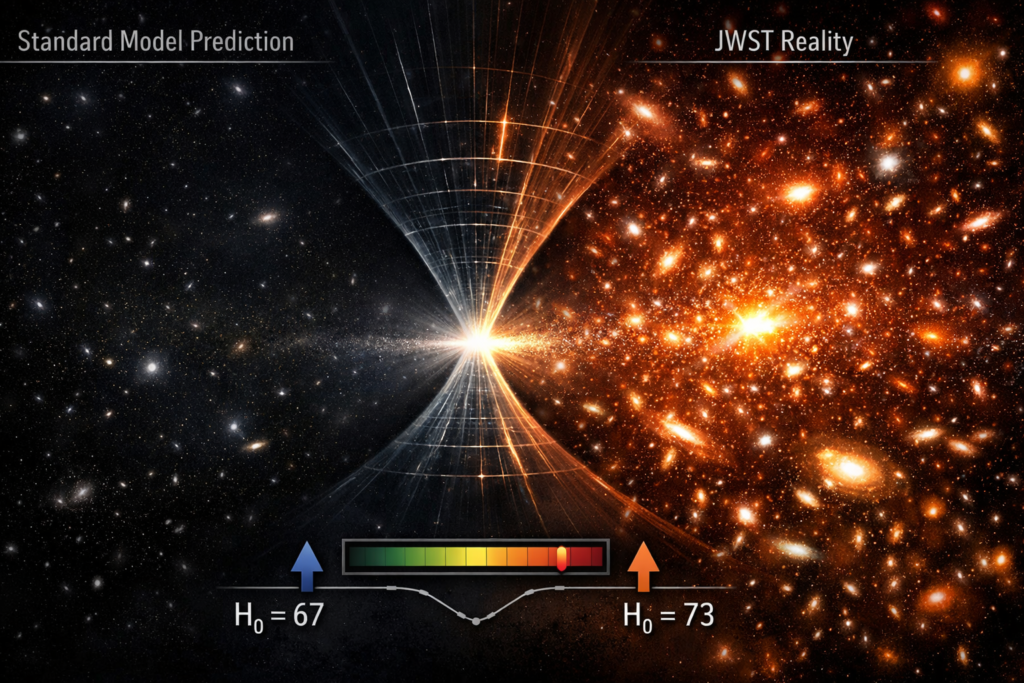
The existence of MoM-z14 adds significant weight to the “Crisis in Cosmology.” The Standard Cosmological Model (CDM) predicts that structures grow from the bottom up over vast stretches of time. Yet, JWST is finding bright, massive galaxies at that are 100 times more abundant than simulations allow. This “Tension” suggests a fundamental discrepancy in our understanding of early matter density.
This problem is linked to the “Hubble Tension”—the irreconcilable difference in the expansion rate of the universe measured from the Cosmic Microwave Background versus direct observations of galaxies. If galaxies like MoM-z14 grew so large and so chemically complex so quickly, it implies our Big Bang timeline is missing a critical driver—perhaps “Early Dark Energy” or modified gravity that accelerated structure formation shortly after the beginning of time. MoM-z14 effectively pushes the “halo limit” to its breaking point, suggesting that nearly 100% of available gas was converted into stars with an efficiency that should be physically impossible.
The Tech: NIRSpec and the Architecture of Discovery
This confirmation was made possible by the Near-Infrared Spectrograph (NIRSpec). While other cameras can see these objects, NIRSpec understands them by breaking their light into a spectroscopic barcode. Using its “Micro-Shutter Array”—250,000 tiny doors that block out foreground glare—NIRSpec captured the sharp Lyman- break in MoM-z14’s spectrum. This break definitively marked its distance and revealed the nitrogen emission lines that are now forcing a total re-evaluation of stellar evolution.
Conclusion
MoM-z14 marks a philosophical shift in our understanding of the “Dark Ages.” We once believed this period was a simple, empty void. We now know it was full of light—a brilliant era where monster stars lived and died in a cosmic blink. MoM-z14 proves the first chapter of the universe was not written in a whisper, but in a shout. The “Impossible Galaxy” is now a firm observational fact, and it has opened a frontier where the mysteries of our origins are finally coming into the light.
READ OUR OTHER ARTICLES
- ओडिशा का दीपक पहुंचा बेंगलुरु, Hardik Pandya की उदारता ने मचाया तहलका
 भारत में क्रिकेट केवल एक खेल नहीं, बल्कि एक गहरी सामाजिक भावना है जहाँ खिलाड़ी भगवान की तरह पूजे जाते हैं और प्रशंसक उनके प्रति अटूट स्नेह प्रदर्शित करते हैं. … Read more
 - Iran’s Darkest Day: Screams for Revenge and a Missing Leader
 On Sunday, July 5, 2026, Iran entered the tense and highly charged Khamenei funeral Day 2. This marked a critical moment in a six-day state funeral meant to show the … Read more
 - अजीत कुमार: प्रेरणादायक सफर और वैश्विक उपलब्धियों का महाकाव्य
 भारतीय सिनेमा के परिदृश्य में कुछ ऐसे व्यक्तित्व होते हैं जो पर्दे की चकाचौंध से परे जाकर समाज और संस्कृति पर अपनी अमिट छाप छोड़ते हैं। दक्षिण भारतीय सिनेमा के … Read more
 - Coachella 2026: Highlights and History-Making Moments You Missed!
 The 25th anniversary of the Coachella Valley Music and Arts Festival just wrapped up, and it was absolutely legendary! From April 10–12 and April 17–19, 2026, the Empire Polo Club … Read more
 - वैभव सूर्यवंशी का टीम इंडिया में चयन हो चुका है?
 भारतीय क्रिकेट के इतिहास में कुछ क्षण ऐसे आते हैं जो केवल खेल के आंकड़ों को नहीं बदलते, बल्कि पूरे देश की खेल भावना और भविष्य की दिशा को पुनर्परिभाषित … Read more