

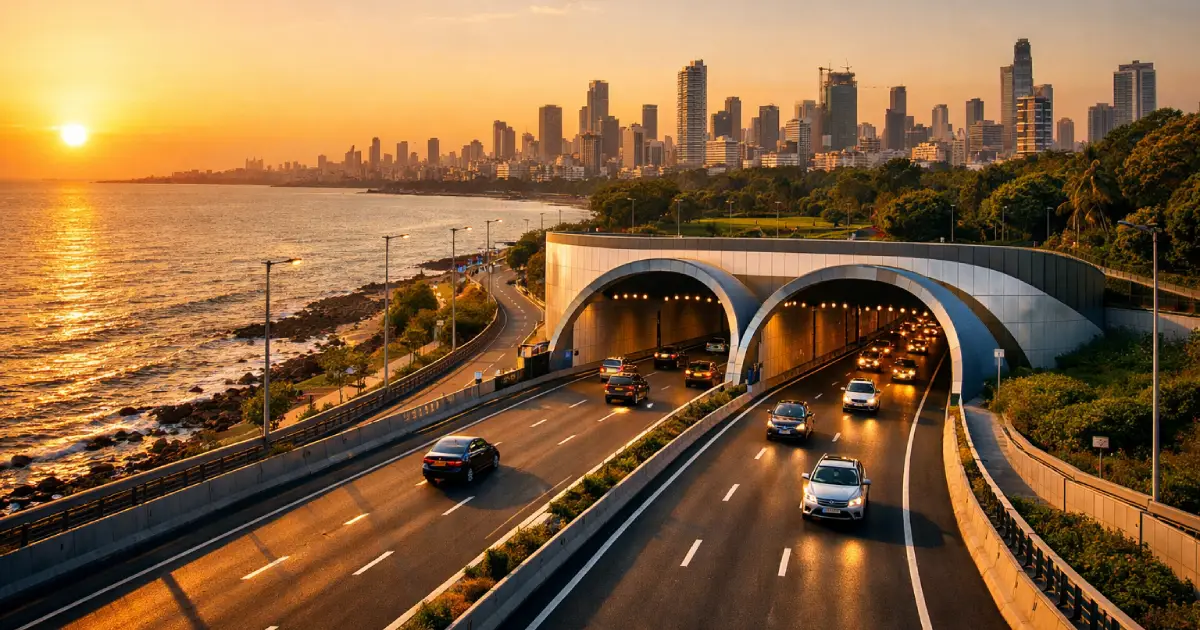
For those looking to experience the future of auditory infrastructure on the Mumbai Coastal Road, a standard commute will not suffice. The installation is an unforgiving mechanical instrument that demands precision from the driver. To transform your car into a high-fidelity playback device for the nation’s most famous anthem, you must strictly adhere to this protocol:
| Feature | Requirement for Optimal Playback |
| Primary Location | Northbound Lane, Dharmaveer Swarajyarakshak Chhatrapati Sambhaji Maharaj Coastal Road. |
| The Trigger Zone | Immediately following the exit of the tunnel as you head toward Worli. |
| Spatial Coordinates | A 500-metre stretch between Priyadarshini Park and Amarsons Garden. |
| Lane Discipline | The fast lane (right-most lane), positioned directly adjacent to the median. |
| The Magic Number | A constant velocity maintained between 70–80 kmph. |
| Acoustic Prep | Roll up all windows for resonance; mute your internal car audio. |
The phenomenon is entirely unplugged. No speakers, no radio broadcast—just the controlled friction between your tires and 66 precision-engineered “music strips” carved into the asphalt.
Mumbai’s Infrastructure Joins the Global Stage
The transition from a silent asphalt glide to a full-throttle Bollywood performance happens in a heartbeat. As a vehicle clears the mouth of the sleek new tunnel on the Mumbai Coastal Road, the sea breeze is accompanied by a sudden, rhythmic vibration permeating the chassis. It isn’t a mechanical failure; it is the opening notes of A.R. Rahman’s “Jai Ho” rising from beneath the floorboards. With this installation, Mumbai has officially joined an elite global club that includes Japan, South Korea, Hungary, and the UAE, where “Singing Roads” have moved from experimental physics to urban reality.
The official inauguration on February 11, 2026, was a high-profile event featuring Devendra Fadnavis Inauguration honors alongside Deputy Chief Minister Eknath Shinde. This wasn’t just a ribbon-cutting; it was the unveiling of only the fifth such road in the entire world. For decades, roads were mere utilities—grey ribbons of tarmac designed for the sole purpose of moving mass. Today, the Mumbai Coastal Road suggests a future where infrastructure is experiential, communicative, and even patriotic. This 500-metre segment, the “Melody Road,” is a pilot initiative transforming the daily trek into a literal concert on wheels.
The Physics of the Performance
To understand how a slab of road can mimic a complex musical score, one must delve into the world of Acoustic Rumble Strips. At first glance, the musical stretch appears as a series of shallow, rhythmic ridges carved into the fast lane. However, each groove is part of a mathematical sequence where spacing acts as the physical representation of musical wavelengths.
The sound is generated through periodic impact. When a tire hits a ridge, it creates a small vibration in the tire’s structure. When these impacts happen in rapid succession, they produce a tone. The frequency f of the resulting note is determined by the vehicle’s speed and the distance between the grooves, calculated as f=v/d. To produce a specific note at the target speed of 72 kmph (20 m/s), engineers must space the grooves at precise intervals—roughly 0.0764 metres for a middle C. Closer spacing increases the frequency, raising the pitch. The vehicle body itself becomes the amplifier, with the cabin acting as a resonating chamber that turns mechanical jolts into a melody audible even with windows rolled up.

The “Sweet Spot”
The most fascinating aspect of India’s First Musical Road is its role as a behavioral speed trap. Unlike cameras that issue fines, the singing road provides real-time rewards for compliance and immediate “fail states” for those who stray from the limit.
To hear “Jai Ho” clearly, you must maintain the “Sweet Spot” of 70–80 kmph. If you accelerate beyond 80 kmph, the frequency of tire impacts increases proportionally. The result is the “Chipmunk Effect”—the heroic anthem is transformed into a high-pitched, frantic jingle that sounds like a cartoon on fast-forward. Conversely, slowing below 60 kmph causes the notes to elongate into a low-frequency drone. This creates a powerful psychological incentive: drivers naturally want to hear the rhythm correctly, and the urge to “get it right” forces a level of speed discipline that signs rarely achieve.
The Engineering
The project was a cross-continental collaboration that brought Hungarian expertise to the shores of the Arabian Sea. Hungary pioneered this technology on its famous Route 67, and the Mumbai project was inspired after an Indian businessman suggested the concept to the Hungarian Consulate and the BMC.
Adapting this for Indian asphalt presented unique challenges. The bitumen must withstand Mumbai’s extreme tropical heat and the relentless pounding of the southwest monsoon. Unlike raised markers used in earlier experiments, the Hungarian methodology involves milling “tuned grooves” directly into the surface with mathematical precision. The project cost, approximately ₹6.21 crore to ₹7.5 crore, covered engineering, specialized milling, and advance signage installed at 500m, 100m, and 60m intervals to warn drivers before they hit the grooves.
The Public Reaction
Between February 11 and 12, 2026, social media erupted as the first videos of the road went viral. For many, the “Jai Ho” road is pure magic; even A.R. Rahman shared a video on X, calling it “musical magic.”
However, the reaction hasn’t been entirely harmonious. A vocal contingent of citizens has questioned municipal priorities. The “Great Pothole Debate” has become a dominant counter-narrative, with critics noting that while the city has a singing road in its affluent corridor, suburban residents still navigate “Hard Rock” symphonies of pothole impacts. One viral comment summed it up: “Musical road exists. Potholes still run the country. vibes > infrastructure. Are we winning or just making noise?” Furthermore, residents in nearby high-rises at Worli have expressed concerns about low-frequency noise pollution from thousands of cars hitting the strips every hour.

Conclusion
As the novelty of India’s First Musical Road settles into daily life, the question remains: is this a gimmick or a genuine innovation? Initial data suggests the “behavioral nudge” works. Officials are already citing the stretch as a template for projects like the Samruddhi Expressway, where “highway hypnosis” is a concern. By using sound to communicate with the driver, Mumbai has moved beyond the silent era of infrastructure. Whether you find it a triumph or a distraction, the “Jai Ho” road has changed the frequency of the Indian commute. For 500 metres, your car is a musical instrument—provided you stay at 70 kmph.
READ OUR OTHER ARTICLES
- Know the Real Reason Behind Tarun Kumar’s Death Over a Holi Balloon
 The Holi festival turned tragic in southwest Delhi this year. On Wednesday, March 4, 2026, the narrow lanes of a JJ Colony in Uttam Nagar became the center of a … Read more
 - T20 World Cup Final 2026: India vs New Zealand
 The cricket world is getting ready for its biggest event. On Sunday, March 8, 2026, the T20 World Cup 2026 final will take place. The stage is set for a … Read more
 - 1,000-Year-Old Kakatiya Vishnu Idol Found in Telangana
 The quiet forests of the Jayashankar Bhupalpally district in Telangana recently gave up a secret they had been keeping for a thousand years. In March 2026, as the summer heat … Read more
 - Kerala Set to Manufacture BrahMos Missile on 180-Acre
 India’s plan to become self-reliant in defense took a major leap forward on March 2, 2026. On this day, the Kerala Cabinet made a historic decision to give 180 acres … Read more
 - Why Aman Gupta Chose His Birthday to Reveal OFF/BEAT ?
 On March 3, 2026, the Indian startup world saw a digital shift that was as much about legacy as it was about the future. Aman Gupta, the famous co-founder of … Read more