

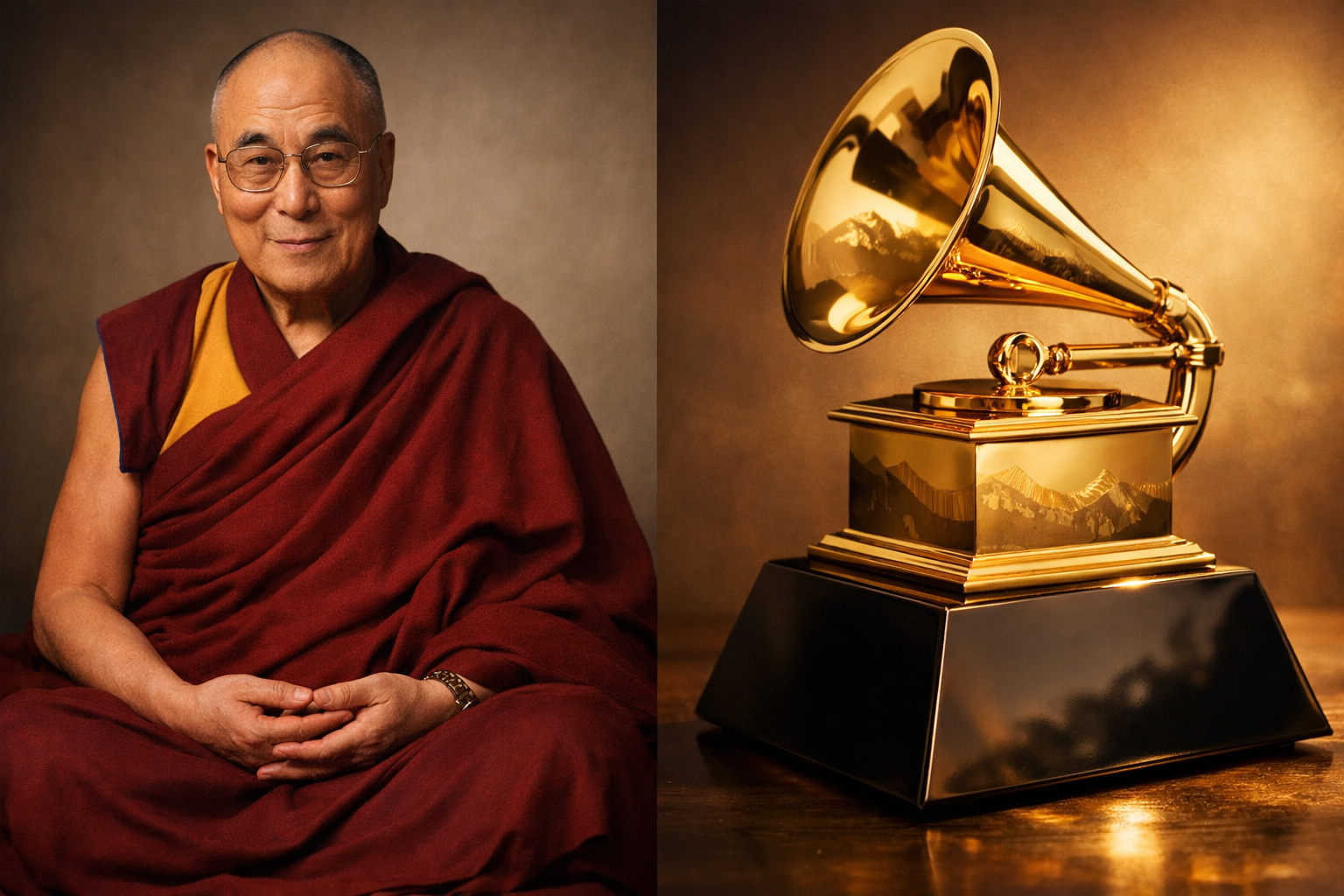
On the night of February 1, 2026, the Crypto.com Arena in Los Angeles was a temple of the secular and the spectacular. The air was thick with the scent of high-fashion leather and the electric hum of an industry built on the relentless cultivation of the “I”. As the 68th Annual Grammy Awards unfolded, the stage was dominated by the pyrotechnic defiance of Bad Bunny and the record-breaking rap dominance of Kendrick Lamar. But the most profound moment of the evening happened in the quietude of the Premiere Ceremony, where the Recording Academy delivered a stunning cultural pivot. Tenzin Gyatso, the 14th Dalai Lama, at the age of 90, was awarded his first Grammy for Best Audio Book, Narration & Storytelling Recording.
The win for his album, Meditations: The Reflections of His Holiness the Dalai Lama, created a jarring, necessary contrast. While the arena outside pulsed with the high-decibel egos of pop stardom, the Academy chose to honor a man who wasn’t even in the building—a nonagenarian monk living in exile in Dharamshala, accepting an award for an album fundamentally about ego-death and “universal responsibility”. Accepted on his behalf by musician Rufus Wainwright, who jokingly clarified, “I am not the Dalai Lama, obviously,” the victory felt less like a celebrity cameo and more like a gatecrashing of the Western zeitgeist by a veteran of spiritual warfare.
The Geopolitics of a Golden Gramophone
This victory is, of course, never just about the audio. In the high-stakes theater of Soft Power, a Grammy for the Dalai Lama is a subtle but unmistakable middle finger from the Western cultural establishment toward Beijing. For decades, the Chinese Communist Party has attempted to frame the spiritual leader as a “wolf in monk’s clothing,” a separatist relic of a bygone Tibet. The reaction from the Chinese Foreign Ministry was as swift as it was predictable: Spokesperson Lin Jian dismissed the award as a “tool for anti-China political manipulation”.
But as the Dalai Lama enters his 90th year, the stakes have shifted from historical grievance to a looming succession crisis. Beijing insists that his reincarnation “must be approved by the central government,” while the Dalai Lama maintains that his successor will emerge from a free country. By awarding him its highest honor, the Recording Academy has effectively granted the Dalai Lama a permanent digital megaphone. The win is a “diplomatic and spiritual validation” for the Tibetan diaspora, proving that while China may control the physical geography of the Himalayas, the spiritual and cultural narrative remains firmly with the man in the maroon robes.
The Sound of Peace
Meditations is far from a conventional spoken-word record. It is an immersive sonic environment where the Dalai Lama’s “calm, steady wisdom” is paired with a sophisticated musical landscape. This is spoken-word poetry stripped of pretension and replaced with biological urgency. In the track “Peace,” he argues that compassion is not a religious luxury but a “crucial factor for the survival of human beings”.
The album’s success is also a symptom of a broader Mindfulness Trend that has captured a fractured Gen Z. In an era of digital overload and “dystopian” political burnout, the Dalai Lama has emerged as an unlikely “science nerd” rockstar for a generation obsessed with authenticity. The project’s collaboration with artists like Maggie Rogers—who was recruited for her academic background in religion and public life at Harvard—ensures the album resonates as a serious intellectual exercise rather than a new-age gimmick.

The Sarod and the Sunyata: The Indian Connection
Perhaps the most overlooked element of this win is its status as a triumph for Indian classical tradition. The album features a masterful collaboration with Sarod maestro Amjad Ali Khan and his sons, Amaan and Ayaan Ali Bangash. The Amjad Ali Khan Collaboration provides the album’s skeletal structure; the sarod, a fretless instrument known for its ability to mimic the singing nuances of the human voice, creates a “sonic dialogue” with the Dalai Lama’s narration.
The Khans utilized specific ragas to deepen the philosophical impact of the teachings. In the track “Water,” the use of Raga Desh—a seasonal melody associated with the monsoon—underscores the leader’s reflections on the diminishing snows of his birthplace in Taktser, Tibet. This blending of Hindustani classical raga with Tibetan philosophy creates a “labor of love” that bridges two of the world’s most profound spiritual and musical lineages. It is a rare moment where the technical rigor of the Indian classical stage meets the global conscience of the Grammy platform.

A Legacy at Ninety
At 90 years old, the Dalai Lama is not merely a figure of history; he is a contemporary narrator using modern mediums to bypass diplomatic blockades. He beat out a field that included the biting wit of Trevor Noah and the judicial gravity of Justice Ketanji Brown Jackson, suggesting that in 2026, the world is hungrier for “universal responsibility” than for observational comedy.
His victory over Fab Morvan of Milli Vanilli—who was seeking his own redemption 35 years after the industry’s most infamous lip-syncing scandal—is particularly poetic. While Milli Vanilli represented the height of manufactured artifice, the Dalai Lama represents the absolute authenticity of the voice. As he noted in his post-win statement, the award is not a personal honor but a “recognition of the oneness of humanity”. In a loud, ego-driven arena, the Sound of the Sunyata (emptiness) proved, for one night, to be the loudest voice in the room.
READ OUR OTHER ARTICLES
- Know the Real Reason Behind Tarun Kumar’s Death Over a Holi Balloon
 The Holi festival turned tragic in southwest Delhi this year. On Wednesday, March 4, 2026, the narrow lanes of a JJ Colony in Uttam Nagar became the center of a … Read more
 - T20 World Cup Final 2026: India vs New Zealand
 The cricket world is getting ready for its biggest event. On Sunday, March 8, 2026, the T20 World Cup 2026 final will take place. The stage is set for a … Read more
 - 1,000-Year-Old Kakatiya Vishnu Idol Found in Telangana
 The quiet forests of the Jayashankar Bhupalpally district in Telangana recently gave up a secret they had been keeping for a thousand years. In March 2026, as the summer heat … Read more
 - Kerala Set to Manufacture BrahMos Missile on 180-Acre
 India’s plan to become self-reliant in defense took a major leap forward on March 2, 2026. On this day, the Kerala Cabinet made a historic decision to give 180 acres … Read more
 - Why Aman Gupta Chose His Birthday to Reveal OFF/BEAT ?
 On March 3, 2026, the Indian startup world saw a digital shift that was as much about legacy as it was about the future. Aman Gupta, the famous co-founder of … Read more