

The career of Palki Sharma Upadhyay has become a case study in the structural realignment of the Indian media sector. In an era where legacy brands once provided the only path to reach, Sharma has demonstrated that a singular personality can act as the primary distribution hub.
Career Timeline
| Phase | Platform | Key Strategic Milestone |
| The Rise (2017 – 2022) | WION | Creation of Gravitas; proving that an Indian lens can command a global, digital-first audience. |
| The Pivot (2023 – 2026) | Firstpost | Proving audience portability; scaling a legacy text portal into a video powerhouse with 673% growth. |
| The Ownership (2026+) | Independent Venture | Transitioning from high-priced employee to IP owner and media entrepreneur. |
The Brand Bigger than the Channel
The Network18 Resignation announced on January 29, 2026, was not a standard corporate exit; it was a declaration of independence. When Network18’s Santosh Menon confirmed Sharma’s departure during an internal town hall, he signaled the end of a transformative three-year tenure that saw Firstpost’s YouTube traffic explode. The industry is now witnessing a definitive trend: first at WION in 2022, and now at Firstpost in 2026, Palki Sharma has proven that the audience follows the individual, not the logo in the corner.
This move marks the “Anchor-as-Institution” era. For years, media houses held the leverage of satellite rights and studio infrastructure. However, in the current landscape, the anchor’s personal brand acts as the primary infrastructure. Sharma isn’t moving to a competitor like NDTV or India Today; she is betting on her own name. This transition confirms that the most valuable asset in modern news isn’t the broadcast license, but the trust and direct connection a creator maintains with millions of subscribers.
Owning the IP
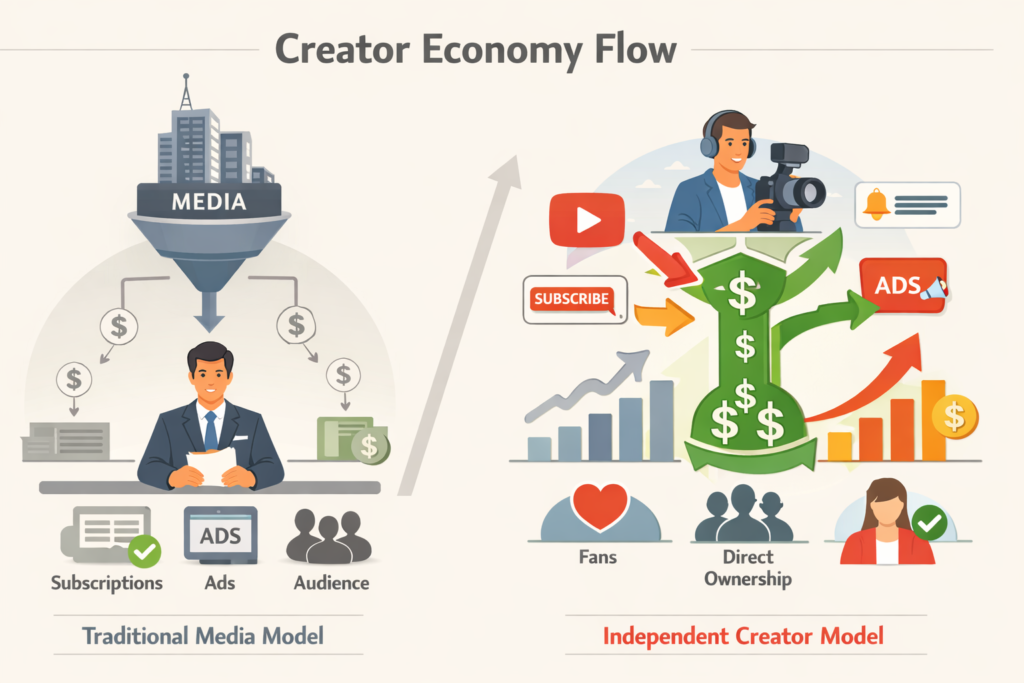
Why would a Managing Editor leave the security of a Reliance-owned conglomerate? The answer lies in the lucrative economics of the Creator Economy. Globally, figures like Tucker Carlson and Megyn Kelly have abandoned legacy networks to launch independent platforms where they own their Intellectual Property (IP). By utilizing firms like Red Seat Ventures for monetization, these “Creator-Journalists” retain a much higher percentage of revenue compared to the fixed salary of a legacy newsroom.
In India, the timing is perfect. The 2026 Union Budget has formally recognized the “Orange Economy,” providing significant policy support for digital creators. Sharma has reportedly already secured funding for her Independent Venture, a move that mirrors her previous entrepreneurial spirit seen with her 2016 saree brand, Reyva. With Firstpost’s YouTube daily revenue estimated to have crossed $25,000 during her peak broadcasts, the financial logic of owning her own distribution—rather than being a “high-priced tenant” for a corporate giant—is undeniable.
WION vs. Firstpost
The media industry is currently experiencing a sense of “WION Deja Vu.” When Sharma left WION in 2022, the channel was predicted to “lose its lustre” and struggle to retain its viewership backbone. Experts noted that the audience for Gravitas was specifically tied to Sharma’s “clutter-free” delivery and India-centric lens. WION’s subsequent struggle to fill that vacuum serves as a warning for Firstpost.
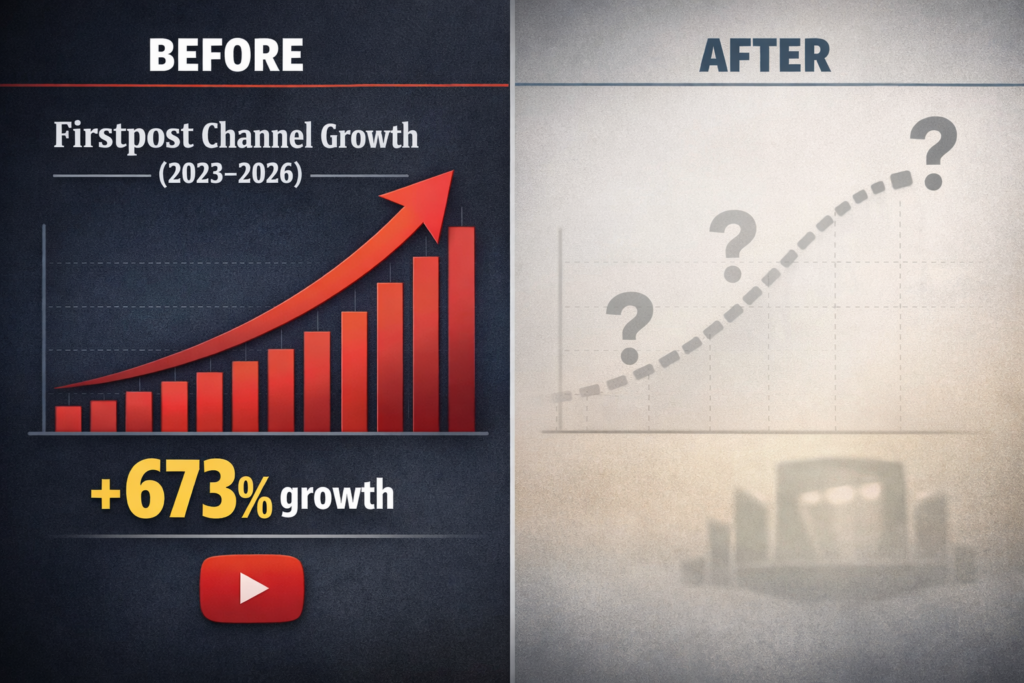
Firstpost now faces a similar Vantage Legacy void. Under Sharma, Vantage became a global brand, with over 60% of its traffic originating from overseas by late 2025. The show was the primary engine for the platform’s 9.22 million subscriber base. Can the show survive without her face? Historical data from Indian television suggests that “Personality-led” franchises rarely survive the exit of their central star. When an anchor’s delivery—described as “fearless yet measured”—is the product itself, the platform becomes secondary.
The Replacement Strategy
In a strategic pivot, Network18 has appointed Binoy Prabhakar as the Chief Content Officer (CCO) of Firstpost. Prabhakar, the former CCO of HT Digital and Editor of Moneycontrol, brings 25 years of editorial expertise, but he is fundamentally an editor, not a “face.” This appointment signals a shift back to a “product-first” digital strategy.
Prabhakar’s challenge is to navigate the “next phase” of the brand by focusing on technical optimization and diversified content. This may indicate that Firstpost is moving away from the “Star Anchor” model toward a more resilient, digital-first ecosystem that utilizes AI-led content and algorithmic disruption to drive traffic, rather than relying on a single individual’s charisma. While this reduces the risk of another high-profile exit, it remains to be seen if “product thinking” can replicate the explosive 673% growth driven by a celebrity journalist.
Predicting the New Venture
As Sharma stays with Network18 until March 2026 to ensure a transition, the industry is already speculating on the architecture of her new venture. Will it be a “Substack-style” subscription model for premium global intelligence, or a YouTube-first network?
Given that subscription and membership now account for 76% of publisher revenue focus, a hybrid model is most likely. She will likely launch a platform that combines free, high-reach YouTube commentary with a premium, tiered membership for exclusive geopolitical briefings. With the government’s push for the “WAVES” platform and the “Creator’s Corner” initiative, Sharma’s independent network could even seek collaboration with national broadcasters to leverage their reach while maintaining her editorial autonomy.
Ultimately, Palki Sharma’s exit is the final nail in the coffin of the idea that the “channel is the institution.” In 2026, the institution will be unbundled. The journalist is now the platform, the distributor, and the brand.
READ OUR OTHER ARTICLES
- Know the Real Reason Behind Tarun Kumar’s Death Over a Holi Balloon
 The Holi festival turned tragic in southwest Delhi this year. On Wednesday, March 4, 2026, the narrow lanes of a JJ Colony in Uttam Nagar became the center of a … Read more
 - T20 World Cup Final 2026: India vs New Zealand
 The cricket world is getting ready for its biggest event. On Sunday, March 8, 2026, the T20 World Cup 2026 final will take place. The stage is set for a … Read more
 - 1,000-Year-Old Kakatiya Vishnu Idol Found in Telangana
 The quiet forests of the Jayashankar Bhupalpally district in Telangana recently gave up a secret they had been keeping for a thousand years. In March 2026, as the summer heat … Read more
 - Kerala Set to Manufacture BrahMos Missile on 180-Acre
 India’s plan to become self-reliant in defense took a major leap forward on March 2, 2026. On this day, the Kerala Cabinet made a historic decision to give 180 acres … Read more
 - Why Aman Gupta Chose His Birthday to Reveal OFF/BEAT ?
 On March 3, 2026, the Indian startup world saw a digital shift that was as much about legacy as it was about the future. Aman Gupta, the famous co-founder of … Read more