

| Case Snapshot | |
| Petitioner | Mamata Banerjee (In Person) |
| Issue | Special Intensive Revision (SIR) / Voter Deletion |
| Accusation | “WhatsApp Commission” / Targeted Disenfranchisement |
| Status | Notice Issued; ECI response mandated by Feb 9, 2026 |
Theater in the Temple of Justice
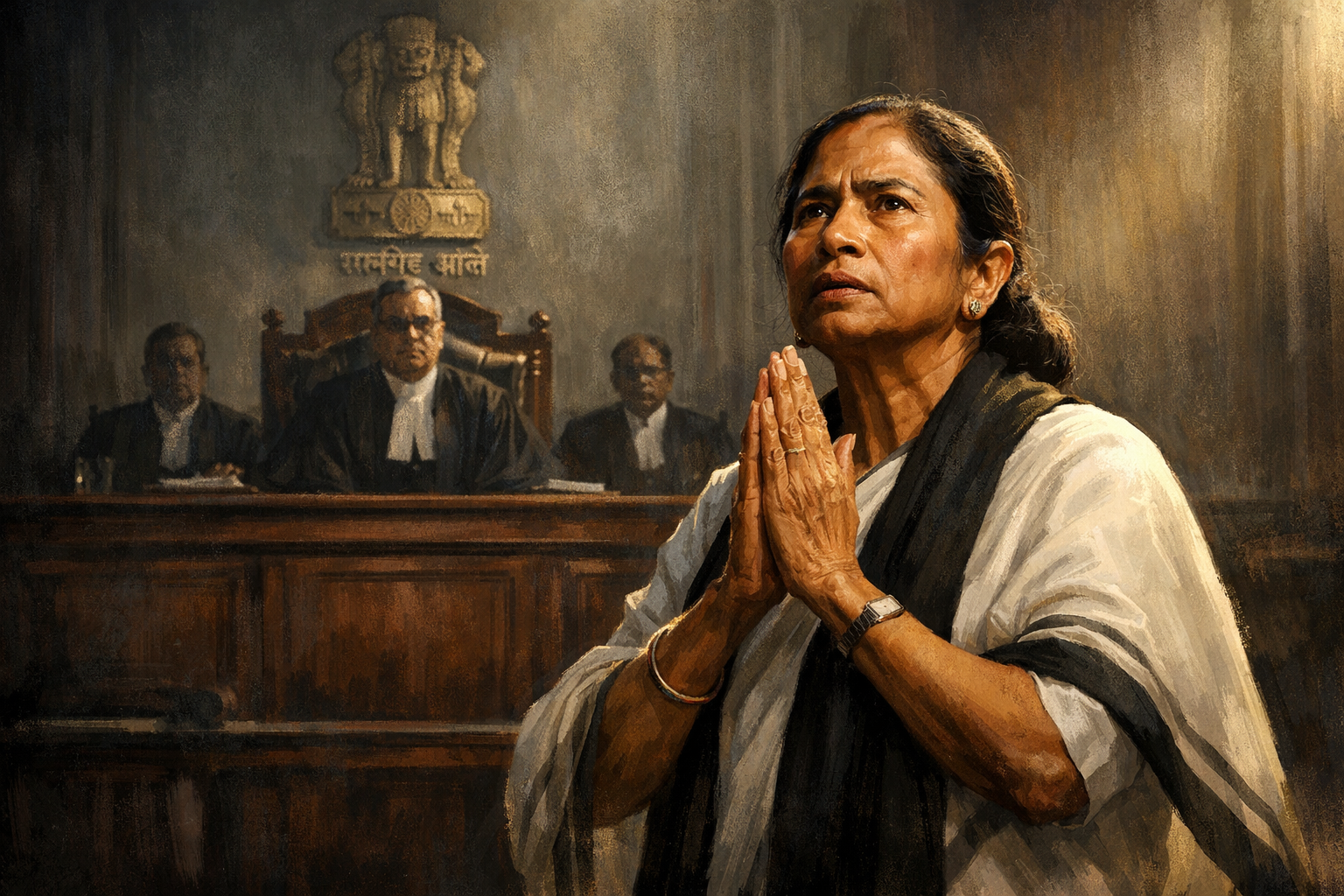
The Supreme Court of India is typically a bastion of dry procedural law and hushed Latinate arguments. But on February 4, 2026, the silence of Courtroom 1 was shattered by the arrival of a “street fighter” in a lawyer’s coat. West Bengal Chief Minister Mamata Banerjee, appearing in person, transformed the apex court into a theater of democratic survival. Clad in her signature white sari and a black scarf to shield against the Delhi winter, she did not wait for her senior counsel to speak. Instead, she folded her hands before Chief Justice Surya Kant and pleaded for the very breath of the republic. The visual was arresting: a sitting CM standing in the well of the court, not as a sovereign, but as a petitioner-in-person claiming her people were being erased. This was no mere legal dispute over paperwork; it was a high-stakes constitutional gambit aimed at stopping a “deletion drive” that she claims targets the heart of Bengal’s electorate.
The “Deletion” Conspiracy
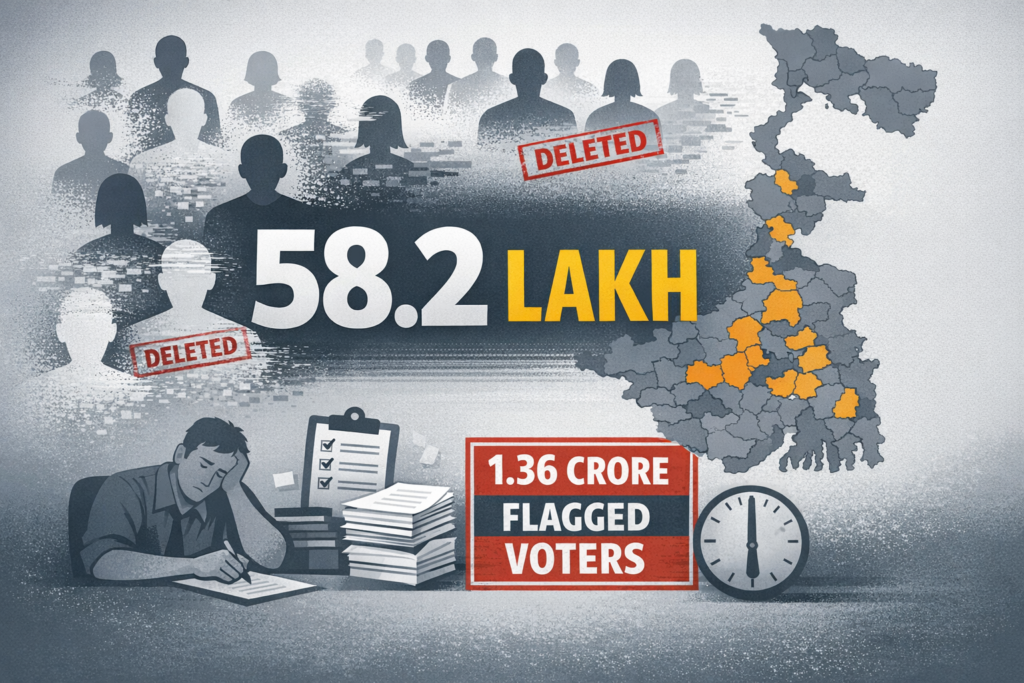
At the center of the storm is the Special Intensive Revision (SIR). While the Election Commission of India (ECI) frames it as a routine “cleanup” to ensure “clean” rolls, Banerjee presented it as a calculated purge. The numbers are staggering: 58.2 lakh names have already been struck from the draft rolls. The CM alleged a “deletion conspiracy” where 1.36 crore voters were flagged for “logical discrepancies,” often without the chance to defend their status under Form 6.
This exercise, compressed into three months during the peak of Bengal’s festival and harvest seasons, has allegedly led to administrative collapse and human tragedy. Banerjee informed a stunned bench that the workload stress was so immense that several booth-level officers (BLOs) had committed suicide. She questioned the selective nature of the intensity: “Why only Bengal? Why not Assam or the Northeast?” By targeting urban constituencies and migrant-heavy blocks, she argued, the ECI was acting as a “bulldozer” rather than a facilitator of the franchise.
Bureaucracy vs. the Citizen
The technical heart of the drama lies in the “Aadhaar trap.” Banerjee lashed out at the ECI for rejecting Aadhaar as a stand-alone proof of identity in Bengal, despite its acceptance elsewhere. In a visceral attack, she branded the ECI as the “WhatsApp Commission,” alleging that critical constitutional instructions were being bypassed through casual messaging apps rather than formal, legally authentic channels. This “casual communication,” she argued, reeked of arrogance and lacked legal legitimacy.
The absurdity of the bureaucratic process was laid bare when the Bench discussed the exclusion of genuine voters over minor phonetic mismatches. Chief Justice Surya Kant, in a moment of literary flair, noted the reported exclusion of poet Joy Goswami, remarking, “Tagore is Tagore, no matter how they spell his name”. The Court observed that name discrepancies often arise from an inability of officials to pronounce local languages—a failure that should not cost a citizen their vote. Banerjee further highlighted the plight of married women, whose names were being deleted simply because they changed their titles or shifted to their in-laws’ homes.

The Micro-Observer Controversy and Legal Outcome
The confrontation reached a fever pitch over the appointment of 8,300 “micro-observers,” whom Banerjee claimed were political operatives from BJP-ruled states sent to override local officials. “They are sitting in offices and deleting names,” she argued, claiming these observers lacked any statutory authority. The ECI’s counsel, Rakesh Dwivedi, countered that these appointments were a necessity because the Bengal government had failed to provide enough high-ranking officers for the task.
The day did not end in a total victory, but it forced the ECI into a corner. The Court issued a notice to the Commission and the Chief Electoral Officer, mandating a reply by February 9. Chief Justice Surya Kant offered a stern assurance: the ECI cannot “run away” from its obligation to ensure every genuine citizen is included. The Court directed the Commission to be “more careful and sensitive” in its notices, effectively putting the “WhatsApp Commission” on a short judicial leash.
Conclusion
Regardless of the final verdict, the optics of February 4 have already been won by the Chief Minister. By standing personally before the CJI, she framed the 2026 election not as a battle of parties, but as a battle for the very existence of the voter. Her plea—”I am not fighting for my party. Please protect democracy,”—resonated far beyond the courtroom walls. In the eyes of the public, she has successfully positioned herself as the lone warrior standing between her people and a faceless, digital-first bureaucracy. Whether the 58 lakh deleted voters find their way back to the ballot box remains to be seen, but the “SIR” showdown has ensured that the “WhatsApp Commission” will no longer operate in the shadows.
READ OUR OTHER ARTICLES
- Know the Real Reason Behind Tarun Kumar’s Death Over a Holi Balloon
 The Holi festival turned tragic in southwest Delhi this year. On Wednesday, March 4, 2026, the narrow lanes of a JJ Colony in Uttam Nagar became the center of a … Read more
 - T20 World Cup Final 2026: India vs New Zealand
 The cricket world is getting ready for its biggest event. On Sunday, March 8, 2026, the T20 World Cup 2026 final will take place. The stage is set for a … Read more
 - 1,000-Year-Old Kakatiya Vishnu Idol Found in Telangana
 The quiet forests of the Jayashankar Bhupalpally district in Telangana recently gave up a secret they had been keeping for a thousand years. In March 2026, as the summer heat … Read more
 - Kerala Set to Manufacture BrahMos Missile on 180-Acre
 India’s plan to become self-reliant in defense took a major leap forward on March 2, 2026. On this day, the Kerala Cabinet made a historic decision to give 180 acres … Read more
 - Why Aman Gupta Chose His Birthday to Reveal OFF/BEAT ?
 On March 3, 2026, the Indian startup world saw a digital shift that was as much about legacy as it was about the future. Aman Gupta, the famous co-founder of … Read more