

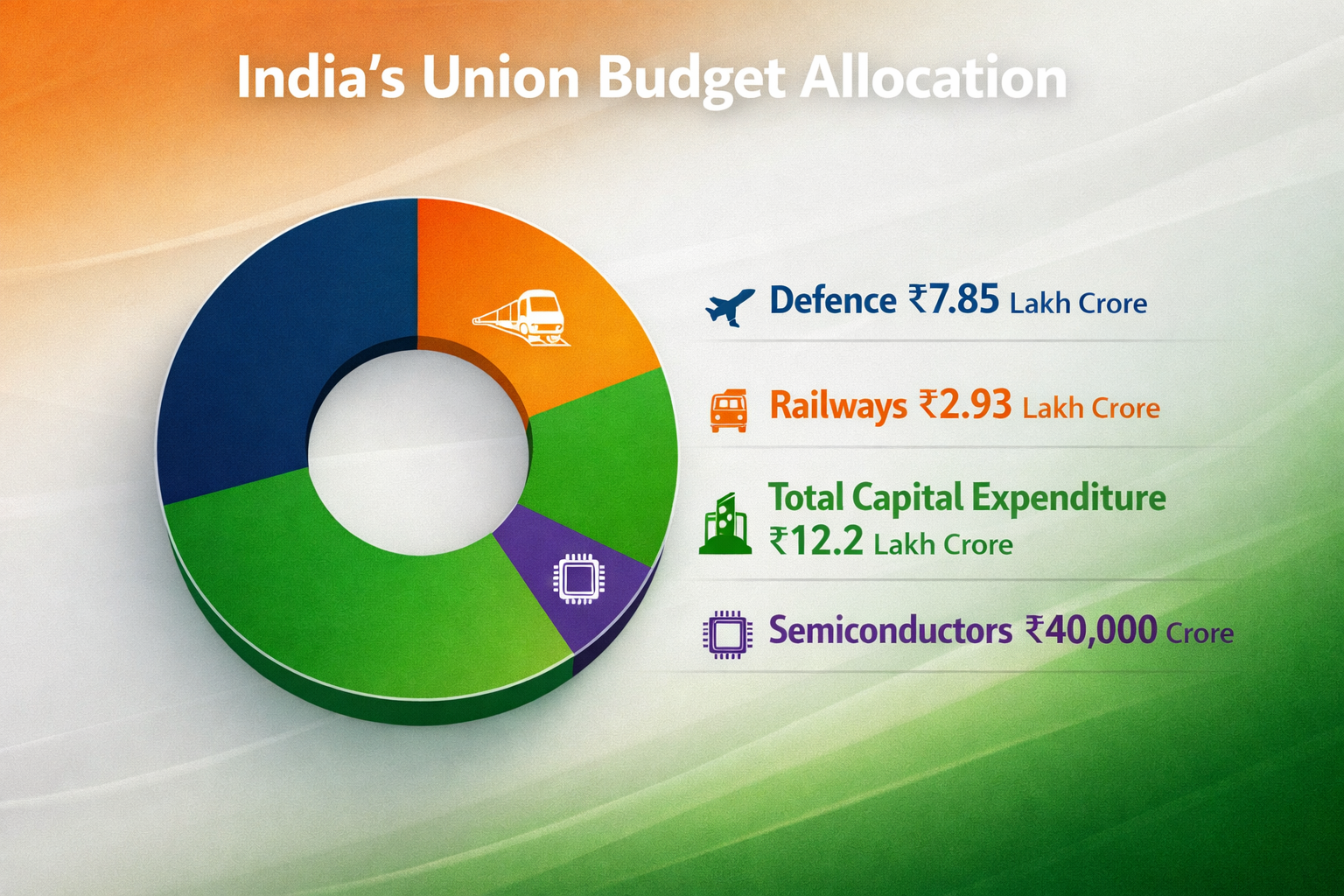
The Union Budget 2026-27 signals a definitive pivot from populist consumption support to an aggressive, state-led manufacturing and infrastructure cycle. With a total expenditure of ₹53.5 lakh crore, the government has ignored calls for tax slab cuts to double down on a record Capex of ₹12.2 lakh crore. This is a “build” budget designed for structural resilience, targeting a fiscal deficit of 4.3% while aiming to reduce the debt-to-GDP ratio to 55.6%. For high-net-worth investors, the thesis is clear: rotate capital out of speculative derivatives and into long-term assets aligned with India’s technological and security sovereignty.
Sector Scorecard
| Sector | Allocation Change | Key Stock Beneficiaries |
| Defence | +15.2% (₹7.85L Cr) | BEL, HAL, Mazagon Dock, Data Patterns |
| Railways | +10.5% (₹2.93L Cr) | RVNL, IRCON, Titagarh Rail, Jupiter Wagons |
| Biopharma | New (₹10,000 Cr) | Biocon, Sun Pharma, Neuland Labs |
| Semiconductors | +74% (₹40,000 Cr) | CG Power, Kaynes Tech, Tata Electronics |
| Agriculture | -23% (Crop Insurance) | Dhanuka Agritech, Coromandel Intl |
| Broking / F&O | STT Hike | Angel One, BSE, MCX (Near-term pressure) |
The Macro Engine: Fiscal Prudence Meets Capex Multiplier
The budget targets a nominal GDP growth of 10%, banking on the “crowding in” of private investment via the ₹12.2 lakh crore public capex thrust. By maintaining a disciplined glide path to a 4.3% deficit, the government is securing India’s sovereign credit profile, which is critical for HNI portfolios sensitive to bond yields and currency stability. The strategy is unsentimental: the state is building the capacity for a $10 trillion economy by 2030, even if it means short-term pain for retail consumption.
Sector A: Infrastructure & Rail—The High-Speed Pivot
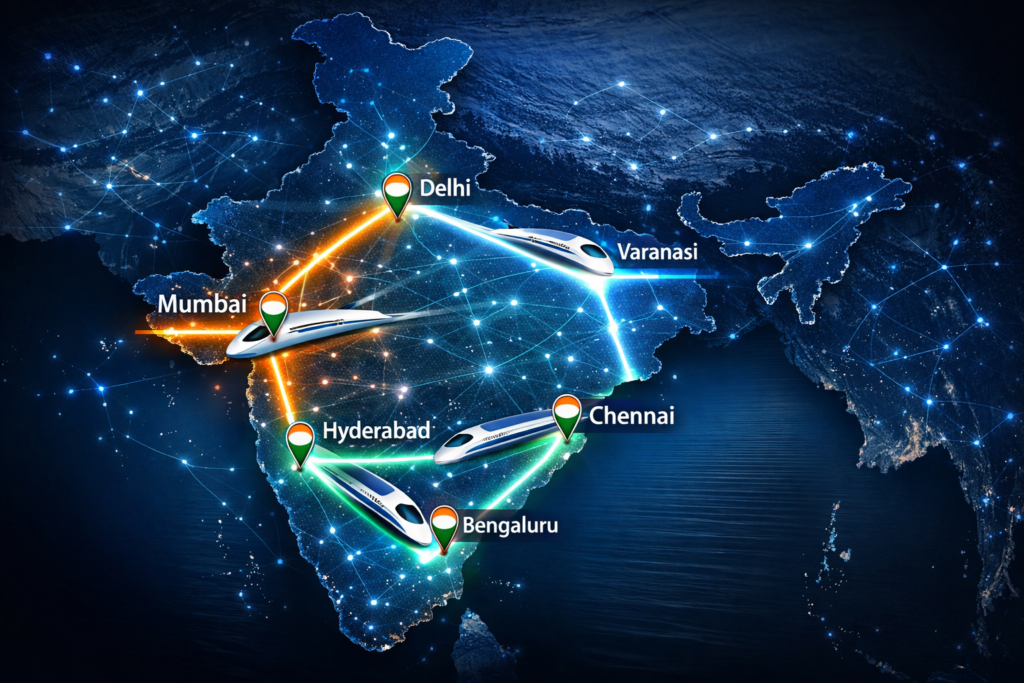
The Ministry of Railways has secured a record ₹2.93 Lakh Crore capex to transform India’s logistics map. The headline move is the announcement of 7 New High-Speed Rail Corridors (including Mumbai-Pune, Delhi-Varanasi, and the “South Triangle” connecting Chennai-Bengaluru-Hyderabad). These corridors are envisioned as “growth connectors,” expected to attract ₹16 lakh crore in total investment over their lifecycle.
This shift is a direct challenge to air travel for inter-city transit. For investors, the beneficiaries extend beyond EPC contractors to rolling stock manufacturers and signalling giants. The focus on Tier-2 connectivity and the new Dedicated Freight Corridor (Surat to Dankuni) creates a multi-year tailwind for industrial logistics and cement demand.
Sector B: Defence—The “Operation Sindoor” Paradigm
Following the security environment shaped by Operation Sindoor (the May 2025 confrontation), the Defence budget has jumped to an unprecedented ₹7.85 Lakh Crore. This is a “war-ready” allocation, with a 22% hike in capital outlay for new fighter jets, drones, and naval assets.
Key “Alpha” triggers include:
- The Rafale Pivot: Finalizing the ₹3.25 lakh crore deal for 114 jets, with a mandate for 60% indigenous manufacturing.
- AIP Submarines: The $8 billion P75I deal with Germany’s TKMS and Mazagon Dock (MDL).
- The Autonomy Stack: Deployment of weaponized unmanned fast interceptor crafts and next-gen drones.
The shift to Aatmanirbharta in deep-tech defence means the “buy” call moves from simple assembly to high-end electronics and sensor providers.
Sector C: Healthcare & Biopharma—The New Gold
A major strategic shift is the launch of the Biopharma SHAKTI scheme with a ₹10,000 crore outlay. This marks a transition from hospital-centric spending to “biologics manufacturing,” positioning India as a global alternative to China in complex drug production. By creating 1,000 accredited clinical trial sites and upgrading NIPERs, the government is incentivizing Research-led Manufacturing (CRDMOs).

The “Hidden Fine Print” and Market Shock
The biggest intraday negative for the markets was the STT Hike on Futures and Options. STT on futures rose to 0.05% (from 0.02%), and on options premiums to 0.15% (from 0.10%). This “speculation tax” triggered a 1,500-point Sensex crash, signaling the government’s discomfort with retail derivative frenzy.
Conversely, the budget hid a massive win for Digital Infrastructure: a Tax Holiday until 2047 for foreign cloud companies using Indian data centers. Combined with the GCC Safe Harbor threshold hike to ₹2,000 crore, this secures India as the global digital backbone.
Agriculture: The Critical Cut
Amidst the high-tech rhetoric, the budget quietly cut the PMFBY (Crop Insurance) allocation to ₹12,200 crore—the lowest in eight years. The state is pivoting away from insurance payouts toward technology-led risk mitigation. This is evidenced by the launch of Bharat-VISTAAR, a ₹150 crore AI tool that integrates AgriStack with ICAR research to provide real-time, precision-farming advisories.
The Investor’s Playbook
The clear mandate of Budget 2026 is to reward long-term equity builders while penalizing high-frequency churn.
- Overweight: Defence electronics, High-Speed Rail contractors, Biopharma CRDMOs, and Data Center operators.
- Underweight: Traditional Crop Insurance providers and retail-heavy brokerage firms are exposed to F&O volume contraction.
- The Alpha Play: Accumulate leaders in the “South High-Speed Triangle” and entities benefiting from the 2047 Cloud Tax Holiday.
READ OUR OTHER ARTICLES
- Know the Real Reason Behind Tarun Kumar’s Death Over a Holi Balloon
 The Holi festival turned tragic in southwest Delhi this year. On Wednesday, March 4, 2026, the narrow lanes of a JJ Colony in Uttam Nagar became the center of a … Read more
 - T20 World Cup Final 2026: India vs New Zealand
 The cricket world is getting ready for its biggest event. On Sunday, March 8, 2026, the T20 World Cup 2026 final will take place. The stage is set for a … Read more
 - 1,000-Year-Old Kakatiya Vishnu Idol Found in Telangana
 The quiet forests of the Jayashankar Bhupalpally district in Telangana recently gave up a secret they had been keeping for a thousand years. In March 2026, as the summer heat … Read more
 - Kerala Set to Manufacture BrahMos Missile on 180-Acre
 India’s plan to become self-reliant in defense took a major leap forward on March 2, 2026. On this day, the Kerala Cabinet made a historic decision to give 180 acres … Read more
 - Why Aman Gupta Chose His Birthday to Reveal OFF/BEAT ?
 On March 3, 2026, the Indian startup world saw a digital shift that was as much about legacy as it was about the future. Aman Gupta, the famous co-founder of … Read more