


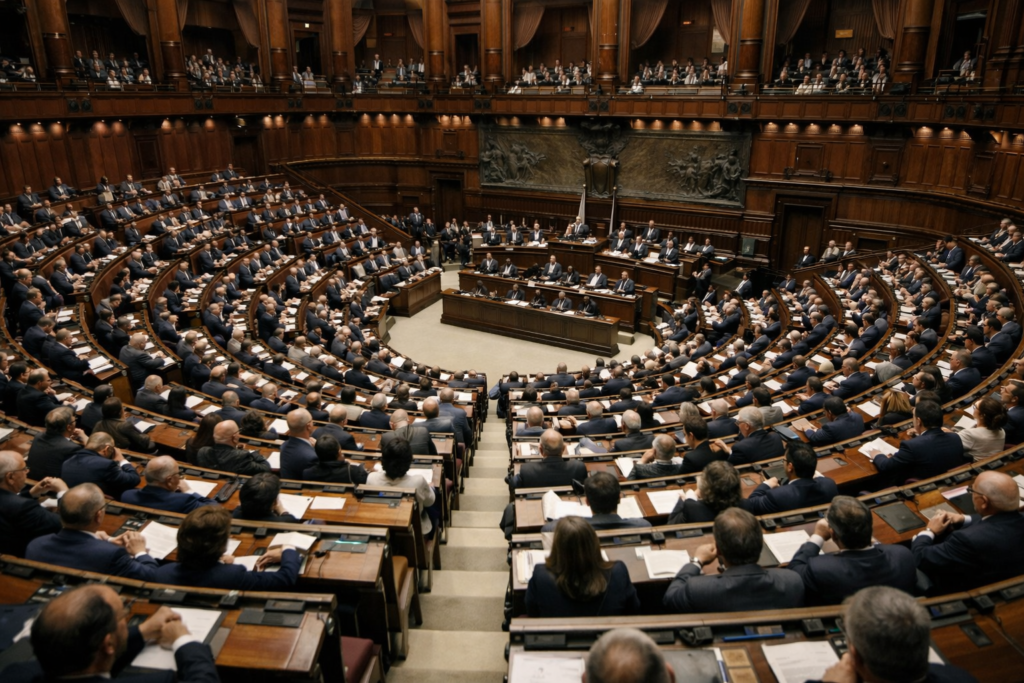
The Italian Parliament has taken a decisive and controversial step toward integrating medical intervention into its penal code for sexual crimes. In a move championed by Deputy Prime Minister Matteo Salvini and his League (Lega) party, the Chamber of Deputies has voted to establish a technical committee tasked with drafting legislation that would introduce chemical castration for convicted rapists and pedophiles.
While the government describes the initiative as a pragmatic solution to a heinous societal problem, legal experts and opposition leaders are branding it a “populist manifesto” that risks violating the Italian Constitution. The vote marks a significant victory for the League, which has campaigned on this issue for years, transforming a fringe punitive theory into a tangible legislative agenda.
The News Hook: A Committee for “Zero Tolerance”
The recent parliamentary vote does not immediately legalize the practice but sets the legislative wheels in motion. The newly formed technical committee acts as a bridge between political intent and medical reality. Its mandate is to evaluate the feasibility, safety, and legal framework required to administer androgen-blocking drugs to prisoners.
For Matteo Salvini, this is the fulfillment of a long-standing campaign promise. Following a series of high-profile sexual assault cases that shocked the Italian public, the League accelerated its push for what it terms “zero tolerance.” The committee’s goal is explicit: to produce a bill that offers chemical castration not merely as a medical option, but as a judicial tool to prevent recidivism. While Prime Minister Giorgia Meloni’s Brothers of Italy (Fratelli d’Italia) has historically been more cautious than their coalition partner on this specific issue, the coalition voted in unison to advance the study, signaling a unified right-wing front on law and order.
The Proposal: How Would It Work?
The mechanism under review involves “chemical castration,” a misleadingly permanent-sounding term for a reversible medical treatment. It involves the administration of drugs (such as medroxyprogesterone acetate or cyproterone acetate) that reduce the production of testosterone, thereby diminishing the sex drive and erectile function. Unlike surgical castration, the physical effects generally cease once the treatment is stopped.
The core of the Italian proposal relies on a “voluntary” framework. To bypass potential constitutional hurdles regarding bodily integrity, the legislation is expected to offer the treatment as a bargain: convicted offenders could opt for the therapy in exchange for suspended sentences, house arrest, or early parole.
However, the medical reality is complex. The treatment requires regular injections or pills and carries significant side effects, including osteoporosis, weight gain, and cardiovascular risks. Furthermore, the committee must grapple with the psychiatric dimension; medical consensus suggests that sexual violence is often driven by power dynamics and antisocial personality disorders, not solely by libido. Therefore, the proposal will likely need to pair hormonal suppression with mandatory psychotherapy, creating a costly and complex rehabilitation regime.

The Supporters’ Argument: Safety and “Cure”
The government’s case is built on two pillars: public safety and the pathologization of the offender. Supporters argue that sexual predators, particularly pedophiles, suffer from a compulsive biological urge that imprisonment alone cannot “correct.”
“If a rapist is sick, we treat them. If they are not sick, we punish them. But we must stop them,” Salvini has argued in various press appearances. The League contends that the recidivism rate for sexual offenses is unacceptably high and that the state has a moral duty to use every tool available—including pharmacology—to protect women and children.
From this perspective, the measure is humanitarian for potential future victims. Supporters point to data from countries with similar programs, arguing that testosterone suppression provides offenders with a “biological brake” that allows them to control impulses they otherwise cannot. By framing the treatment as voluntary, the government argues it is empowering the prisoner to choose rehabilitation over incarceration.
The Critics’ Argument: “State Barbarism” and Coercion
The opposition, led by the Democratic Party (PD) and the Green-Left Alliance, views the proposal as a dangerous erosion of human rights. The central critique is that a choice made by a prisoner desperate for freedom is not a choice at all—it is state coercion.
“This is not justice; it is state barbarism,” declared members of the opposition during the chamber debate. Legal scholars warn the measure likely violates Article 32 of the Italian Constitution, which forbids mandatory health treatments unless required by law for public interest, and Article 27, which mandates that punishment cannot be inhumane.
Critics also attack the scientific premise. They argue that chemical castration treats the symptom (physical arousal) rather than the cause (violence and desire for dominance). There is a fear that the state is offering a “technological fix” for a complex social problem. If an offender’s testosterone is lowered but their violent misogyny remains untreated, they may simply resort to other forms of violence. Furthermore, opponents accuse the government of using the bodies of prisoners to score easy political points, creating a “security theatre” that sounds tough but fails to address the roots of gender-based violence.
International Context: A European Outlier?
If Italy proceeds, it will join a complex patchwork of nations utilizing similar measures, though the context matters immensely.
- Poland and Russia: Both nations have laws allowing for mandatory or heavily coerced chemical castration for pedophiles and rapists, often cited by critics as examples of authoritarian penal populism.
- Western Europe: Countries like Germany, the UK, and Sweden do offer libido-suppressing medication, but the context is radically different. In these nations, the treatment is strictly therapeutic, clinically driven, and divorced from the direct political bargaining of “treatment for freedom” that the Italian right is proposing.
Italy’s move appears to be shifting the country closer to the Polish model, where the treatment is integrated into the penal code as a condition of release, rather than the German model, where it is a quiet, patient-led psychiatric tool.
READ OUR OTHER ARTICLES
- T20 World Cup Final 2026: India vs New Zealand
 The cricket world is getting ready for its biggest event. On Sunday, March 8, 2026, the T20 World Cup 2026 final will take place. The stage is set for a … Read more
 - 1,000-Year-Old Kakatiya Vishnu Idol Found in Telangana
 The quiet forests of the Jayashankar Bhupalpally district in Telangana recently gave up a secret they had been keeping for a thousand years. In March 2026, as the summer heat … Read more
 - Kerala Set to Manufacture BrahMos Missile on 180-Acre
 India’s plan to become self-reliant in defense took a major leap forward on March 2, 2026. On this day, the Kerala Cabinet made a historic decision to give 180 acres … Read more
 - Why Aman Gupta Chose His Birthday to Reveal OFF/BEAT ?
 On March 3, 2026, the Indian startup world saw a digital shift that was as much about legacy as it was about the future. Aman Gupta, the famous co-founder of … Read more
 - Who’s Behind ViRosh’s Wedding Jewelry & Outfits?
 For a long time, celebrity weddings in India seemed to follow a very specific script. We saw a sea of pastel colors, minimalist decor, and a focus on what would … Read more