

A Morning That Ends a Half-Century Silence
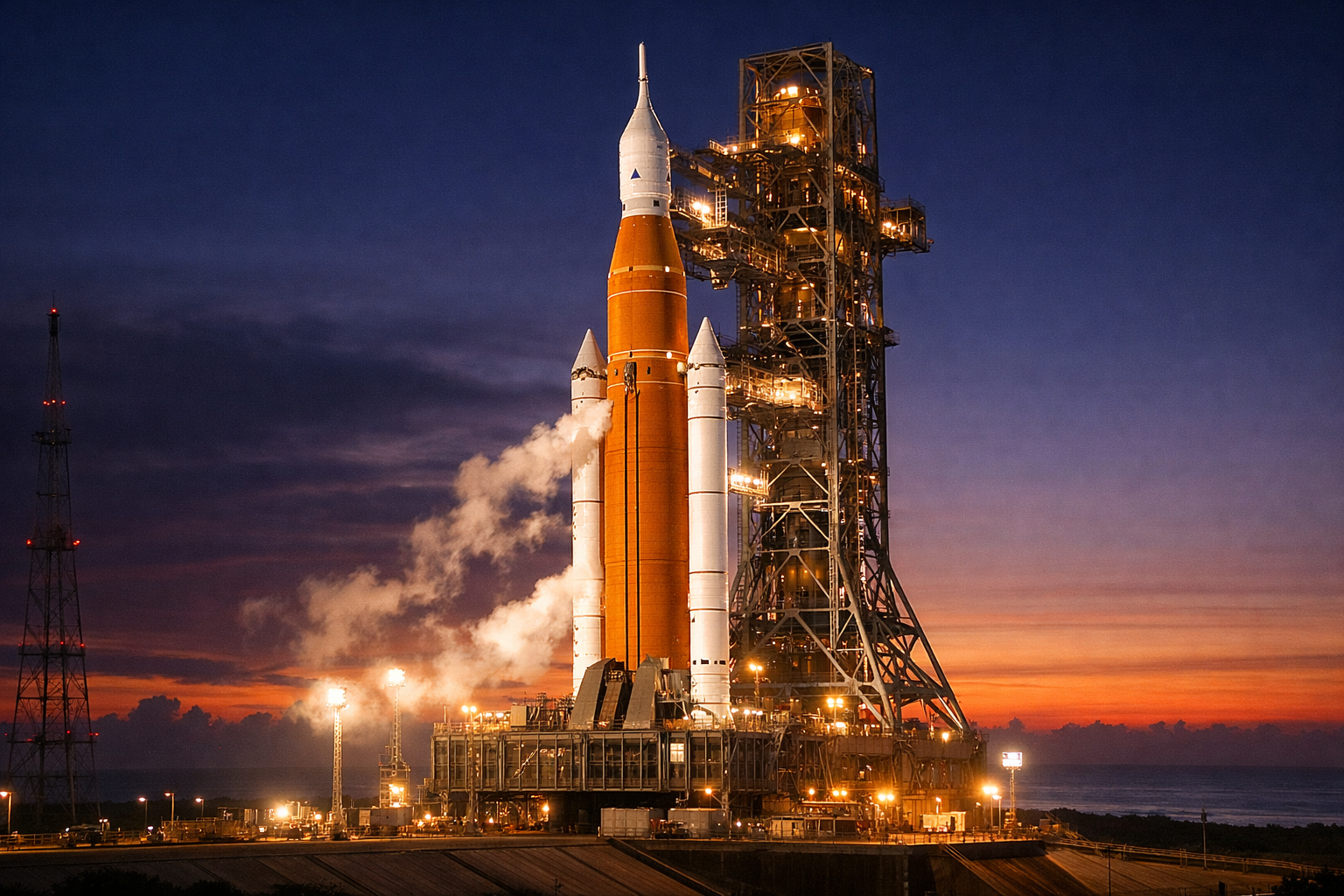
On the morning of February 8, 2026, the salt-heavy air of Florida’s Space Coast carries a weight that cannot be measured by barometers alone. At Kennedy Space Center, Launch Complex 39B—a site that once served as the gateway to the heavens during the Apollo era—now cradles a monolithic 322-foot-tall titan: the Space Launch System (SLS). Encased in its signature orange foam, the core stage is a vertical reservoir containing over 700,000 gallons of super-cooled liquid hydrogen and liquid oxygen. The silence surrounding the pad is the held breath of a civilization that has spent 54 years confined to the shallow waters of Low Earth Orbit (LEO). This morning, that silence will be shattered by 8.8×10⁶ pounds of thrust, an artificial sun igniting to end a drought of deep-space exploration that has persisted since 1972.
Inside the Orion capsule, christened Integrity, four individuals wait. They are the physical manifestation of humanity’s return to the lunar sphere. Since the departure of the Apollo 17 crew from the lunar surface, no human has ventured more than 400 miles from the Earth’s crust. Today, the Artemis II crew will embark on a 10-day odyssey that will take them 230,000 miles into the void, looping around the far side of the Moon on a high-altitude slingshot that will send them further into the deep black than any human has ever gone before.
Reflections on the 54-Year Gap
The shadow of Apollo looms large over the Artemis program—a ghost that both inspires and haunts the halls of NASA. To understand the significance of this launch, one must reflect on why it took five decades to return to the lunar vicinity. When Gene Cernan stepped off the Moon in December 1972, the expectation was a permanent settlement. Instead, the geopolitical landscape shifted. The intense pressure of the Cold War space race dissipated, and national prestige became tied to the utility of the Space Shuttle and the collaborative diplomacy of the International Space Station.
During the intervening 54 years, humanity’s vision contracted to the limits of LEO. This period was characterized by budget-conscious incrementalism and shifting political mandates. Artemis II is the triumphant rejection of this confinement. It represents a pivot from “visiting” the Moon to “staying” near it, utilizing technologies that were unimaginable in the 1970s. While the 1968 Apollo 8 mission was a “Hail Mary” to beat a rival, Artemis II is a methodical validation of a complex, international architecture designed for the long term. The gap was not a failure of will, but a necessary maturation of strategy.
The Mission Reality
It is crucial to clarify that Artemis II will not land on the Moon. This is a lunar flyby, a 10-day test flight designed to push the Orion capsule and its life-support systems to their limits before the landing attempt of Artemis III. The mission utilizes a “Free-Return Trajectory,” a mathematical masterpiece of orbital mechanics that uses the combined gravity of the Earth and Moon to create a figure-eight loop.
The beauty of the free-return path lies in its inherent safety: even if the service module’s main engine were to fail, the gravity of the Moon would naturally pull the ship around and slingshot it back toward Earth. This trajectory will take the crew approximately 6,400 miles beyond the lunar far side, reaching a maximum distance from Earth of roughly 257,000 miles—breaking the all-time human distance record set by Apollo 13.
The Crew: The Faces of a New Era
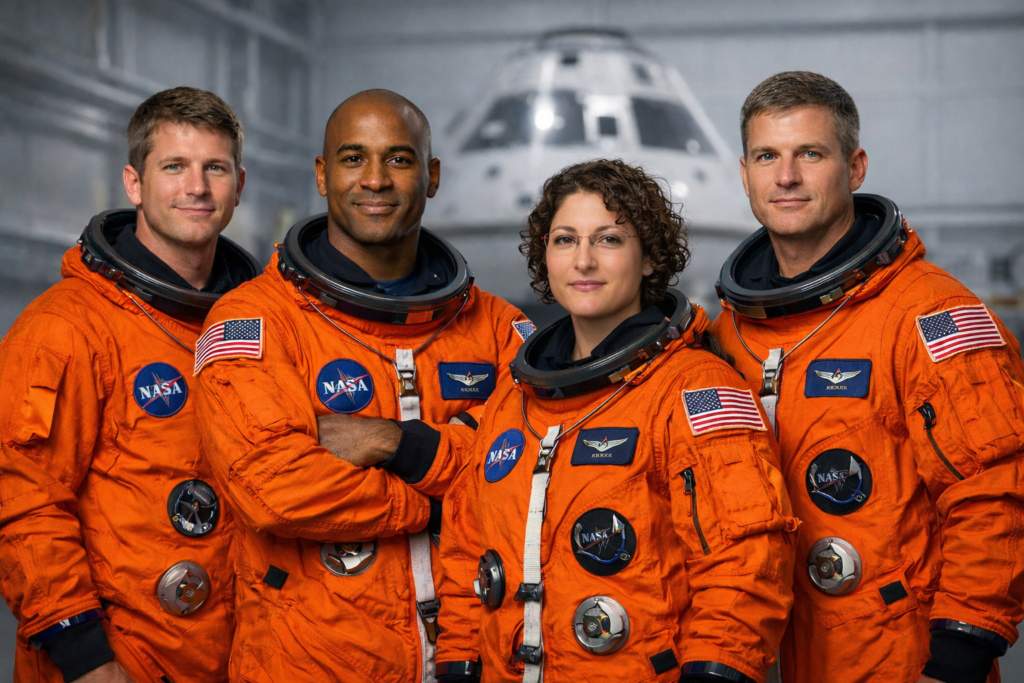
The Artemis II crew reflects the diversity and international spirit of the 21st century. Commander Reid Wiseman, a Navy test pilot, provides the steady hand required to lead humanity’s first deep-space mission in half a century. Pilot Victor Glover will make history as the first person of color to leave LEO, responsible for navigating Orion’s digital “glass cockpit”. Mission Specialist Christina Koch, who holds the record for the longest single spaceflight by a woman, becomes the first woman to venture into the deep void. Finally, Mission Specialist Jeremy Hansen of the Canadian Space Agency becomes the first non-American to participate in a lunar mission—a signal that the era of nationalist races has evolved into global cooperation.
The View from the Far Side
The most evocative moment of the mission will occur on Day 6, when Orion swings behind the Moon. For 45 minutes, the lunar mass will block all radio contact with Earth. In this profound isolation, the crew will lose the umbilical of communication—the psychological peak of the mission.
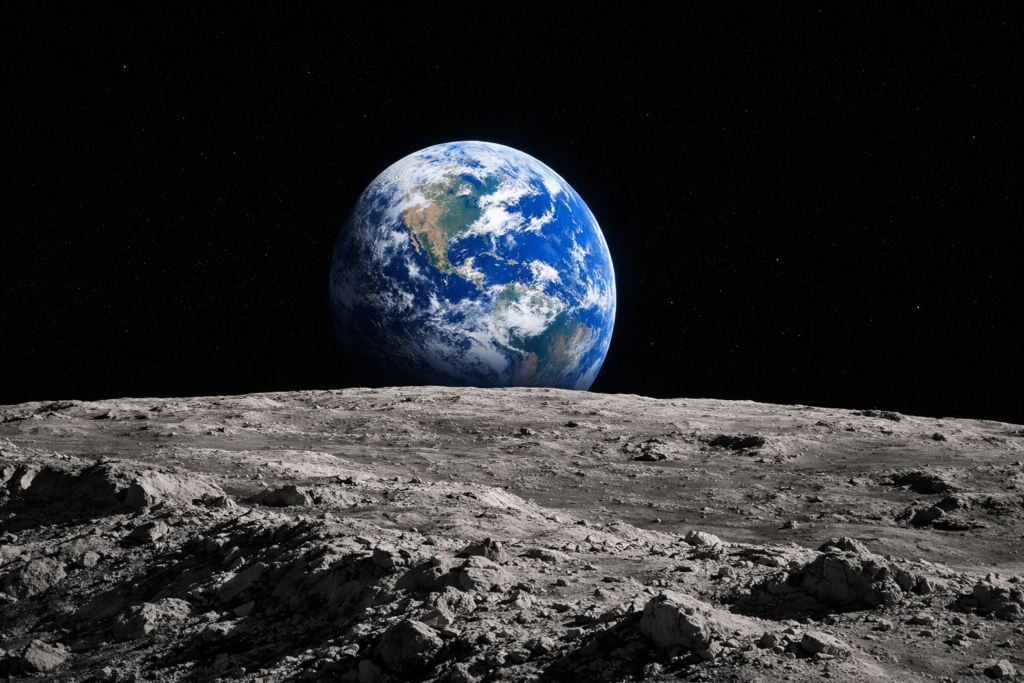
Because the launch is timed for early February, the lunar far side will be bathed in full sunlight, offering a rare view of the “hidden” hemisphere. From an altitude of 4,000 to 6,000 miles, the Moon will appear roughly the size of a “basketball held at arm’s length”. The crew may be the first to directly observe the Orientale Basin—a spectacular 600-mile-wide multi-ringed impact feature. As they emerge from the blackout, the crew will witness a brilliant “Earthrise” over the barren horizon, a view that reinforces the fragility of our home.
The Canadian Twist
The inclusion of Jeremy Hansen is a recognition of Canada’s essential role, specifically its contribution of the Canadarm3 for the future Lunar Gateway. This marks the end of Cold War competition. Today, the Artemis program is built on the Artemis Accords—international agreements promoting transparency and shared goals. Hansen’s journey from a pilot in Ontario to a lunar voyager symbolizes a coalition that understands the strategic importance of a sustained presence beyond Earth’s orbit.
Conclusion
Artemis II is the essential proof that the ship works. It is the final “exam” for the SLS and Orion before we entrust them with the astronauts who will walk on the lunar South Pole during Artemis III. By breaking the “LEO Curse,” Artemis II restores humanity’s identity as a multi-planetary species. As the four astronauts look back at the Earth from 250,000 miles away, they will lead us toward a future where we do not just visit the heavens, but stay. February 8, 2026, is the first day of the rest of human history.
READ OUR OTHER ARTICLES
- T20 World Cup Final 2026: India vs New Zealand
 The cricket world is getting ready for its biggest event. On Sunday, March 8, 2026, the T20 World Cup 2026 final will take place. The stage is set for a … Read more
 - 1,000-Year-Old Kakatiya Vishnu Idol Found in Telangana
 The quiet forests of the Jayashankar Bhupalpally district in Telangana recently gave up a secret they had been keeping for a thousand years. In March 2026, as the summer heat … Read more
 - Kerala Set to Manufacture BrahMos Missile on 180-Acre
 India’s plan to become self-reliant in defense took a major leap forward on March 2, 2026. On this day, the Kerala Cabinet made a historic decision to give 180 acres … Read more
 - Why Aman Gupta Chose His Birthday to Reveal OFF/BEAT ?
 On March 3, 2026, the Indian startup world saw a digital shift that was as much about legacy as it was about the future. Aman Gupta, the famous co-founder of … Read more
 - Who’s Behind ViRosh’s Wedding Jewelry & Outfits?
 For a long time, celebrity weddings in India seemed to follow a very specific script. We saw a sea of pastel colors, minimalist decor, and a focus on what would … Read more