

On February 23, 2026, the Ministry of Home Affairs MHA fundamentally altered India’s internal security landscape by releasing its first-ever consolidated National Counter-Terrorism Policy and Strategy, titled ‘PRAHAAR’. For years, India’s counter-terror efforts were guided by various laws and tactical procedures, but never by a single, written public doctrine. This eight-page document marks a historic transition from a reactive “defense” mindset to a proactive, “intelligence-guided” framework. By formalizing this strategy, the government has set a clear “zero-tolerance” benchmark, signaling that the dismantle-and-disrupt approach is now the official national standard.
The Framework
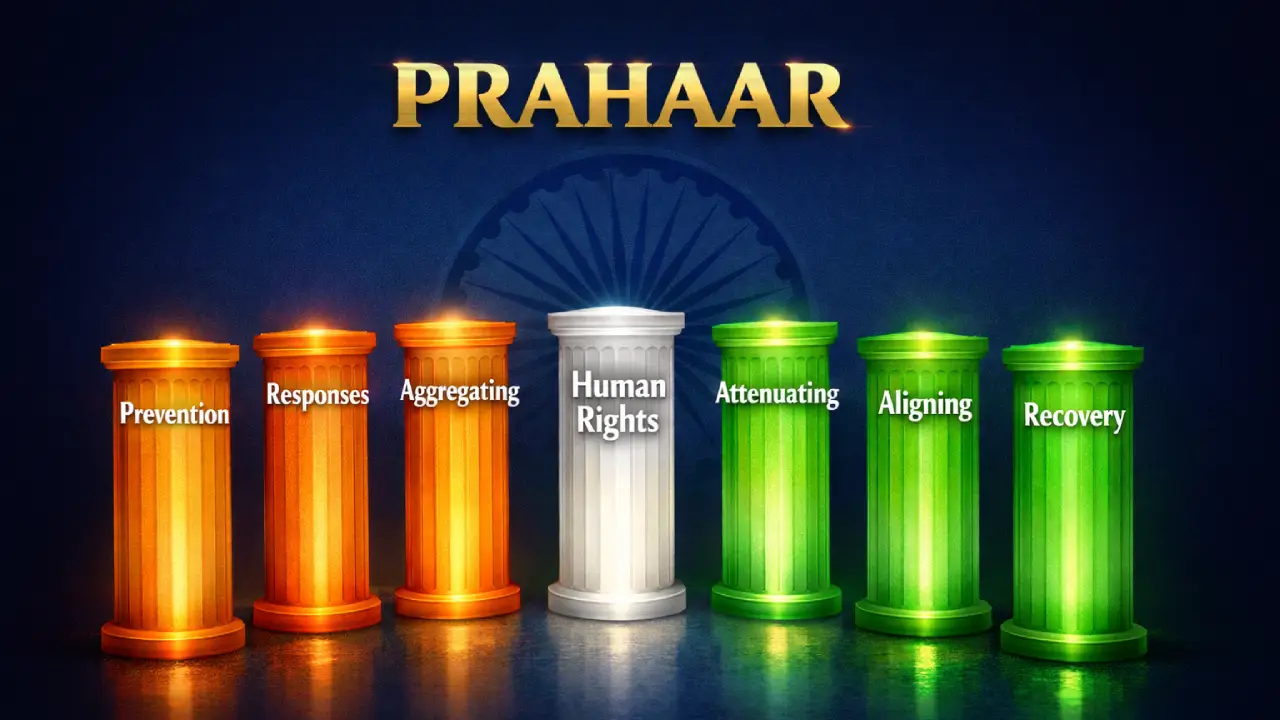
The PRAHAAR anti-terror policy is built upon seven core pillars, with the acronym itself standing for: Prevention, Responses, Aggregating internal capacities, Human rights, Attenuating enabling conditions, Aligning international efforts, and Recovery. This framework is not just a list of goals; it is a “whole-of-government” playbook designed to synchronize every arm of the state—from the local beat constable to the highest intelligence officer in New Delhi.
At the heart of this doctrine is the shift toward an “intelligence-led” model. The policy gives primacy to the Multi-Agency Centre (MAC) and the Joint Task Force on Intelligence (JTFI), both functioning under the Intelligence Bureau (IB). These units serve as the primary nodal platforms for real-time data sharing across the country. The logic is simple: preventing an attack is far more effective than responding to one. By aggregating information from state and central agencies, the MAC aims to spot and stop terror modules before they can act.
The policy also addresses the historical problem of unequal resources between different state police forces. Under the pillar of “Aggregating Internal Capacities,” the MHA plans to modernize law enforcement agencies with advanced tools and standardized training. This ensures that whether a threat appears in a major metro or a remote village, the response is swift, uniform, and professionally coordinated.
Drones, Dark Web, and Modern Battlefield
One of the most critical sections of the doctrine focuses on the “Tech-Terror Nexus”. The MHA explicitly warns that the character of warfare is changing, with terrorists increasingly using technology to bypass physical borders. This is particularly evident in the growing cross-border drone threat.
In states like Punjab and Jammu and Kashmir, handlers from across the border are frequently using drones and robotics for “lethal purposes”. These unmanned systems are used to smuggle weapons, explosives, and narcotics—the profits of which fuel local terror cells. To counter this, India has developed a multi-layered defense that includes vulnerability mapping of the borders, the deployment of anti-drone sensors, and the creation of “depth nakas” (checkpoints) to catch those receiving drone payloads.
Beyond the physical threat of drones, the PRAHAAR policy highlights the “digital front” of terrorism. Terrorist groups are now utilizing the “cloak of invisibility” offered by encrypted messaging apps, the dark web, and crypto-wallets to move money and coordinate attacks anonymously. The policy classifies these as part of the “CBRNED” (Chemical, Biological, Radiological, Nuclear, Explosive, and Digital) threat category, treating a major cyber-attack on the national power grid or railways with the same gravity as a traditional bombing.

The “Whole-of-Society” Approach
Perhaps the most nuanced part of the PRAHAAR doctrine is its focus on the human element. The MHA makes it clear that India does not link terrorism to any specific religion, ethnicity, or civilization. Instead, it looks at radicalization as a social challenge that requires a “whole-of-society” response.
The policy introduces a “graded police response” for youth identified as being at risk of recruitment. This means that legal action is not a one-size-fits-all solution; it is based on the individual’s level of radicalization.
- For those at the initial stages: The focus is on constructive engagement, counseling, and de-radicalization programs involving family members, NGOs, and psychologists.
- For hardcore operatives: Firm legal action and prosecution under the Unlawful Activities (Prevention) Act (UAPA) are initiated to ensure national safety.
This approach recognizes that families are the most efficient “signaling” mechanism for early detection. By involving moderate religious preachers and community leaders to counter extremist narratives, the government aims to build national resilience from the ground up.

Institutional Synergy and Global Alignment
To ensure high conviction rates, which the policy views as a key deterrent, the MHA suggests a major shift in how terror cases are investigated. The doctrine recommends associating legal experts at every stage, from the initial filing of the First Information Report (FIR) to the final prosecution in court. This ensures that the evidence gathered is legally robust and can withstand the highest levels of judicial review.
On the global stage, the PRAHAAR doctrine aligns India’s internal security with its “Zero-Terror” diplomacy. Following the Pahalgam terror attack in 2025 and the subsequent “Operation Sindoor,” India has aggressively pushed for international cooperation in blocking terror-financing channels and proscribing global terror groups. The policy emphasizes that transnational terrorism can only be defeated through treaties, extradition, and a global consensus on the misuse of information technology.
Conclusion
The release of the PRAHAAR doctrine in 2026 marks the end of India’s era of strategic ambiguity regarding its internal security. By protecting seven critical sectors, Power, Railways, Aviation, Ports, Defence, Space, and Atomic Energy, the government is building a “fortress India” that is resilient to both physical and digital threats.
PRAHAAR is more than just a security manual; it is a foundational document that balances hard power with the rule of law and community partnership. It serves as a strategic compass for the nation, ensuring that the fight against terrorism remains proactive, technologically advanced, and deeply rooted in the resilience of Indian society.
READ OUR OTHER ARTICLES
- Know the Real Reason Behind Tarun Kumar’s Death Over a Holi Balloon
 The Holi festival turned tragic in southwest Delhi this year. On Wednesday, March 4, 2026, the narrow lanes of a JJ Colony in Uttam Nagar became the center of a … Read more
 - T20 World Cup Final 2026: India vs New Zealand
 The cricket world is getting ready for its biggest event. On Sunday, March 8, 2026, the T20 World Cup 2026 final will take place. The stage is set for a … Read more
 - 1,000-Year-Old Kakatiya Vishnu Idol Found in Telangana
 The quiet forests of the Jayashankar Bhupalpally district in Telangana recently gave up a secret they had been keeping for a thousand years. In March 2026, as the summer heat … Read more
 - Kerala Set to Manufacture BrahMos Missile on 180-Acre
 India’s plan to become self-reliant in defense took a major leap forward on March 2, 2026. On this day, the Kerala Cabinet made a historic decision to give 180 acres … Read more
 - Why Aman Gupta Chose His Birthday to Reveal OFF/BEAT ?
 On March 3, 2026, the Indian startup world saw a digital shift that was as much about legacy as it was about the future. Aman Gupta, the famous co-founder of … Read more