

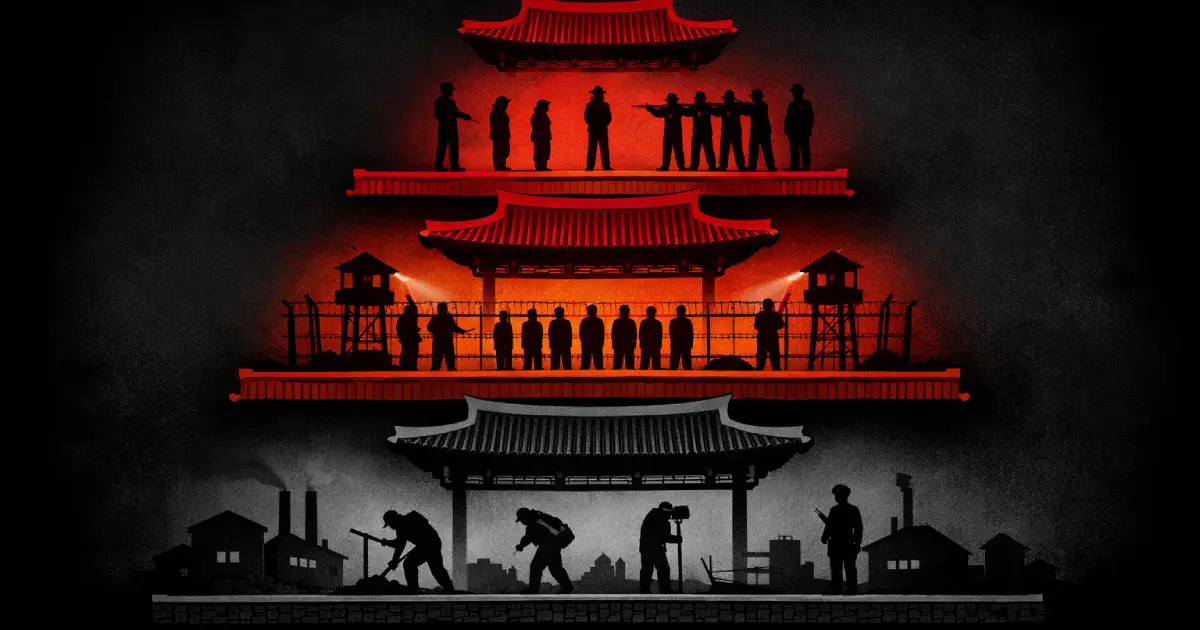
The morning mist over the Yalu River usually conceals the frantic activities of smugglers, but in early 2026, it served as a shroud for a far more sinister display of state power. At the Hyesan Airfield, a desolate stretch of tarmac in Ryanggang Province, thirty thousand residents were forcibly rounded up to witness an “ideological purification” ritual. Standing before a ten-man firing squad were seven high school students, their youth a stark and agonizing contrast to the grim charges of “reactionary thought” levelled against them.
Their crime—watching and sharing the South Korean survival drama Squid Game—represented a transgression so severe that it required the ultimate erasure of their existence. As thirty rounds of automatic fire tore through the morning air, the regime signaled to its people that the wall between North and South is no longer merely a physical barrier of barbed wire, but a psychological fortress that the state will defend with the bodies of its own children. The punishment did not stop with the dead: in a brutal application of collective responsibility, their homeroom teacher and school principal were stripped of their citizenship and banished to a life of gruelling labour in remote coal mines for “failing to educate” the youth.
The Hierarchy of Terror
Within this grim architecture of control, a specific hierarchy of punishment—a ladder of terror—has been codified to deter any deviation from state-approved thought. The regime distinguishes between degrees of “cultural contamination,” with punishments escalating based on the perceived hostility of the source material. For instance, the consumption of “unsocialist” but non-hostile media, such as Bollywood films or Russian television, typically results in three to five years of forced labour in a disciplinary center. These are viewed as minor infractions of lifestyle rather than direct attacks on the state’s legitimacy.
However, the consumption of South Korean media is treated as a high-stakes act of treason. Under current laws, simply watching a K-Drama or listening to K-Pop can lead to fifteen years in a political prison camp (kwan-li-so) or, increasingly, the death penalty. The most severe tier of the ladder is reserved for distribution. For those found smuggling or sharing digital copies of “puppet” content, the state bypasses re-education entirely, moving directly to immediate public execution. The regime views the movement of these digital files not as entertainment, but as a coordinated political conspiracy designed to rot the revolutionary spirit of the North Korean people from within.
The Legal Weapon
This massacre is the brutal climax of a legal war that intensified with the adoption of the Anti-Reactionary Thought and Culture Act. While North Korea has always restricted information, this legislation represents a fundamental shift from a system of re-education to one of elimination. The law defines South Korean content as a “rotten ideology” that paralyzes the masses, Distorting the very fabric of North Korean society. By 2026, the threshold for capital punishment has lowered significantly; even minors are no longer exempt from the firing squad if their actions are deemed to “encourage group viewing.”
Enforcement of these draconian codes falls to the “Group 109” (Strike Force), a multi-agency task force that has become the most feared entity in the security apparatus. Their tactics are a blend of archaic intimidation and modern digital forensics. Group 109 Surveillance teams are known to cut the electricity to entire apartment blocks before raiding individual units. This tactic is designed to catch residents using “Notetels”—portable media players that trap a disc or USB drive inside when the power fails, providing undeniable evidence for the state. In border cities like Hyesan, these raids are now supported by advanced signal detectors that can pinpoint the frequency of a smuggled smartphone from hundreds of meters away, narrowing the “crackdown radius” until escape is impossible.
The ‘Squid Game’ Paradox
It is a profound irony that Squid Game—a show that critiques the brutal inequalities of capitalism—is viewed as an existential threat by a communist state. In the West, the show is a Halloween costume; in Pyongyang, it is a dangerous revelation. For decades, the Kim regime has maintained a carefully curated lie: that South Korea is a land of starvation, destitution, and American colonial oppression.
Squid Game shatters this narrative in a single viewing. Even the most desperate, debt-ridden characters in the show possess smartphones, cars, and a level of material abundance that exceeds that of even mid-level North Korean party officials. For a North Korean student, seeing a “poor” person in Seoul gamble for millions of won reveals a standard of living that the state media has spent generations claiming was a myth. This realization breeds more than envy; it breeds a total loss of faith in the regime’s ideology. The state does not fear the show’s violence; it fears the background scenery—the signs of a prosperity they cannot match.

The Smuggling Ecosystem
Despite the terror at Hyesan Airfield, the USB Smuggling Ring continues to operate as the nation’s primary information lifeline. Trade between China and the DPRK rebounded to $2.73 billion in 2025, providing the necessary cover for a surge in illicit media hidden among legitimate cargo. Small 4GB drives, containing everything from Squid Game to the Korean Wikipedia, are smuggled across the shallow fords of the Yalu River by brokers who often bribe Chinese border guards to turn a blind eye.
These drives are often the work of defector-led organizations like “Flash Drives for Freedom,” which have reached over 1.3 million North Koreans with uncensored information. In cities like Hyesan, a bribe of $5,000 to $10,000 can often buy one’s way out of a Group 109 raid, creating a “bribe economy” where only the poor face the firing squad. This corruption is the regime’s greatest weakness; even the security agents tasked with leading the executions often return home to watch the same forbidden content in secret, knowing that the “bloody winds of investigation” could just as easily turn on them.

Conclusion
The public execution of high school students in Hyesan is the ultimate testament to the fragility of the Kim Jong-un regime. A state that must kill its children to survive is a state that has already lost the war for the minds of its people. The Anti-Reactionary Thought Law may have turned North Korea into a digital panopticon, utilizing facial recognition and biometric tracking to monitor every citizen, but it has failed to extinguish the curiosity of the “Jangmadang Generation.”
READ OUR OTHER ARTICLES
- T20 World Cup Final 2026: India vs New Zealand
 The cricket world is getting ready for its biggest event. On Sunday, March 8, 2026, the T20 World Cup 2026 final will take place. The stage is set for a … Read more
 - 1,000-Year-Old Kakatiya Vishnu Idol Found in Telangana
 The quiet forests of the Jayashankar Bhupalpally district in Telangana recently gave up a secret they had been keeping for a thousand years. In March 2026, as the summer heat … Read more
 - Kerala Set to Manufacture BrahMos Missile on 180-Acre
 India’s plan to become self-reliant in defense took a major leap forward on March 2, 2026. On this day, the Kerala Cabinet made a historic decision to give 180 acres … Read more
 - Why Aman Gupta Chose His Birthday to Reveal OFF/BEAT ?
 On March 3, 2026, the Indian startup world saw a digital shift that was as much about legacy as it was about the future. Aman Gupta, the famous co-founder of … Read more
 - Who’s Behind ViRosh’s Wedding Jewelry & Outfits?
 For a long time, celebrity weddings in India seemed to follow a very specific script. We saw a sea of pastel colors, minimalist decor, and a focus on what would … Read more