

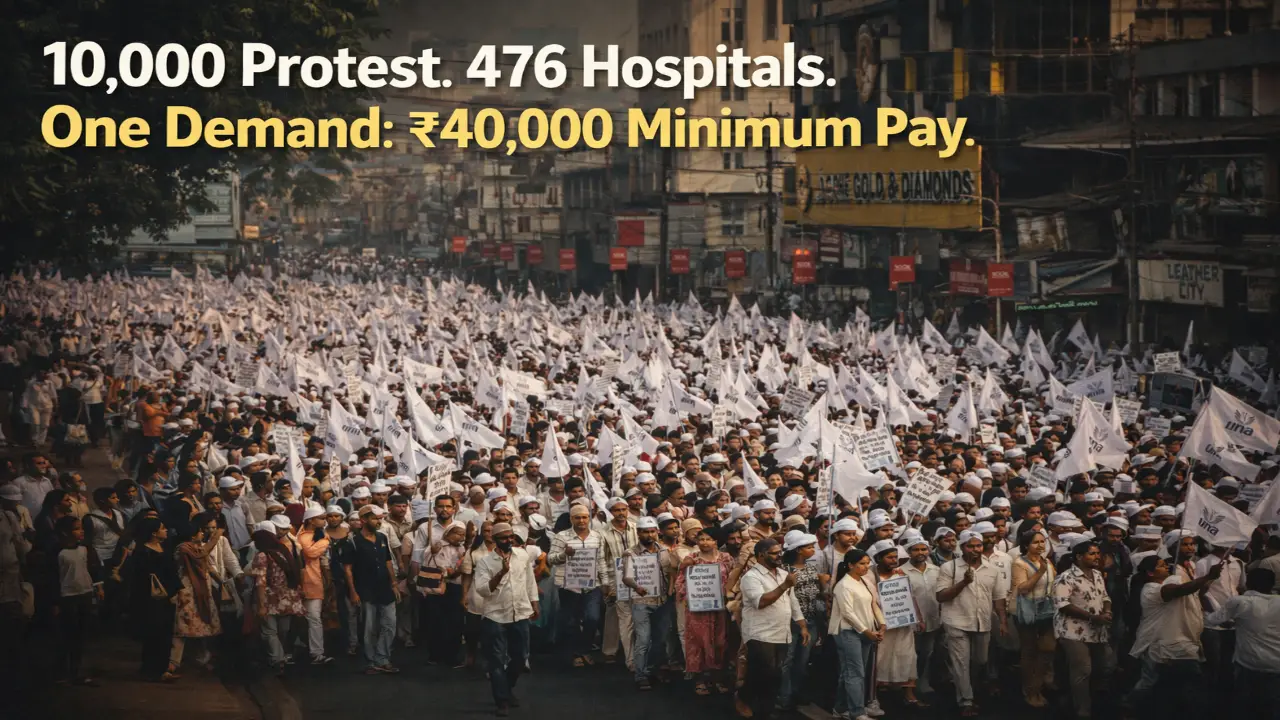
On February 21, 2026, the streets of Thrissur turned into a sea of white and blue. More than 10,000 nurses gathered for the “Rights Declaration Convention” at Rojy Roy Nagar. It was a massive show of strength that brought the city to a standstill. But the impact went far beyond one city. Across Kerala, nurses in 476 private hospitals walked off the job for a one-day token strike. Out-patient departments (OPDs) shut down, and while nurses made sure emergencies were covered, the message was clear: they are tired of being ignored.
At the center of this protest is the United Nurses Association (UNA). Its National President, Jasmine Shah, spoke to the crowd with a sharp message for the government and hospital owners. He called the current situation a “gross injustice”. Nurses in Kerala are currently living on wages set way back in April 2018. For seven years, their pay has stayed the same while the price of food, rent, and fuel has gone through the roof. The UNA is now demanding that the minimum basic pay be doubled, moving from ₹20,000 to ₹40,000.
Two Worlds of Healthcare
The strike highlights a shocking gap between two different worlds in Kerala’s healthcare system. In government hospitals, a staff nurse starts with a salary of around ₹60,000 when all allowances are included. But in the private sector, the same sector that handles a huge chunk of the state’s patients, most nurses earn less than ₹20,000.
This isn’t just a matter of “low pay”; it is a legal issue. The Supreme Court has already ruled on the principle of “Equal Pay for Equal Work”. It said that nurses in private hospitals should get pay similar to government nurses if they do the same work. Yet, the Kerala Private Hospital Management Association (KPHMA) has allegedly used its influence to stop the government from raising wages. While hospitals have increased their own charges and fees over the last seven years, the nurses who do the actual work haven’t seen an extra rupee in their basic pay.
Broken Promises
The system isn’t just failing on pay; it’s failing on basic working conditions. Over ten years ago, a group called the S. Balaraman Committee made 50 recommendations to improve the lives of nurses. Today, 32 of those 50 reforms are still just “ghost recommendations” on paper. Rules about safe staffing levels and proper benefits are being ignored.
Even small improvements are being fought in court. Recently, the government tried to bring in a “6-6-12” shift system. This would have given nurses two six-hour day shifts and one twelve-hour night shift, replacing the brutal 14-hour shifts many work now. But private hospital owners got a court order to stop it, arguing it would be too expensive to hire enough staff to make the shifts work. For a workforce that is mostly women, these long hours aren’t just tiring, they are unsafe.
When Fatigue Leads to Tragedy
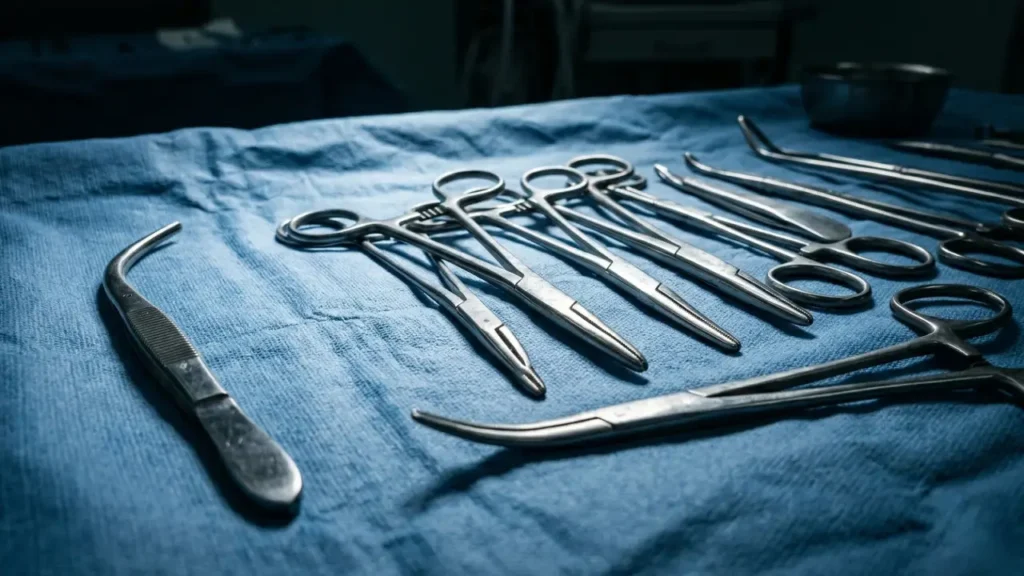
This lack of staff and rest isn’t just bad for nurses; it’s dangerous for patients. During the Thrissur protest, leaders pointed to the tragic case of Usha Joseph. Usha lived with terrible stomach pain for five years after a surgery at the Alappuzha Government Medical College in 2021. Finally, an X-ray showed that a 7-cm surgical tool, an artery forceps, had been left inside her abdomen.
The government’s response was to blame the nurses. An inquiry cleared the surgeon and pointed the finger at the nursing staff for not counting the tools correctly. But the United Nurses Association says this is unfair. During that surgery in 2021, the hospital was short-staffed because of the pandemic. There wasn’t even a specific “scrub nurse” assigned to handle the tools. When you force one nurse to do the work of four, mistakes happen. Using nurses as “scapegoats” for a broken system only makes the anger on the streets grow.
State of Healthcare System
The nurses aren’t the only ones fighting back. As they marched in Thrissur, government doctors from the KGMCTA were on their 33rd day of a hunger strike. These doctors are also demanding years of unpaid back-pay and better staffing.
This “Dual Crisis” means that both the public and private sectors are failing at the same time. Usually, if private hospitals are on strike, people go to government ones. But with government doctors also boycotting work, the “common person” in Kerala has nowhere to turn. In major hospitals like Kozhikode and Trivandrum, the number of patients seen daily has dropped by more than half.
The state government, led by the LDF, has mostly stayed silent or called the protests “political”. Health Minister Veena George even became a flashpoint herself after an alleged scuffle at a railway station left her with minor injuries, an incident the opposition calls a “drama” to distract people from the medical errors being reported.
The Threat of Total Shutdown
The February 21 strike was only a warning. The nurses have made it clear: they will not wait another seven years for a raise. If the government doesn’t issue a formal order to fix the ₹40,000 minimum wage and follow the Balaraman reforms, the unions are threatening an indefinite “total shutdown” of all hospital services.
Kerala often brags about its “world-class” healthcare, but that system is currently being held together by the thin patience of its workers. The “angels” in white coats have reached their limit. If the government continues to side with hospital owners over the rights of its frontline workers, the Kerala healthcare model might finally collapse under the weight of its own neglect.
READ OUR OTHER ARTICLES
- Know the Real Reason Behind Tarun Kumar’s Death Over a Holi Balloon
 The Holi festival turned tragic in southwest Delhi this year. On Wednesday, March 4, 2026, the narrow lanes of a JJ Colony in Uttam Nagar became the center of a … Read more
 - T20 World Cup Final 2026: India vs New Zealand
 The cricket world is getting ready for its biggest event. On Sunday, March 8, 2026, the T20 World Cup 2026 final will take place. The stage is set for a … Read more
 - 1,000-Year-Old Kakatiya Vishnu Idol Found in Telangana
 The quiet forests of the Jayashankar Bhupalpally district in Telangana recently gave up a secret they had been keeping for a thousand years. In March 2026, as the summer heat … Read more
 - Kerala Set to Manufacture BrahMos Missile on 180-Acre
 India’s plan to become self-reliant in defense took a major leap forward on March 2, 2026. On this day, the Kerala Cabinet made a historic decision to give 180 acres … Read more
 - Why Aman Gupta Chose His Birthday to Reveal OFF/BEAT ?
 On March 3, 2026, the Indian startup world saw a digital shift that was as much about legacy as it was about the future. Aman Gupta, the famous co-founder of … Read more