

| Category | Detail |
| Date | Thursday, February 19, 2026 |
| Key Policy | PM Modi’s M.A.N.A.V. AI Framework (Moral, Accountable, National, Accessible, Valid) |
| Key Corporate Announcement | Tata AI Chips N Chandrasekaran: Development of industry-specific chips (Automotive) |
| The Consensus | Sam Altman IAEA for AI: OpenAI CEO calls for a global regulatory body |
| Viral Ground Moment | Altman (OpenAI) and Amodei (Anthropic) awkward “fist-bump” snub on stage |
The Geopolitical Stance
The air at Bharat Mandapam was thick with diplomatic gravity on Thursday as the AI Impact Summit Leaders Plenary formally commenced. In a show of multilateral strength, Prime Minister Narendra Modi led the inauguration alongside Emmanuel Macron India AI supporter and French President, and UN Secretary-General Antonio Guterres. The session was not merely a formal opening; it was a demonstration of technological sovereignty. In a highlight of the ceremony, the Prime Minister’s address featured live AI-enabled sign language interpretation and real-time dubbing into 11 Indian languages, underscoring India’s “AI for All” philosophy.
The M.A.N.A.V. Vision
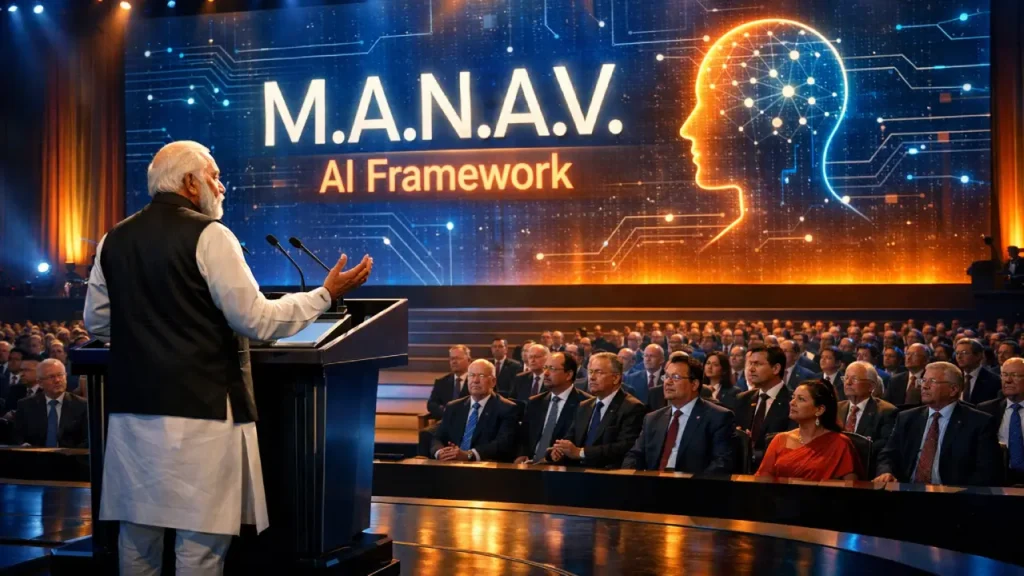
The centerpiece of the day was the unveiling of the M.A.N.A.V. AI Framework. PM Modi presented this human-centric doctrine as a global roadmap to ensure AI serves humanity rather than reducing individuals to “mere data points”.
- M – Moral and Ethical Systems: Grounding AI in fairness and human oversight.
- A – Accountable Governance: Establishing transparent rules and robust oversight.
- N – National Sovereignty: Protecting data rights and digital boundaries.
- A – Accessible and Inclusive AI: Turning AI into a multiplier for the masses, not a monopoly.
- V – Valid and Legitimate Systems: Ensuring AI remains lawful and verifiable.
The geopolitical tension was palpable when President Macron delivered an unscripted statement to reporters. Rejecting the current bipolar tech order, Macron stated he does not support an international system that boils down to a relationship of “overlord to vassal,” signaling France’s alignment with India’s pursuit of “Strategic Autonomy” in the digital age.
The Parade of Tech Titans
Following the plenary, the “Corporate Core” took center stage as a dense roster of global tech power converged to outline the commercial frontier.
Tata’s Hardware Leap
In the day’s most significant business move, Tata Sons Chairman N. Chandrasekaran announced that the Tata Group has officially commenced building industry-specific AI chips. The first of these specialized semiconductors will cater to the automotive sector, marking India’s entry into high-end AI hardware. Chandrasekaran also detailed a massive 100MW AI-optimized data center project in partnership with OpenAI, intended to scale to 1GW.
The Regulatory Consensus
OpenAI CEO Sam Altman used his keynote to address the existential risks of AGI. He argued that by late 2028, intellectual capacity inside data centers could surpass that outside them, necessitating a global regulatory body modelled after the International Atomic Energy Agency (IAEA). While emphasizing safety, Altman praised India’s unique position as a leader in AI usage, noting it is already OpenAI’s fastest-growing market.
Big Tech Highlights
- Sundar Pichai (Google): Reaffirmed a $15 billion investment in India, focusing on an AI Hub in Visakhapatnam and international subsea cables to bridge the connectivity divide.
- Brad Smith (Microsoft): Warned that AI must be used to close, rather than exacerbate, the economic divide between the Global North and South.
- Dario Amodei (Anthropic): Struck a cautious note regarding “autonomous behavior,” while announcing the opening of a new Anthropic office in Bengaluru.
- Alexandr Wang (Meta): Emphasized “personal superintelligence,” noting that India already hosts more consumer AI startups than the United States. He highlighted how Indian small businesses are building WhatsApp-based AI agents in under 10 minutes.
The Viral “Unscripted” Moment
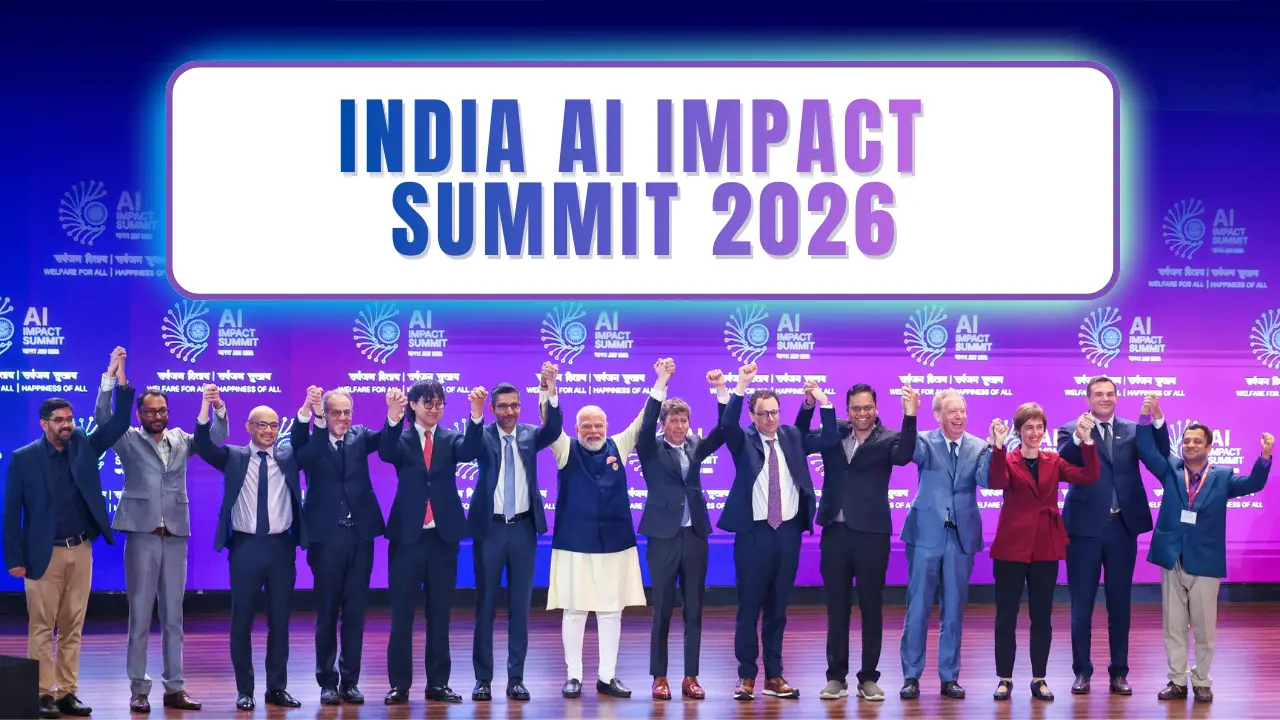
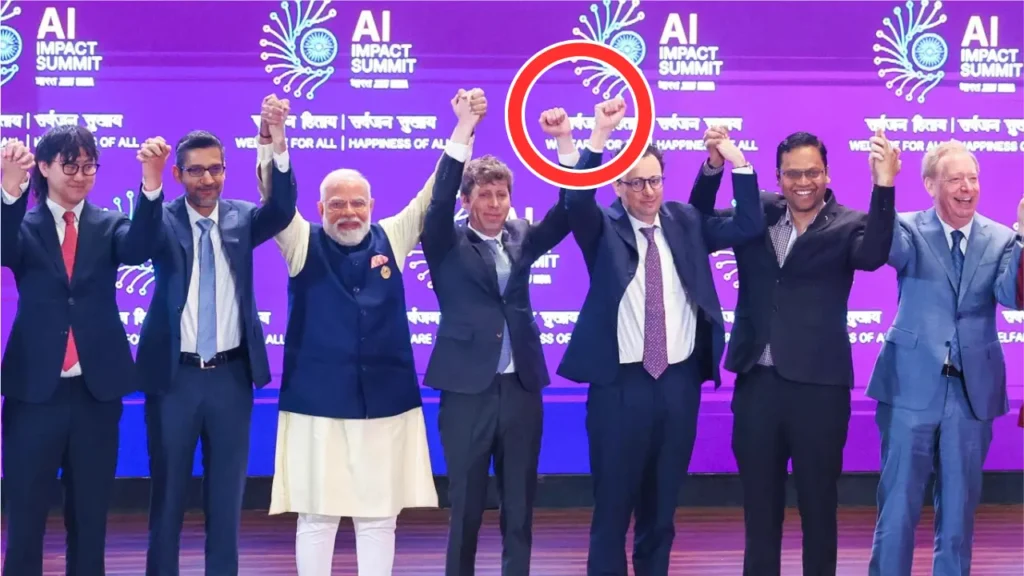
Despite the official themes of collaboration, the deep-seated rivalries of Silicon Valley were laid bare in a single, unscripted moment that dominated social media. During the traditional group photograph, world leaders and tech CEOs were asked to link hands as a symbol of global unity.
Standing in the center, PM Modi reached out to join the “unity chain.” However, the chain broke when it reached Sam Altman and Anthropic’s Dario Amodei. The two fierce rivals—whose ideological split over AI safety led to Anthropic’s founding—appeared visibly uncomfortable standing side-by-side. Instead of holding hands like the other dignitaries, both men chose to raise separate, clenched fists, maintaining a noticeable physical distance and avoiding eye contact.
Social media immediately dubbed the scene the “AI Cold War on Stage”. While Altman later dismissed the incident as “mere confusion” regarding stage instructions, analysts at Bharat Mandapam viewed it as a symbolic manifestation of the high-stakes battle for AGI dominance. The moment served as a stark reminder that while the “New Delhi Declaration” seeks a unified path, the architects of the technology remain deeply divided.
Conclusion
Day 4 concluded with the formal adoption of the New Delhi Declaration by 89 nations, solidifying a “Global South” consensus on AI governance. As the delegates departed, the narrative was clear: India has transitioned from a technology consumer to a primary architect of the global AI order, bridging the gap between Silicon Valley’s ambition and the Global South’s necessity.
READ OUR OTHER ARTICLES
- Know the Real Reason Behind Tarun Kumar’s Death Over a Holi Balloon
 The Holi festival turned tragic in southwest Delhi this year. On Wednesday, March 4, 2026, the narrow lanes of a JJ Colony in Uttam Nagar became the center of a … Read more
 - T20 World Cup Final 2026: India vs New Zealand
 The cricket world is getting ready for its biggest event. On Sunday, March 8, 2026, the T20 World Cup 2026 final will take place. The stage is set for a … Read more
 - 1,000-Year-Old Kakatiya Vishnu Idol Found in Telangana
 The quiet forests of the Jayashankar Bhupalpally district in Telangana recently gave up a secret they had been keeping for a thousand years. In March 2026, as the summer heat … Read more
 - Kerala Set to Manufacture BrahMos Missile on 180-Acre
 India’s plan to become self-reliant in defense took a major leap forward on March 2, 2026. On this day, the Kerala Cabinet made a historic decision to give 180 acres … Read more
 - Why Aman Gupta Chose His Birthday to Reveal OFF/BEAT ?
 On March 3, 2026, the Indian startup world saw a digital shift that was as much about legacy as it was about the future. Aman Gupta, the famous co-founder of … Read more