

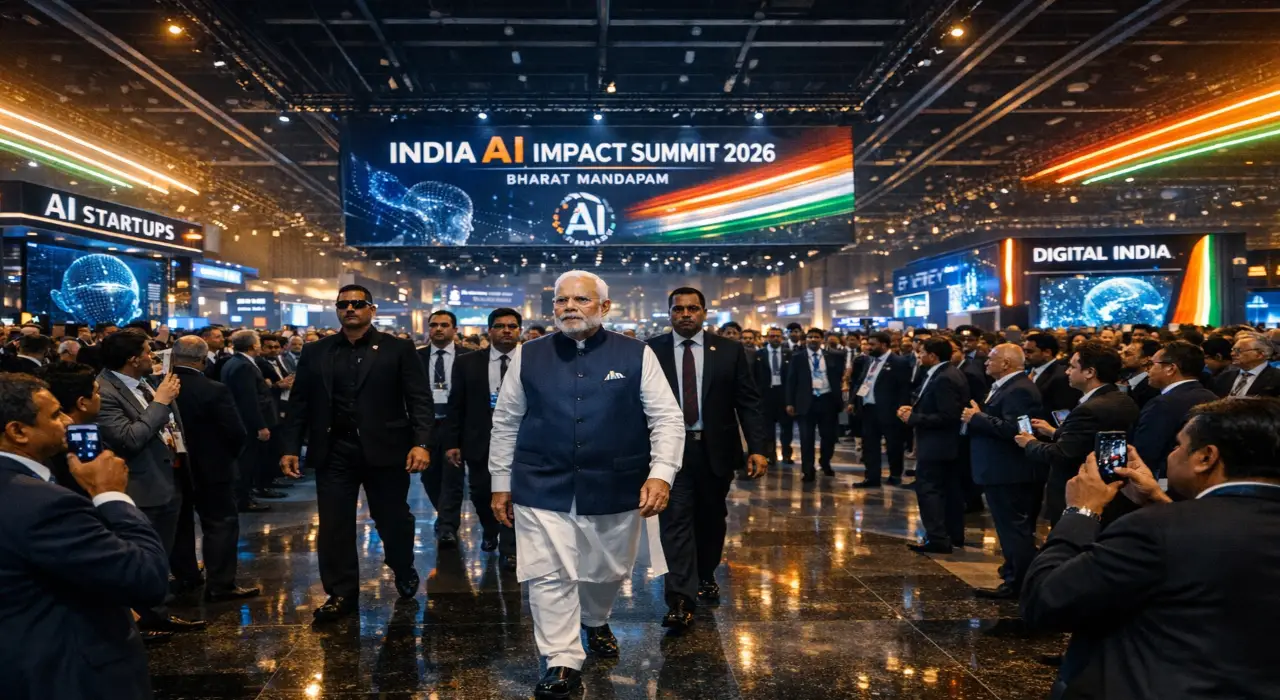
Monday, February 16, 2026, marked a watershed moment for the Global South as the Bharat Mandapam AI Summit officially commenced in New Delhi. As the first major global AI convening held outside the traditional tech hubs of the West, the India AI Impact Summit 2026 represents a shift from existential risk debates to a “development-first” framework. While the halls of the convention center buzzed with high-level policy discussions, the ground reality was a complex mix of technological ambition and logistical friction, as tens of thousands of delegates converged on the capital.
| Day 1 Executive Summary | Details |
| Date | February 16, 2026 |
| Key Inauguration | India AI Impact Expo 2026 by PM Narendra Modi |
| Key Highlight | 600+ Startups Showcased; Major cancellation by NVIDIA CEO |
| Ground Reality | 80,000+ Attendees; “Utter chaos” due to security lockdowns and logistics |
The Inauguration & The Expo
The summit’s physical centerpiece, the India AI Impact Expo 2026, was inaugurated by Prime Minister Narendra Modi, transforming the Bharat Mandapam into a 70,000-square-meter demonstration of sovereign technological capability. The PM Modi AI Vision was on full display as he navigated through an assembly of over 600 high-potential start-ups and 13 dedicated country pavilions, including representation from Japan, the UK, Australia, and a regional African pavilion.
A pivotal stop in the Prime Minister’s walkthrough was the Jio Intelligence Pavilion. Here, Akash Ambani, Chairman of Reliance Jio, provided a live briefing on the Jio AI Stack, a foundational infrastructure designed to industrialize AI deployment for Indian enterprises. Ambani demonstrated the versatility of the ecosystem through several localized models:
- Jio Sanskriti AI: Focused on linguistic preservation through AI-driven translation for India’s 22 official languages.
- Jio Arogya AI: A health-tech solution aimed at strengthening digital diagnostics in underserved regions.
- Jio Shiksha: An education-centric model designed for personalized, adaptive learning pathways.
“Sarvajana Hitaya, Sarvajana Sukhaya”
The intellectual bedrock of the summit is the philosophy of Sarvajana Hitaya, Sarvajana Sukhaya (Welfare for All, Happiness for All). This vision is operationalized through a unique structural framework:
- The Three Sutras: The core pillars of People, Planet, and Progress ensure that AI serves human dignity, environmental sustainability, and equitable global development.
- The Seven Chakras: These thematic working groups—ranging from Human Capital and Inclusion to Safe & Trusted AI—channel multilateral energy toward solving practical societal challenges.
Under this framework, India is unveiling 12 indigenous foundation models under the IndiaAI Mission, specifically trained on domestic datasets to ensure technological sovereignty.
Summit Sessions
The first day’s Feb 16 AI Summit Sessions featured high-stakes debates on how AI will disrupt and redefine traditional sectors. Major panels included:
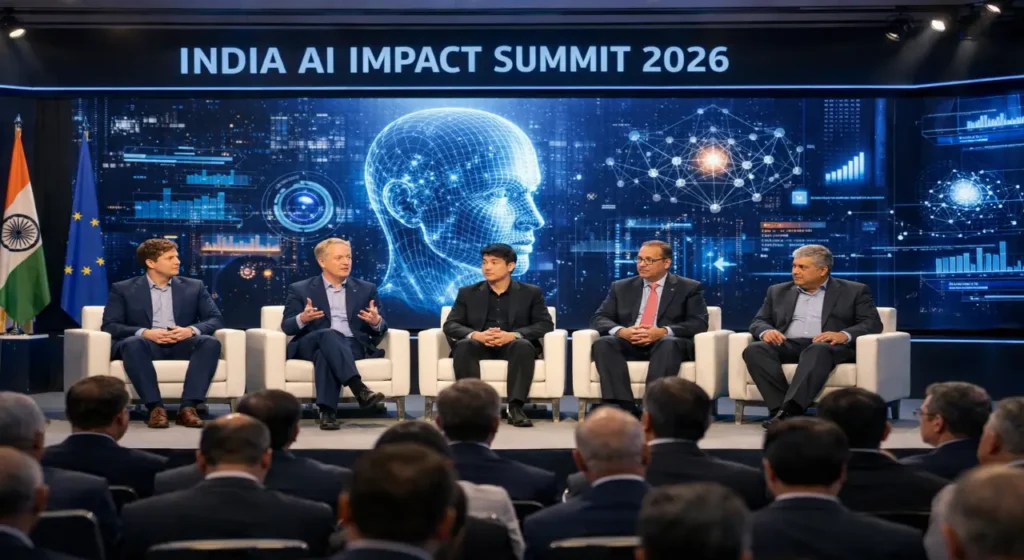
- The Future of Employability in the Age of AI: A high-level roundtable featuring Sanjiv Bikhchandani (InfoEdge), Sateesh Seetharamaiah (EdgeVerve), and the Chief Economic Advisor. Dr. V. Anantha Nageswaran noted that with intentional policy, India could achieve “human abundance,” while Bikhchandani emphasized that “adaptability is the only viable approach” for the youth facing job redundancy.
- Safe & Trusted AI at Scale: Led by representatives from STPI and the India AI Mission, this session focused on moving beyond isolated pilots to enterprise-wide ecosystems that reconcile rapid innovation with accountability.
- AI for Smart and Resilient Agriculture: Cross-border research discussions involving INRAE (France), BAIF, and the FAO explored how AI can support climate-resilient farming. Key takeaways focused on “fair adoption” and ensuring that AI tools address the actual needs of small-scale farmers.
The Logistical Reality
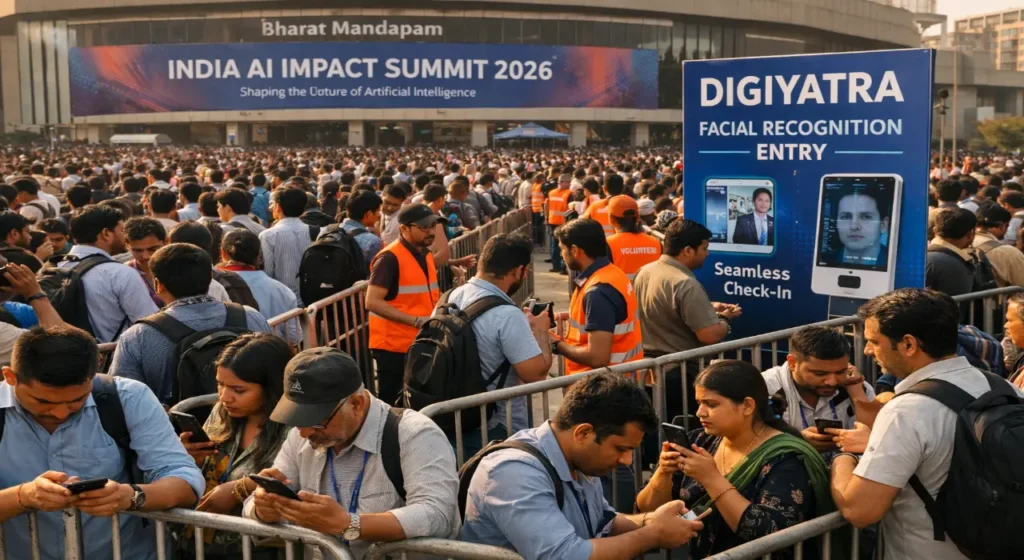
While the interior sessions focused on the future, the exterior grounds faced immediate logistical hurdles. Despite 2.5 lakh total registrations, a staggering 80,000 people attempted to access the venue simultaneously on the first day.
To manage the volume, organizers utilized DigiYatra for facial-recognition entry, though the registration system reportedly crashed under the load. Innovative food solutions were deployed, including an on-site Zepto dark store for rapid fulfilment and Swiggy-integrated food kiosks that allowed attendees to order meals to specific drop-off zones.
However, the day was also marked by significant friction. Security sanitization for PM Modi’s arrival at 5 PM led to the evacuation of exhibition halls as early as 2 PM. This left thousands of exhibitors and delegates, some who had travelled from the US and South Africa, stranded in the heat without access to food or water. Social media was flooded with complaints regarding “logistic mayhem,” citing long queues, the theft of AI wearables during stall evacuations, and the irony of patchy mobile internet and a complete lack of Wi-Fi at a premier technology event.
The Convergence of Global VIPs
The prestige of the event was high, but it suffered a notable “minor dampener” just ahead of the start. While the attendee list featured global titans, the most anticipated name was missing from the floor.
- The NVIDIA Absence: Although Jensen Huang (Founder & CEO, NVIDIA) was a headline attraction on the pre-summit attendee list, he cancelled his visit at the last minute. The company confirmed he was “under the weather” after three straight weeks of travel and had caught a bug. Jay Puri was deputed to lead the NVIDIA delegation in his place.
- Confirmed Attendees: Despite Huang’s absence, other global leaders were present, including Sam Altman (OpenAI), Sundar Pichai (Google), Brad Smith (Microsoft), and Alexandr Wang (Meta).
- Domestic Giants: Indian captains like Mukesh Ambani (Reliance), Natarajan Chandrasekaran (Tata), and Nandan Nilekani (Infosys) were active participants, focusing on applying AI to Indian societal contexts.
The presence of over 20 heads of state and 60 ministers reinforces that the summit is as much a diplomatic forum as a technological one.
Conclusion
Day 1 of the summit provided a vivid contrast between the sophisticated “AI for All” vision and the physical challenges of executing that vision at an Indian scale. While the absence of Jensen Huang was felt, the focus remains on whether the 3 Sutras can successfully transition from high-level dialogue to demonstrable, ground-level impact for the billion citizens they are meant to serve.
The summit didn’t end in disorder. See how Day 2 reset the narrative.
READ OUR OTHER ARTICLES
- Know the Real Reason Behind Tarun Kumar’s Death Over a Holi Balloon
 The Holi festival turned tragic in southwest Delhi this year. On Wednesday, March 4, 2026, the narrow lanes of a JJ Colony in Uttam Nagar became the center of a … Read more
 - T20 World Cup Final 2026: India vs New Zealand
 The cricket world is getting ready for its biggest event. On Sunday, March 8, 2026, the T20 World Cup 2026 final will take place. The stage is set for a … Read more
 - 1,000-Year-Old Kakatiya Vishnu Idol Found in Telangana
 The quiet forests of the Jayashankar Bhupalpally district in Telangana recently gave up a secret they had been keeping for a thousand years. In March 2026, as the summer heat … Read more
 - Kerala Set to Manufacture BrahMos Missile on 180-Acre
 India’s plan to become self-reliant in defense took a major leap forward on March 2, 2026. On this day, the Kerala Cabinet made a historic decision to give 180 acres … Read more
 - Why Aman Gupta Chose His Birthday to Reveal OFF/BEAT ?
 On March 3, 2026, the Indian startup world saw a digital shift that was as much about legacy as it was about the future. Aman Gupta, the famous co-founder of … Read more