

| Feature | Details of Tuesday, February 17, 2026 |
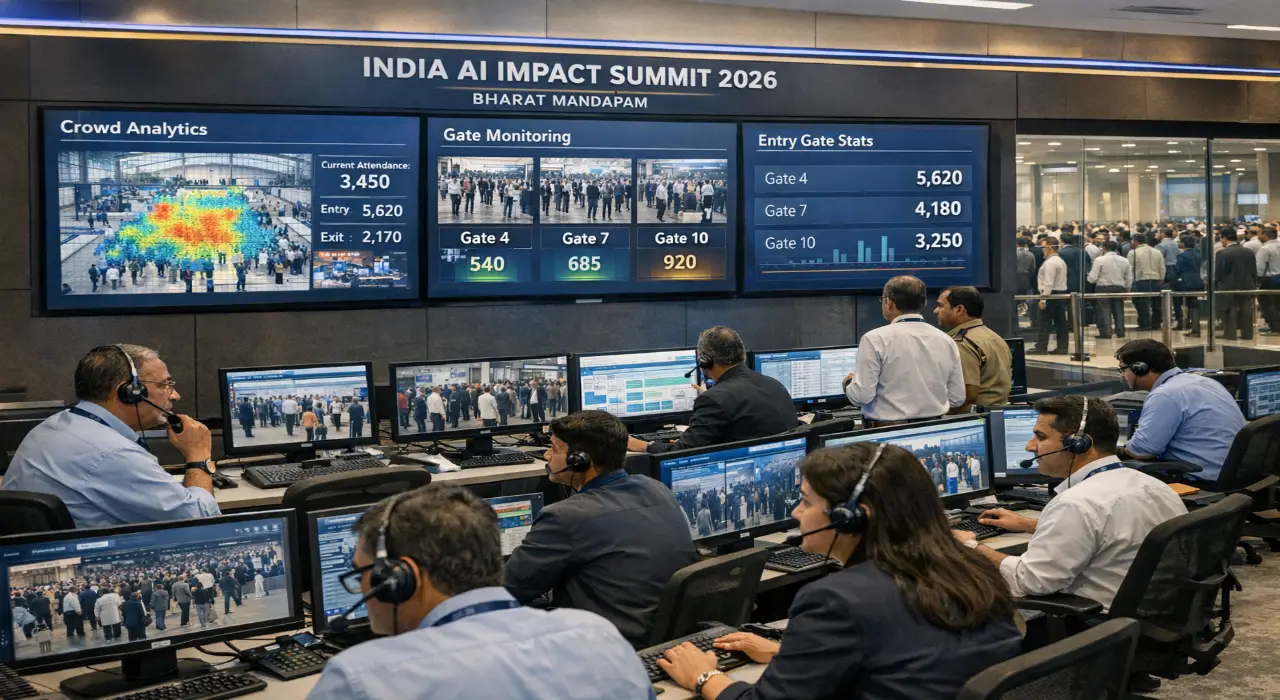
| Ground Reality | Establishment of a 24/7 “war room”; smoother management for 70,000+ attendees. |
| Compute Surge | Ashwini Vaishnaw 20,000 GPUs additional order announced. |
| Policy Pivot | Proposed age-based social media curbs and mandatory fair remuneration for news publishers. |
| Sectoral Impact | Launch of 6 “Knowledge Compendiums” (Health, Agri, Energy, etc.) with 170+ use cases. |
| Inclusive AI | Tata AI Sakhi program: 1,553 rural women completed 4,727 tasks. |
The Ground Reality
The narrative of the India AI Impact Summit 17 Feb 2026 was reclaimed on Tuesday by a candid public apology. Following an opening day marred by “utter chaos,” long queues, and security-related displacements, IT Minister Ashwini Vaishnaw took the stage to acknowledge the “logistical nightmare” that saw delegates and founders locked out of their own exhibition stalls. The contrast on Day 2 was deliberate and functional. The Ministry of Electronics and Information Technology (MeitY) activated a centralized “war room” to manage the staggering 70,000+ attendees who converged on the 100-acre Bharat Mandapam.
The vibe shift was immediate. Where Day 1 focused on the “PR-hungry” optics of high-security inaugurations, Day 2 was about execution. Entry protocols were streamlined at Gates 4, 7, and 10, wait times dropped, and even a Bengaluru-based startup’s stolen wearables, a symbol of the Day 1 security lapse, were recovered by Delhi Police within 24 hours. By Tuesday afternoon, the discourse had successfully transitioned from crowd control to the actual mechanics of Sovereign AI Models.
Scaling to 60,000 GPUs
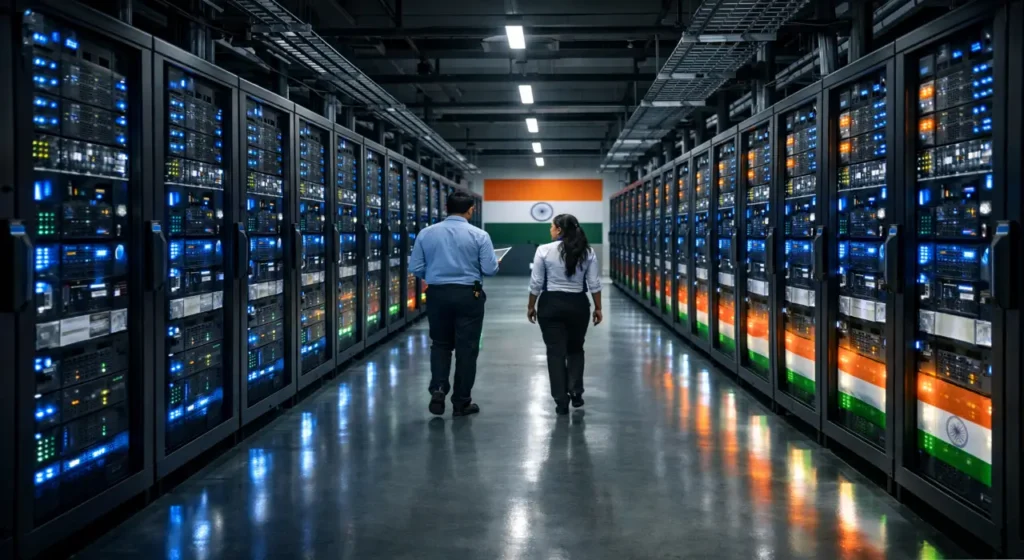
The technical centerpiece of the day was Vaishnaw’s announcement that India is set to scale its compute capacity. Under “AI Mission 2.0,” the government will order 20,000 high-end GPUs in the coming week, augmenting the existing base of 38,000 units. This move is designed to democratize high-end compute, providing resources to startups at a subsidized rate of ₹65 per hour, roughly one-third of the global average.
The strategic intent behind this push is “strategic autonomy.” By building out a common compute pool and focusing on semiconductor design under “Semiconductor 2.0,” the government aims to foster 50 deep-tech companies capable of training models on indigenous datasets. This expansion is tied to an anticipated $200 billion in AI investments over the next two years, supported by the fact that 51% of India’s power capacity is now clean, making its data centers globally competitive in sustainability.
Physical AI and the Multilingual Expo
The Bharat Mandapam Expo floor on Tuesday buzzed with the debut of “Physical AI.” U.S. chipmaker Qualcomm showcased its full robotics stack, featuring the Dragonwing IQ-10 processor designed for humanoid robots and industrial autonomous mobile robots (AMRs). This marked the platform’s Indian debut, with live demonstrations of robots performing high-demand tasks in logistics and manufacturing, such as item picking and inventory scanning.
Simultaneously, the expo highlighted the “democratization of language.” Exhibitors showcased Multilingual Large Language Models (LLMs) built for regional nuances. Vaishnaw noted that several Indian models have now been tested against global benchmarks and are outperforming international systems in specific local contexts. These tools are specifically targeted at small business owners in remote villages, allowing them to handle accounting and content generation in their native tongues.
Applied AI & Policy
The day’s sessions provided a transition from vision to actionable outcomes through several key launches:
- Knowledge Compilation: The government officially released six “AI Impact Casebooks” documenting over 170 scalable innovations across Health, Energy, Education, Agriculture, Gender Empowerment, and Accessibility.
- Health and Public Safety: Health MoS Anupriya Patel reported that AI-assisted tools for tuberculosis (CA-TB) have increased case detection by 16% and reduced negative treatment outcomes by 27%. She emphasized that AI is an “All-Inclusive Intelligence” intended to augment, not replace, clinicians.
- Regulatory Hardening: The government signaled a shift toward stricter governance. Minister Vaishnaw advocated for deepfake regulations and explored age-based social media curbs for children, aligning with trends in Australia and the UK.
- Publisher Rights: In a major win for traditional media, Vaishnaw asserted that news publishers must receive fair remuneration when AI companies use their copyrighted content for training models.
Inclusive AI
The human impact of the summit was most visible through the Tata AI Sakhi Immersion Program. In a live demonstration, 1,553 women from six states, many of them traditional artisans, were trained to use AI on their own mobile phones. Over 2.5 hours, they completed 4,727 AI-powered tasks in their local languages, such as generating design ideas for Pattachitra and Madhubani crafts or accessing government schemes.
Meanwhile, the AI by HER Challenge finals at Sushma Swaraj Bhawan highlighted 30 women-led teams. These entrepreneurs presented solutions ranging from retinal screening tools to voice-to-EMR platforms, competing for awards totaling ₹2.5 crore and demonstrating how AI can bridge social inequities.

The Amitabh Kant Warning
Despite the technological optimism, the day concluded with a significant warning from NITI Aayog’s Amitabh Kant. He noted a striking disparity: India provides 33% more data to models like ChatGPT than the United States, yet the value is largely captured by foreign entities. Kant warned that without a Digital Public Infrastructure (DPI) framework, AI risks creating a “deeply unequal global society.” He called for the development of “desi” AI chatbots and indigenous models to ensure that social transformation, rather than Big Tech valuation, remains the goal.
Conclusion
Day 2 of the India AI Impact Summit 17 Feb 2026 marked the moment the event grew up. By moving past the chaos of the first day and focusing on the Ashwini Vaishnaw 20,000 GPUs commitment and sectoral impact data, India has begun to frame its own digital destiny. The shift to a “war room” management style and the focus on “All-Inclusive Intelligence” suggests that the nation is ready to host the Global South’s conversation on AI, not as a bystander, but as an infrastructure-led leader.