

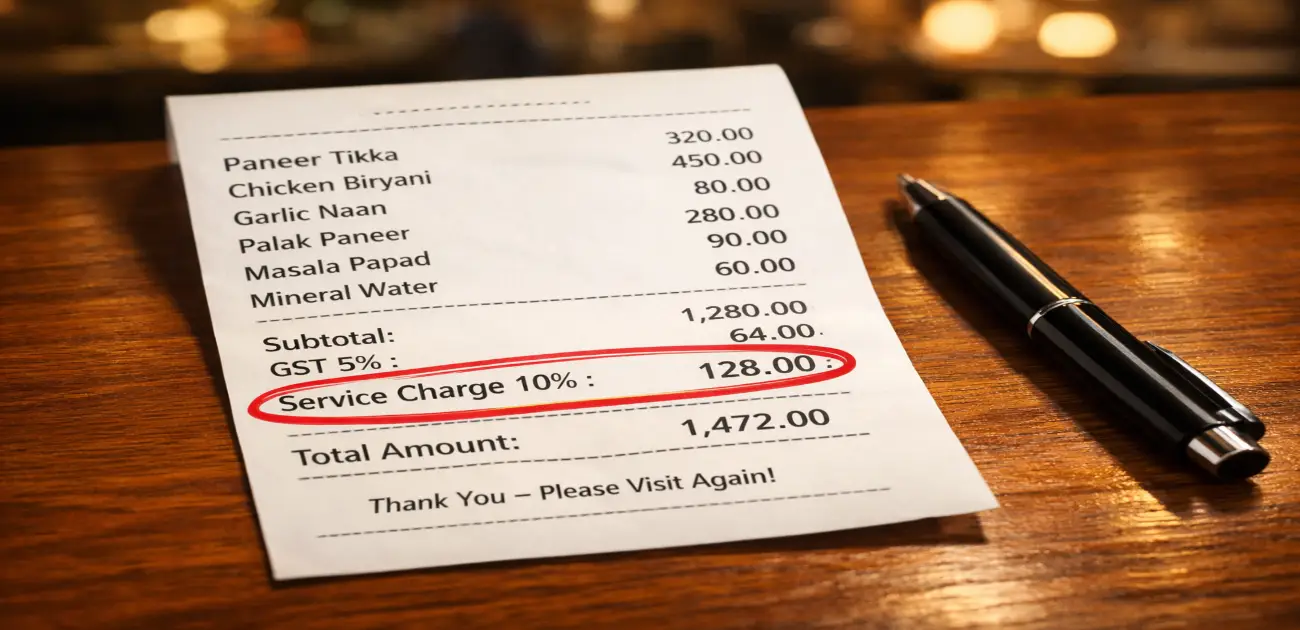
To clear up the confusion between taxes and voluntary tips, use this decoder to identify exactly what you are paying for when the check arrives.
| Charge Type | Legal Status | Recipient | Regulatory Oversight | Taxability (GST) |
| GST (CGST + SGST) | Mandatory | Central/State Government | Ministry of Finance | Mandatory 5% or 18% |
| Service Charge | Voluntary | Restaurant Management | CCPA / Consumer Affairs | Illegal to levy GST if mandatory |
| Service Tax | Abolished | N/A (Defunct) | Ministry of Finance | Illegal and Fraudulent |
| Staff Contribution | Voluntary | Staff Welfare Fund | CCPA / Consumer Affairs | Cannot be auto-added |
| Handling Fee | Voluntary | Restaurant Management | CCPA / Consumer Affairs | Cannot be auto-added |
The Psychological Architecture of the Guilt Trip
It is a scene played out in thousands of air-conditioned restaurants across India every evening: the celebratory meal ends, the laughter fades, and a leather folder is placed on the table. As you scan the bill, your eyes land on a “Service Charge” totaling 10% of your meal. For a family dinner costing ₹4,000, this is a sudden, uninvited ₹400 surcharge.
This moment is carefully engineered social friction. The hospitality industry relies on a “guilt economy,” betting that you will pay the fee rather than risk the awkwardness of questioning it in front of guests or family. Waitstaff are often trained to present this charge as a “fixed cost” or a “government rule”. This is not just a white lie; it is a calculated attempt to leverage your social anxiety against your legal rights. However, as of February 2026, the power dynamic has shifted. The government has declared war on this mandatory “tip,” and for the first time, the law has real teeth.
News crackdown in February
The Central Consumer Protection Authority (CCPA) has initiated a massive enforcement blitz. This week (February 2026), the authority penalized 27 major restaurant chains nationwide for the mandatory levy of service charges. This isn’t just a slap on the wrist; it is a systemic dismantling of what the regulator terms an “Unfair Trade Practice” under Section 2(47) of the Consumer Protection Act, 2019.
The CCPA took suo motu cognizance of a surge in complaints on the National Consumer Helpline (NCH), where diners provided digital evidence of restaurants hard-coding these charges into their billing software. The message is clear: no brand is too big to be held accountable.
Big Brands Under Fire
The crackdown has hit the biggest names in the casual dining sector. In a landmark order passed on February 4, 2026, the CCPA directed Barbeque Nation Hospitality Ltd to immediately discontinue its practice of adding service charges. The case originated from a consumer complaint regarding a ₹335 service charge. When the customer first objected, the restaurant offered a “credit note” for a future bill—a classic stalling tactic. The CCPA intervened, forcing the chain to issue a full cash refund to the consumer’s source account.
Similarly, China Gate Restaurant Private Limited (which operates the popular Bora Bora chain in Mumbai) was slapped with a ₹50,000 fine on December 29, 2025. Investigators found that the restaurant was not only adding a 10% charge by default but was also brazenly levying GST on top of that illegal charge. Furthermore, the establishment’s non-cooperation—including a non-functional grievance email—compounded the penalty.
The Judicial Verdict
These enforcement actions are the direct result of the Delhi High Court’s March 28, 2025 ruling in NRAI v. Union of India. The court unequivocally upheld the CCPA’s guidelines, stating that a service charge is voluntary, not mandatory. The court held that a tip is a private contract between the diner and the server; management has no legal right to mandate it or embed it into the pricing of food.
Know Your Rights
To avoid being overcharged, every consumer must memorize the five core rules issued by the CCPA and backed by the judiciary.
- No Automatic Addition: A restaurant cannot add a service charge to the bill “by default” or “automatically”.
- No Disguised Renaming: The fee cannot be renamed to “Staff Contribution,” “Staff Welfare Fund,” or “Handling Fee” to bypass the law.
- No Denial of Entry: You cannot be denied entry or service if you state upfront that you refuse to pay a service charge.
- Discretion is Absolute: Any additional payment must be the result of your explicit, proactive choice.
- No GST on Top: A service charge shall not be added to the bill and then subjected to GST.
The Illegal vs. Legal Bill
The following table shows how an illegal bill inflates your costs by taxing you on an unlawful fee.
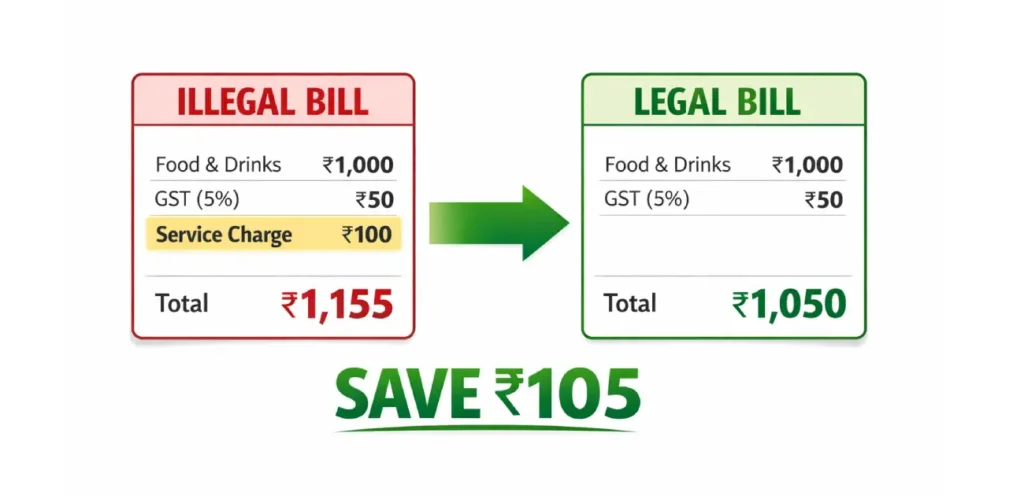
| Item | Non-Compliant Bill (Illegal) | Compliant Bill (Legal) |
| Subtotal (Food) | ₹1,000 | ₹1,000 |
| Service Charge (10%) | ₹100 (Added by Default) | ₹0 (Optional Tip) |
| Total Before GST | ₹1,100 | ₹1,000 |
| GST (5%) | ₹55 (On total + illegal fee) | ₹50 (On food only) |
| Final Bill Amount | ₹1,155 | ₹1,050 |
By refusing the mandatory charge, you save not only the ₹100 fee but also the extra ₹5 in GST that would have been wrongly collected.
Why Restaurants Do It
Why do restaurants risk these heavy penalties? The answer lies in “shadow pricing.” By keeping menu prices artificially low and adding a mandatory 10% fee at the end, restaurants appear more competitive on delivery apps like Zomato or Swiggy while effectively increasing their revenue by 10% without a corresponding increase in the listed price.
The industry lobby, the National Restaurant Association of India (NRAI), argues that these charges are “transparent” and help subsidize low wages for back-of-house staff. The government’s response is simple: if you need to pay your staff more, increase your menu prices honestly. You cannot force a “gratuity” as if it were a mandatory tax.
The Power is in Your Hands
Despite the law being on your side, a February 2026 survey by LocalCircles found that 59% of consumers still paid a service charge in the last month. Most did so to avoid a confrontation. This is the “guilt economy” at work, but the era of the forced tip is ending.
The Solution: Don’t Argue — Report
If a manager refuses to remove the service charge from your bill, do not engage in a heated argument. Follow this three-step protocol:
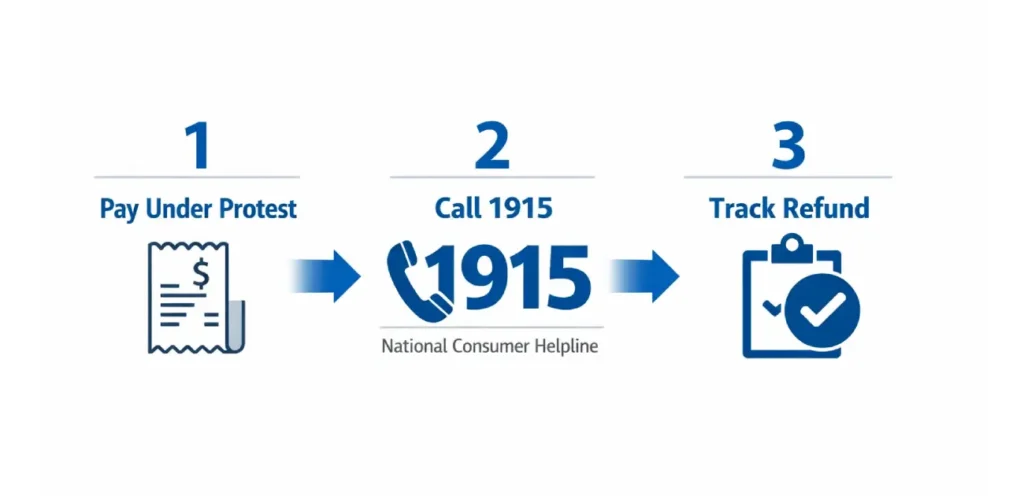
- Pay Under Protest: Pay the bill to avoid a scene, but ensure you keep the original itemized invoice.
- Lodge an Instant Complaint: Call 1915 (the National Consumer Helpline) or use the NCHS App (also known as the National Consumer Helpline NCH App).
- Track Your Refund: Every complaint generates a unique docket number. Between April and December 2025 alone, over ₹45 crore in refunds were secured for consumers through these platforms.
The government has done its part by penalizing 27 major chains this week. Now, it is up to the consumer to stop paying the shadow tax. The next time you dine out, remember: the 10% is yours to give, not theirs to take.
READ OUR OTHER ARTICLES
- Know the Real Reason Behind Tarun Kumar’s Death Over a Holi Balloon
 The Holi festival turned tragic in southwest Delhi this year. On Wednesday, March 4, 2026, the narrow lanes of a JJ Colony in Uttam Nagar became the center of a … Read more
 - T20 World Cup Final 2026: India vs New Zealand
 The cricket world is getting ready for its biggest event. On Sunday, March 8, 2026, the T20 World Cup 2026 final will take place. The stage is set for a … Read more
 - 1,000-Year-Old Kakatiya Vishnu Idol Found in Telangana
 The quiet forests of the Jayashankar Bhupalpally district in Telangana recently gave up a secret they had been keeping for a thousand years. In March 2026, as the summer heat … Read more
 - Kerala Set to Manufacture BrahMos Missile on 180-Acre
 India’s plan to become self-reliant in defense took a major leap forward on March 2, 2026. On this day, the Kerala Cabinet made a historic decision to give 180 acres … Read more
 - Why Aman Gupta Chose His Birthday to Reveal OFF/BEAT ?
 On March 3, 2026, the Indian startup world saw a digital shift that was as much about legacy as it was about the future. Aman Gupta, the famous co-founder of … Read more