

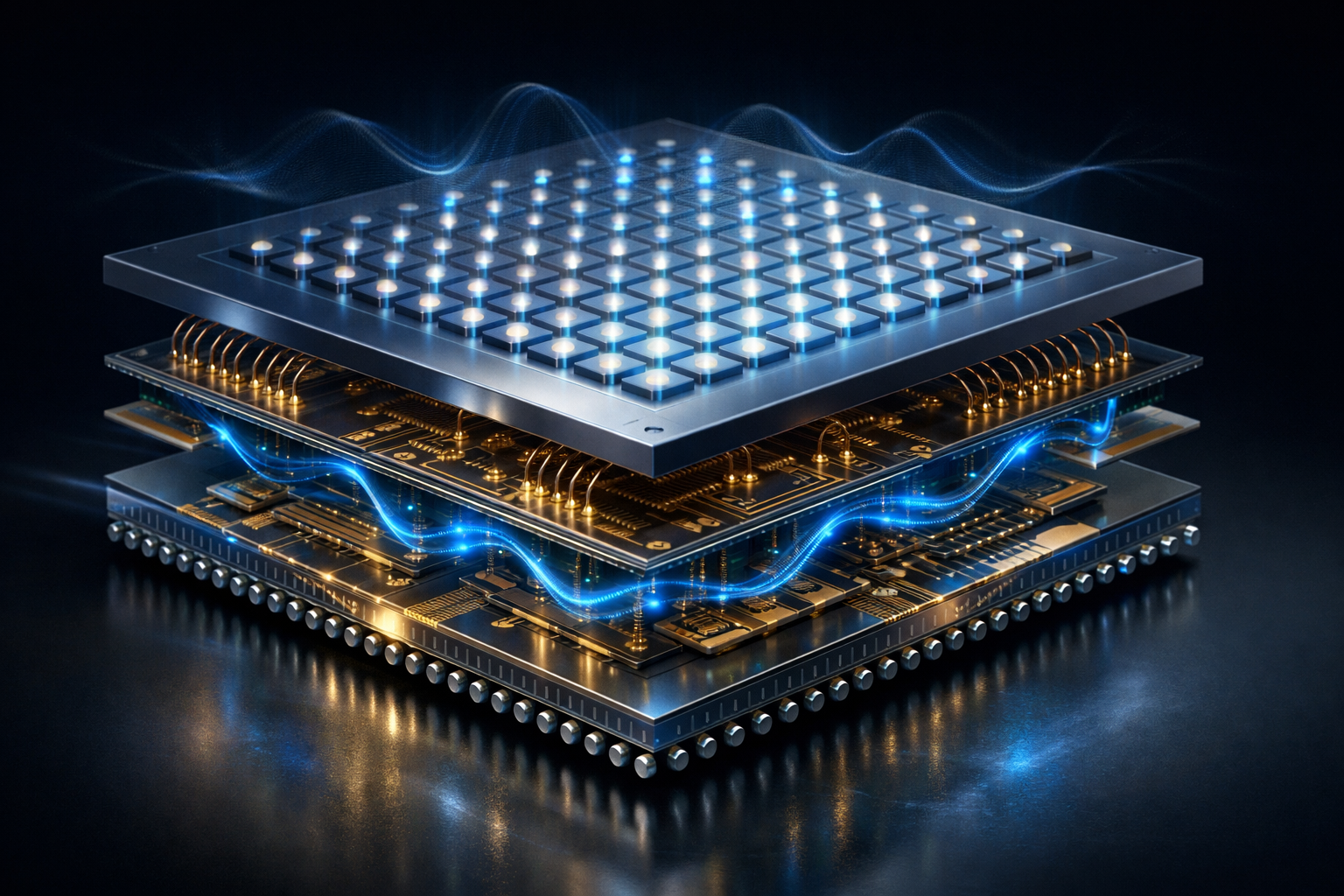
The global computational landscape is currently navigating a paradigm shift from classical binary logic to the probabilistic potential of quantum mechanics. In this high-stakes technological race, the capacity to design and fabricate indigenous quantum hardware has become a defining marker of scientific and strategic sovereignty. The recent unveiling of the Kaveri 64-qubit superconducting quantum processor by the Bengaluru-based startup QpiAI represents a pivotal milestone in India’s national history. This development formally positions India as one of only six nations globally with active, indigenous programs focused on the development of quantum hardware at this scale.
Launched in November 2025 at the Emerging Science, Technology and Innovation Conclave in Delhi, the Kaveri chip is a centerpiece of India’s “sovereign computing” ambition. Presided over by Prime Minister Narendra Modi and Union Minister for Science and Technology Dr. Jitendra Singh, the launch signifies India’s transition from a technology consumer to a global contributor in the subatomic frontier.
The Technical Genesis: Kaveri’s Superconducting Architecture
The Kaveri processor is built on a superconducting transmon qubit architecture, which is currently the most mature hardware pathway globally, also utilized by leaders like IBM and Google. However, QpiAI has introduced significant architectural innovations to address the scaling bottlenecks that plague early-stage quantum systems.
Flip-Chip Integration and 3D Architecture
One of the primary technical hurdles in scaling quantum computers is the “interconnect bottleneck”—the physical difficulty of routing control signals to qubits without introducing noise. QpiAI utilizes a proprietary “flip-chip integrated” design. This architecture involves a three-dimensional (3D) integration approach where the qubit layer is physically separated from the interconnect layer.
This separation serves critical functions:
- Reduced Decoherence: It significantly minimizes electromagnetic cross-talk and signal loss, which are primary drivers of gate errors.
- Enhanced Scalability: The 2D square lattice with 3D integration allows for higher qubit density without exponentially increasing the complexity of the wiring.
- Target Performance: The Kaveri chip targets a coherence time of 100 microseconds (
𝜇s), a significant improvement over its predecessor, the 25-qubit Indus system.
Technical Specifications and Roadmap
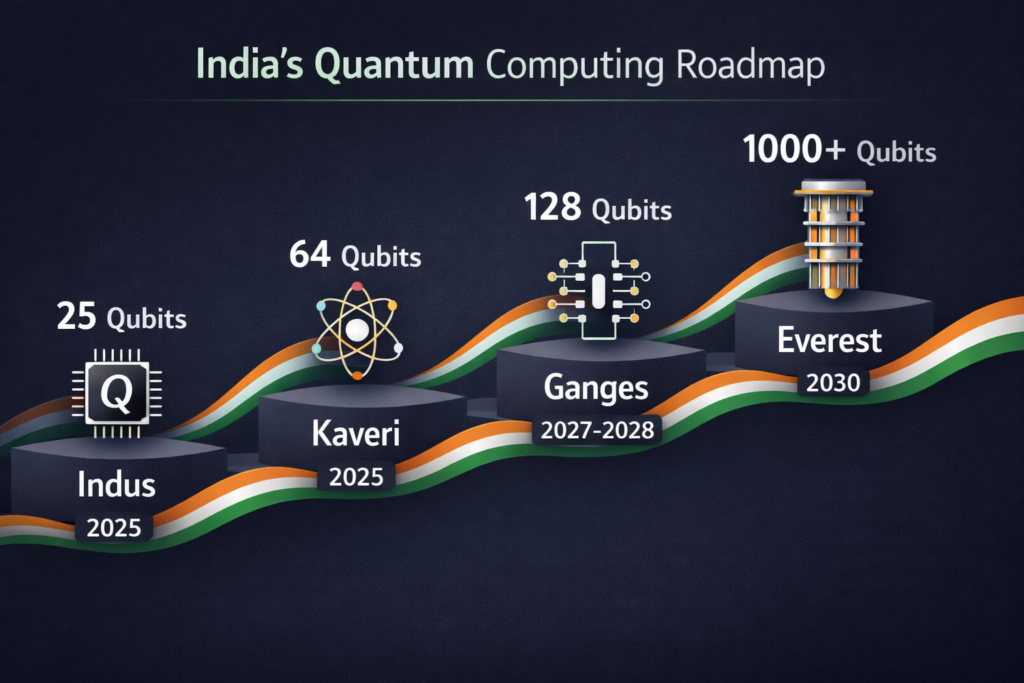
The Kaveri processor features an error rate target of 10^{-2}, utilizing built-in surface code error correction. The following table illustrates the progression from India’s first full-stack system to the utility-scale targets of 2030.
| Specification | QpiAI-Indus (Gen-1) | QpiAI-Kaveri (Gen-2) | QpiAI-Ganges (Gen-3) | QpiAI-Everest (Target) |
| Qubit Count | 25 NISQ Qubits | 64 NISQ Qubits | 128 NISQ Qubits | 1000+ NISQ Qubits |
| Architecture | Superconducting Transmon | Superconducting Transmon | Superconducting Transmon | Application-Optimal QPU |
| Release Date | April 2025 | November 2025 | 2026/2027 (Target) | 2030 (Target) |
| Target Coherence | 60 | 100 | 100 | 100+ |
| Integration | Standard Planar | 2D Square / 3D Integration | 2D Square / 3D Integration | High-Density 3D |
The Full-Stack Ecosystem: National Quantum Mission (NQM)
The emergence of Kaveri is inextricably linked to the National Quantum Mission (NQM), a multi-billion-rupee initiative aimed at positioning India as a global leader in next-generation computing. QpiAI is one of eight startups selected and funded under the NQM, reflecting a shift toward aggressive public-private partnerships.
Dr. Ajai Chowdhry, Chairman of the Mission Governing Body for NQM, noted that QpiAI launched the Kaveri system “much ahead of time,” urging research institutions and government departments to adopt the hardware for algorithm development. This mission provides a platform for talent development, bringing together hardware engineers, algorithm developers, and toolchain specialists to create a robust domestic supply chain.
Strategic Utility: Industry Verticals and the Hybrid AI Model
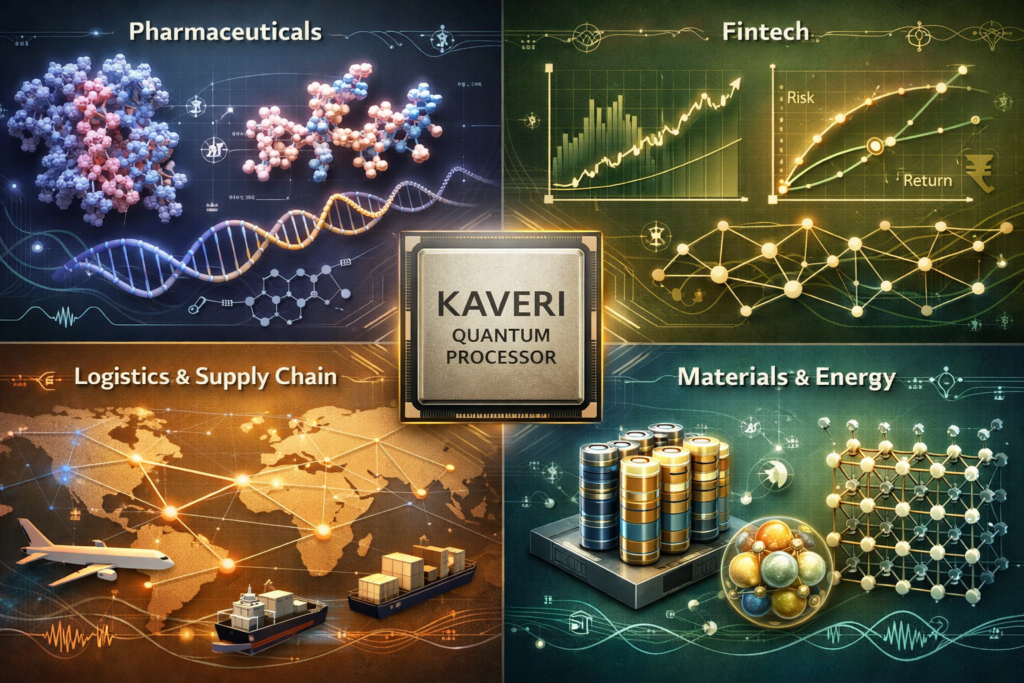
The Kaveri processor is not merely a laboratory prototype; it is designed for utility-scale applications, with commercial availability slated for Q3 2026. QpiAI employs a hybrid quantum-classical model, where the quantum processor acts as a specialized accelerator for complex sub-tasks while classical AI handles high-level logic.
1. Pharmaceuticals and Drug Discovery
Simulating the exact electronic structure of complex molecules is computationally impossible for classical supercomputers. With its 64-qubit capacity, Kaveri can model molecular interactions with high precision, accelerating lead optimization and reducing the time-to-market for life-saving drugs.
2. Finance and Risk Management
India’s fintech sector can leverage Kaveri for portfolio optimization and real-time fraud detection. Quantum-enhanced machine learning (QML) algorithms can identify anomalies in vast datasets with higher accuracy and lower latency than traditional methods.
3. Logistics and Supply Chain
Kaveri excels at solving massive optimization problems, such as multi-modal freight routing and warehouse management. For instance, it can optimize real-time traffic grids in smart cities or national-scale scheduling for rail and port networks, drastically reducing operational costs.
4. Materials Science and Energy
Designing new materials for the green energy transition—such as higher-efficiency batteries for electric vehicles (EVs) or carbon-capture materials—requires the precise atomic-level simulation that only quantum systems can provide.
Geopolitics of the “Quantum Superpower Club”
By building the Kaveri chip domestically, India joins an elite circle of nations—including the US, China, Canada, and France—that possess the sovereign capacity to maintain a full quantum hardware stack.
National Security and Data Sovereignty
Indigenous hardware is critical for national security. Quantum computers have the theoretical potential to break traditional RSA and ECC encryption. While Kaveri is not yet powerful enough for such tasks, having a domestic hardware program ensures India is ready for the “Post-Quantum Era” by developing quantum-resistant cryptographic systems. Domestic fabrication also mitigates the risk of “black box” hardware dependencies, where foreign components could theoretically harbor backdoors or be subject to remote disabling during geopolitical conflicts.
Conclusion: A New Era of Indian Science
The launch of the Kaveri 64-qubit processor is a defining moment in India’s deep-tech journey. It represents a successful convergence of world-class talent, venture capital, and visionary government policy. As Dr. Nagendra Nagaraja, Founder and CEO of QpiAI, stated: “Kaveri 64 shows what can be done when Indian innovation meets strong teamwork.” By securing a foothold in the global quantum hardware race, India has ensured its strategic and economic autonomy in the century of subatomic computation.
READ OUR OTHER ARTICLES
- T20 World Cup Final 2026: India vs New Zealand
 The cricket world is getting ready for its biggest event. On Sunday, March 8, 2026, the T20 World Cup 2026 final will take place. The stage is set for a … Read more
 - 1,000-Year-Old Kakatiya Vishnu Idol Found in Telangana
 The quiet forests of the Jayashankar Bhupalpally district in Telangana recently gave up a secret they had been keeping for a thousand years. In March 2026, as the summer heat … Read more
 - Kerala Set to Manufacture BrahMos Missile on 180-Acre
 India’s plan to become self-reliant in defense took a major leap forward on March 2, 2026. On this day, the Kerala Cabinet made a historic decision to give 180 acres … Read more
 - Why Aman Gupta Chose His Birthday to Reveal OFF/BEAT ?
 On March 3, 2026, the Indian startup world saw a digital shift that was as much about legacy as it was about the future. Aman Gupta, the famous co-founder of … Read more
 - Who’s Behind ViRosh’s Wedding Jewelry & Outfits?
 For a long time, celebrity weddings in India seemed to follow a very specific script. We saw a sea of pastel colors, minimalist decor, and a focus on what would … Read more