

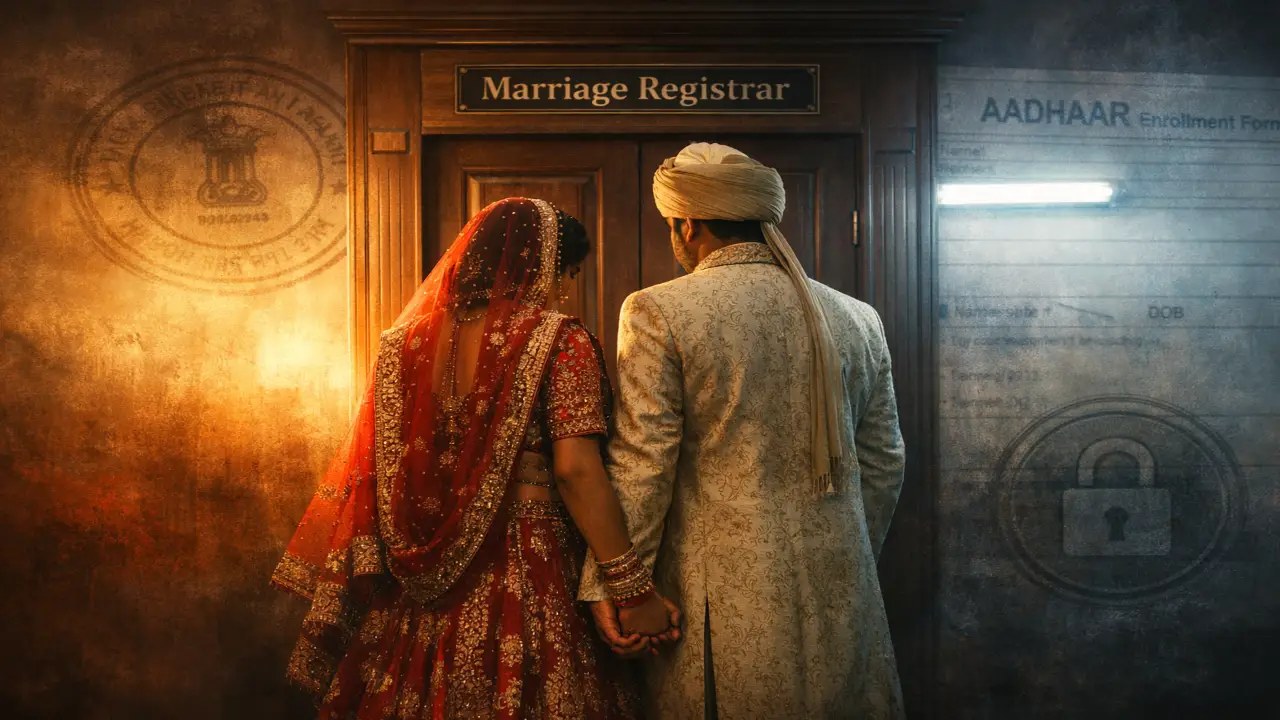
On February 20, 2026, the Gujarat state assembly discussed a big change to how people get married. Deputy CM Harsh Sanghavi introduced new rules for the Gujarat Registration of Marriages Act 2006. He said these rules are meant to act as a “shield” to protect young women. But if you look closer, these rules make it much harder for adults to make their own choices. By starting the Parental Notification Rule, the government is now helping families keep an eye on their adult children. This report explains how these new rules work, why politicians are supporting them, and why they might be illegal under India’s Constitution.
Gujarat’s 2026 Marriage Draft
| Rule | What it says |
| The Main Change | Parents must be told whenever a couple applies to register their marriage. |
| The Timeline | The government will send a notice to parents within 10 days of the application. |
| The Waiting Period | Couples must wait 30 to 40 days before they can get their final marriage certificate. |
| Where to Register | Couples can only register in the area where the bride lives (according to her Aadhaar address). |
| Legal Problem | This ignores Article 21 Right to Choose, which says adults can pick their own partners without permission. |
The Bureaucratic Hurdles
The new rules create several “speed bumps” or hurdles for couples. In the past, registering a marriage was mostly about keeping a record. Now, it has become a way for the state to check in with a couple’s family before the marriage is finalized.
WhatsApp Alerts and 10-Day Notices
Under the new system, couples must sign a form saying whether or not their parents know about the wedding. They must also give the government their parents’ phone numbers, Aadhaar details, and home addresses. Once the Assistant Registrar gets this information, they have exactly 10 working days to notify the parents.
The government plans to use modern technology like WhatsApp and SMS to send these alerts instantly. For couples who have run away to get married because their families are against it, this is very dangerous. It takes away the “safety window” they used to have to find a safe place to stay before their parents found out where they were.
The 40-Day Wait and the Aadhaar Rule
The second hurdle is the long waiting period. In the old system, registration could happen quickly. Now, couples must wait at least 30 to 40 days. During this time, the government will upload the couple’s photos and witness details to a public website. This gives families plenty of time to find the couple and try to stop the wedding.
Another major change is where you can register. Before, a couple could register their marriage in any city, like Ahmedabad, where they felt safe. Now, they must register in the area where the bride’s Aadhaar card is registered. This means eloping couples are forced back to their hometowns, where their local community and caste leaders can easily find them and pressure them to stop the marriage.

“Protecting Daughters”
The language used by politicians in the assembly was very strong. Harsh Sanghavi talked about “Love Jihad” and said the state must stop a “Salim posing as a Suresh”. He argued that these rules are needed to protect “Sanatan tradition” and keep “innocent girls” from being tricked.
Everyone Seems to Agree
One of the most surprising things is that almost all political parties in Gujarat support these rules. It is not just the BJP. The Aam Aadmi Party (AAP) legislator, Hemant Ahir, even claimed that his party came up with the idea first. Senior Congress leaders, like Geniben Thakor, have also supported the move. Thakor has said that “99% of love marriages fail” and that young girls often get “carried away” by their emotions.
This happens because big community groups, such as the Patidars and the Thakors, have been asking for these rules for a long time. These groups want to stop “love marriages” for two main reasons:
- Caste Tradition: They want to make sure people only marry within their own caste.
- Property: They are worried that if a woman marries outside the caste, she will still claim a share of the family’s land and property, which they want to keep within their own community.
The Legal Reality
Even though the politicians like these rules, legal experts say they might be unconstitutional. The main issue is Article 21, which is the part of the Indian Constitution that protects a person’s life and liberty.
The Right to Choose Your Partner
The Supreme Court of India has said many times that two adults have the right to marry whoever they want. In the famous Supreme Court Hadiya Verdict (Shafin Jahan v. Asokan K.M.), the judges were very clear: the state and the family have no right to choose a partner for an adult.
In another case, Lata Singh v. State of Uttar Pradesh, the Court said the government should protect couples who marry against their parents’ wishes, not help the parents find them. By sending WhatsApp alerts to parents, the Gujarat government is doing the exact opposite of what the Supreme Court ordered.
The “Objection” Loophole
The biggest legal problem is the “objection” window. The rules say that during the 40-day wait, people can file “objections”. But the law does not explain what a “valid” objection is.
Usually, you can only object to a marriage if it is illegal, for example, if one person is already married to someone else. But if these rules allow a father to stop a marriage just because he doesn’t like the groom, it gives the family a “veto” over the daughter’s choice. This would be a major violation of her rights.
A Battle in the Courts
The 2026 changes to the Gujarat Registration of Marriages Act 2006 are a way for the government to bring back old family controls using new technology. By using the Parental Notification Rule, the state is acting like a “Nanny State” that doesn’t trust its own adult citizens to make their own choices.
Lawyers are already preparing to challenge these rules in court. They will argue that the rules:
- Invade Privacy: The government shouldn’t share a couple’s private wedding photos on a public portal.
- Discriminate against Women: The rules focus on “protecting daughters” as if women are not capable of making their own decisions.
- Break Supreme Court Rules: The rules go against the Supreme Court Hadiya Verdict which protects individual freedom.
For now, the government has asked for public feedback for 30 days. But soon, the highest courts in India will have to decide: Does an adult in Gujarat truly have the right to choose their own life partner, or do they still need their parents’ permission?
READ OUR OTHER ARTICLES
- Know the Real Reason Behind Tarun Kumar’s Death Over a Holi Balloon
 The Holi festival turned tragic in southwest Delhi this year. On Wednesday, March 4, 2026, the narrow lanes of a JJ Colony in Uttam Nagar became the center of a … Read more
 - T20 World Cup Final 2026: India vs New Zealand
 The cricket world is getting ready for its biggest event. On Sunday, March 8, 2026, the T20 World Cup 2026 final will take place. The stage is set for a … Read more
 - 1,000-Year-Old Kakatiya Vishnu Idol Found in Telangana
 The quiet forests of the Jayashankar Bhupalpally district in Telangana recently gave up a secret they had been keeping for a thousand years. In March 2026, as the summer heat … Read more
 - Kerala Set to Manufacture BrahMos Missile on 180-Acre
 India’s plan to become self-reliant in defense took a major leap forward on March 2, 2026. On this day, the Kerala Cabinet made a historic decision to give 180 acres … Read more
 - Why Aman Gupta Chose His Birthday to Reveal OFF/BEAT ?
 On March 3, 2026, the Indian startup world saw a digital shift that was as much about legacy as it was about the future. Aman Gupta, the famous co-founder of … Read more