

Journey of the Gem
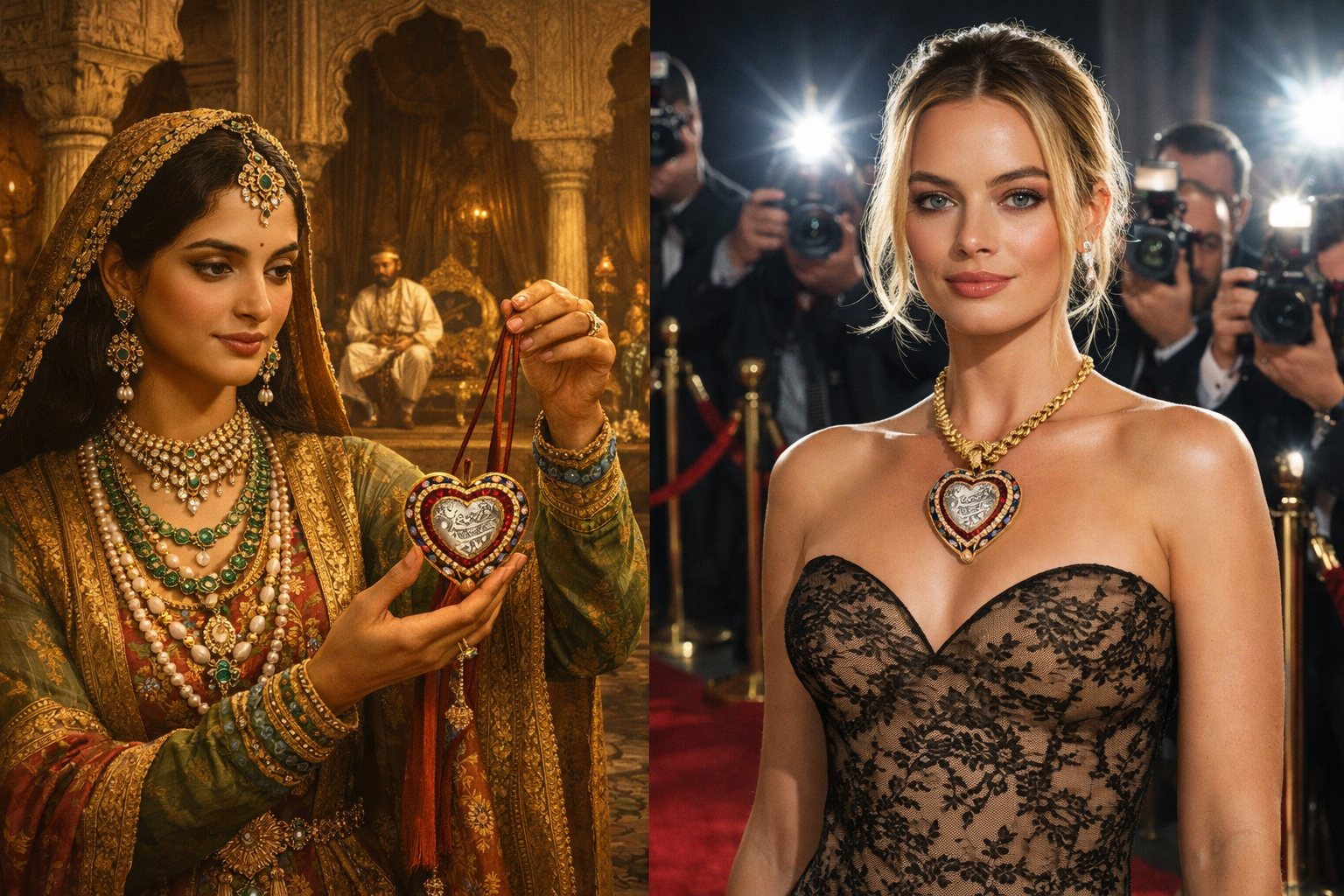
- 1627–1628: Mughal Court – Commissioned by Emperor Jahangir for Empress Nur Jahan; inscribed with the year 1037.
- 1631: The Succession – Passed to Shah Jahan, who gifted it to Mumtaz Mahal before her death.
- 1739: The Exodus – Believed to be looted from Delhi during Nadir Shah’s invasion.
- 1972: JFK Airport Exchange – Cartier President Michael Thomas presents the necklace to Richard Burton and Elizabeth Taylor.
- 2011: The Record Sale – Sold at Christie’s for $8.8 million following Taylor’s passing.
- 2026: The Hollywood Revival – Margot Robbie wears the jewel to the Wuthering Heights World Premiere.
On January 28, 2026, the world premiere of Wuthering Heights at the TCL Chinese Theatre provided the stage for a collision of Mughal history and Hollywood “method dressing”. Margot Robbie walked the red carpet in a custom Schiaparelli gown that evoked the Gothic decay of the Yorkshire moors, but the true protagonist was the artifact at her throat: the ₹74 crore Taj Mahal Diamond. The irony was palpable—an Australian actress promoting a quintessentially British romance while draped in a 400-year-old Indian treasure. This was not merely a red-carpet accessory; it was a ghost of imperial power and romantic devotion resurrected for a global audience.
Decoding the Mughal Relic
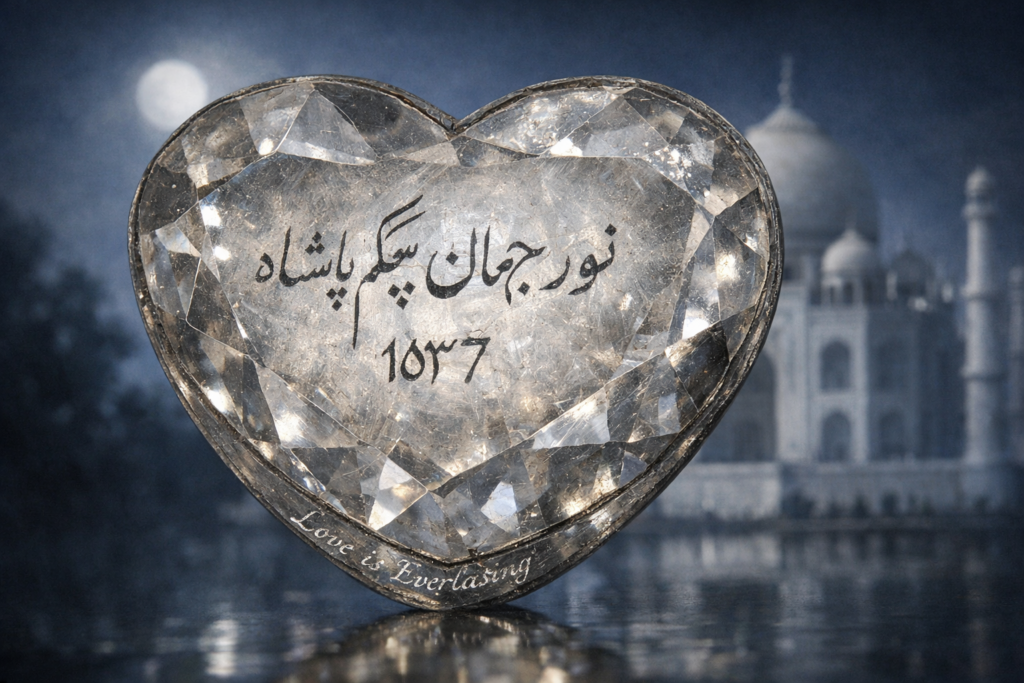
The diamond’s story begins in the 17th-century Mughal Court, an era where gems were more than wealth—they were diaries. The heart-shaped, table-cut “lasque” diamond features a Persian inscription in Arabic characters: “Nur Jahan Begum-e-Padshah 1037”. This identifies the original owner as Empress Nur Jahan, the formidable “power behind the throne” for Emperor Jahangir.
The lineage of the stone is a map of Mughal succession. From Jahangir, it passed to his son, Shah Jahan, who eventually gifted the diamond to his most adored wife, Mumtaz Mahal. The tragedy of her death in childbirth in 1631 inspired the construction of the Taj Mahal, forever fusing the monument’s name to this specific gemstone. The inscription “Love is Everlasting” remains etched upon its surface, a permanent testament to an empire’s romantic legacy.
Love and Death: Method Dressing
Robbie and her stylist, Andrew Mukamal, chose the piece to underscore the “Method Dressing” synonymous with her recent press tours. The choice was deeply symbolic: Robbie drew a direct parallel between the tempestuous real-life romance of Richard Burton and Elizabeth Taylor and the doomed passion of Cathy and Heathcliff.
Just as Burton claimed he would have bought Taylor the actual Taj Mahal if it were transportable, the diamond represents a “Heart of the Ocean” equivalent for the Wuthering Heights universe. The necklace symbolizes a love that transcends death, mirroring the film’s morbid romanticism. By wearing Taylor’s favorite relic, Robbie positioned the film as a stylized tribute to Old Hollywood epics, where the weight of the jewelry matches the weight of the tragedy.
From Silk to Gold
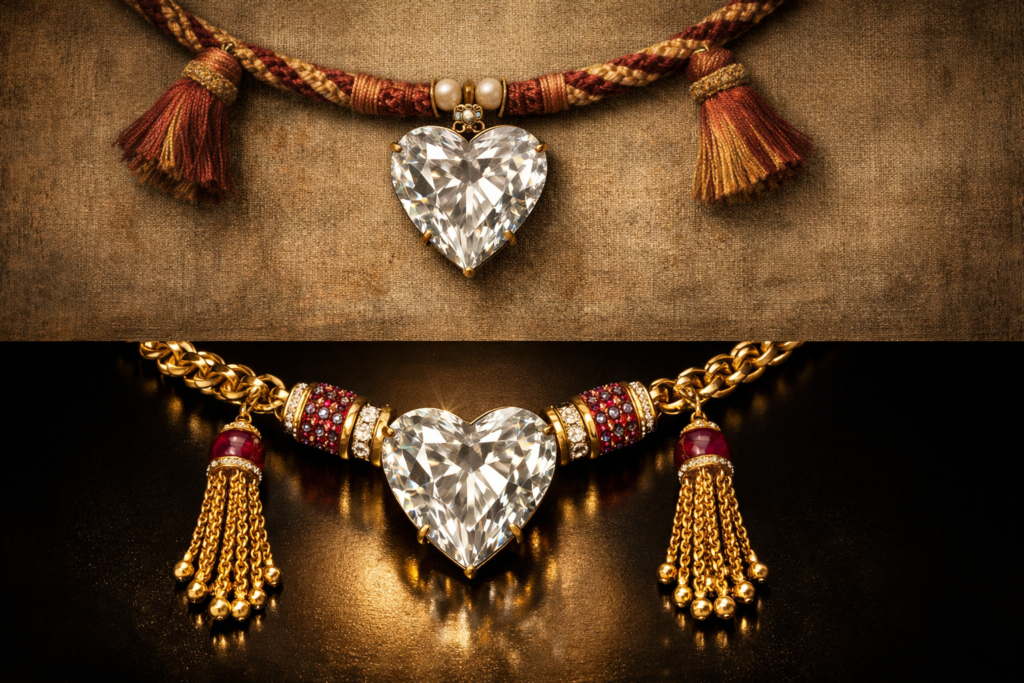
While the diamond is ancient, its current setting is a 1970s Cartier masterpiece. Originally, the Mughal pendant would have hung from a traditional Indian silk cord. In 1971, Cartier designer Alfred Durante replaced this with a woven gold and ruby chain designed to mimic the cord’s original silhouette, adding adjustable rondelles and a decorative tassel at the back. This transformation by the French maison allowed the stone to travel from an imperial treasury to the neck of a Hollywood legend during a famous 1972 layover at JFK Airport, where Burton purchased it as a 40th birthday gift for Taylor.
The “Colonial Elephant” in the Room
However, the visual triumph was met with a critical backlash regarding cultural heritage. Online debates mirrored the controversy of the 2022 Patiala Necklace incident, as critics accused the media of “whitewashing” the diamond’s history. By focusing almost exclusively on the Taylor-Burton provenance, many felt the stone’s 300 years of Indian heritage were erased.
The moment served as a stark reminder of the “elephant in the room”: the sheer volume of Indian heritage currently sitting in Western vaults or private collections. For many in the South Asian diaspora, seeing the jewel on a Hollywood red carpet was less a tribute to romance and more a reminder of historical displacement and the ease with which imperial treasures are rebranded as Western luxury.
Conclusion
Margot Robbie’s appearance with the Taj Mahal Diamond proves that jewelry carries ghosts. Whether viewed as an emblem of Mughal devotion, a token of Hollywood excess, or a relic of colonial history, the gem’s narrative remains fluid. As the artifact returns to its vault, it leaves behind a renewed global discourse on the ethics of the archive and the power of a single stone to tell the story of two different worlds.
READ OUR OTHER ARTICLES
- Know the Real Reason Behind Tarun Kumar’s Death Over a Holi Balloon
 The Holi festival turned tragic in southwest Delhi this year. On Wednesday, March 4, 2026, the narrow lanes of a JJ Colony in Uttam Nagar became the center of a … Read more
 - T20 World Cup Final 2026: India vs New Zealand
 The cricket world is getting ready for its biggest event. On Sunday, March 8, 2026, the T20 World Cup 2026 final will take place. The stage is set for a … Read more
 - 1,000-Year-Old Kakatiya Vishnu Idol Found in Telangana
 The quiet forests of the Jayashankar Bhupalpally district in Telangana recently gave up a secret they had been keeping for a thousand years. In March 2026, as the summer heat … Read more
 - Kerala Set to Manufacture BrahMos Missile on 180-Acre
 India’s plan to become self-reliant in defense took a major leap forward on March 2, 2026. On this day, the Kerala Cabinet made a historic decision to give 180 acres … Read more
 - Why Aman Gupta Chose His Birthday to Reveal OFF/BEAT ?
 On March 3, 2026, the Indian startup world saw a digital shift that was as much about legacy as it was about the future. Aman Gupta, the famous co-founder of … Read more