

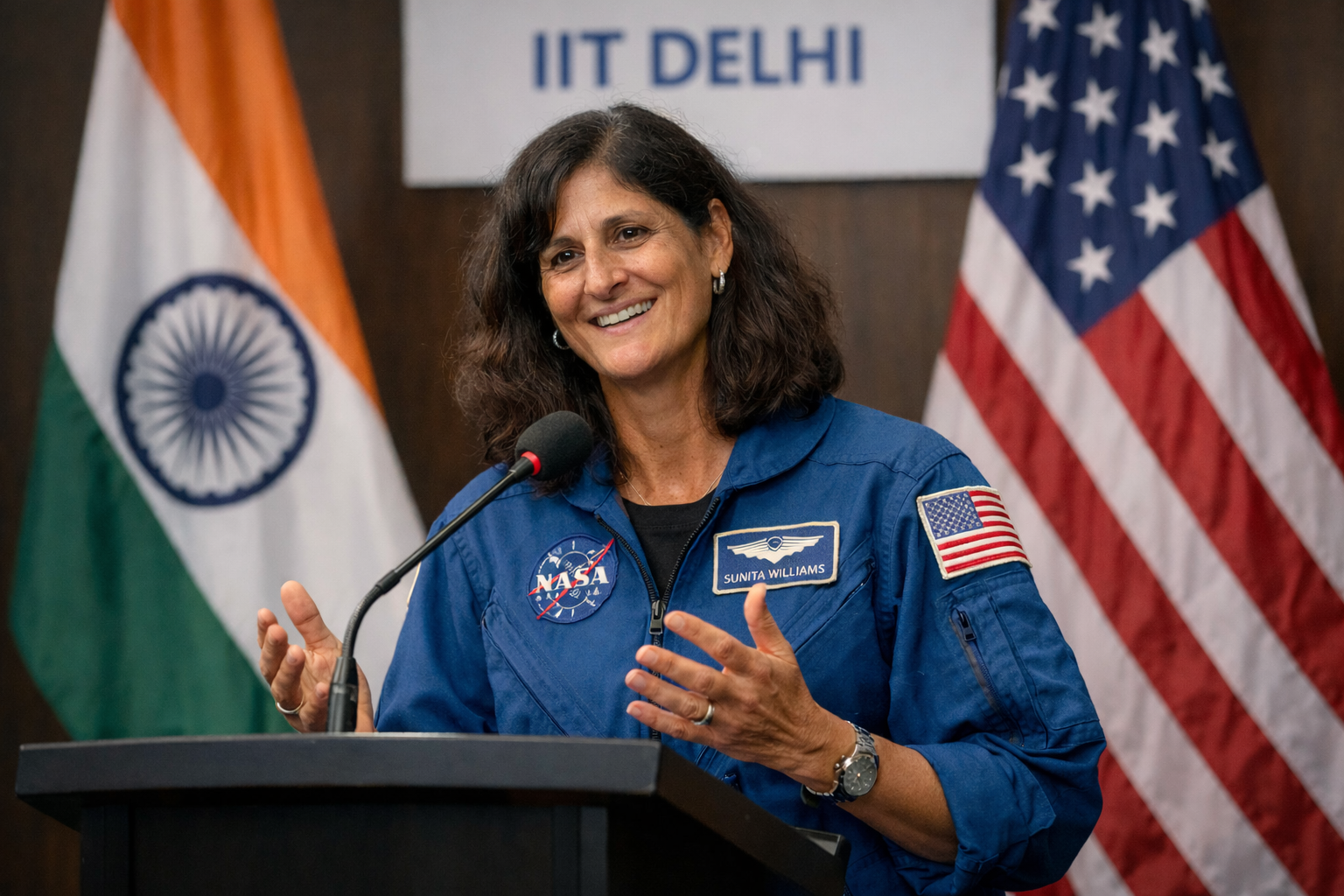
For Sunita Williams, gravity has always felt a little heavier than it does for the rest of us. On Wednesday, in the Indian capital, the 60-year-old astronaut finally announced she is stopping the clock. After 27 years, three missions, and a staggering 608 days in orbit, Williams is retiring from NASA.
It is a retirement that marks the end of an era for the American space agency. When Williams was selected as a Naval aviator in 1998, the ISS was little more than a few lonely modules drifting in the dark. Today, as she steps away, she leaves behind a station that is a bustling laboratory, one she commanded twice. The woman who once cut her hair in microgravity for charity and ran a marathon on a treadmill while circling the Earth has evolved from an energetic rookie into the steady hand of NASA’s most uncertain decade.
The Marathon Runner
To understand the endurance of Sunita Williams, you have to look back to the “Marathon Years.” Long before her recent unplanned residency in orbit, she was already redefining what the human body could do in the void. During Expedition 14 in 2007, she didn’t just survive space; she competed with it. Strapped to a treadmill with bungee cords to simulate gravity, she ran the Boston Marathon in 4 hours and 24 minutes while the station orbited the Earth twice
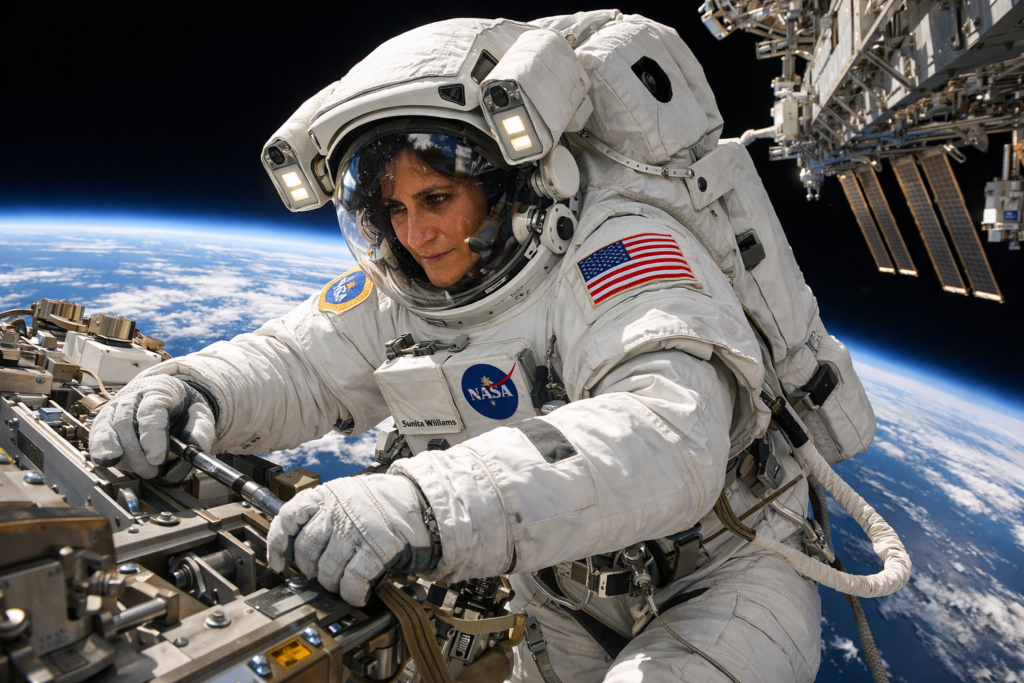
It wasn’t a stunt; it was a statement. Williams belonged to a generation of astronauts who transitioned NASA from the short sprints of the Space Shuttle era to the grueling marathons of permanent occupation. Across Expeditions 14 and 32, she racked up seven spacewalks, spending over 50 hours in the vacuum fixing solar arrays and ammonia pumps with the calm precision of a mechanic working on a Sunday afternoon. She held the record for total spacewalk time by a woman for years, a title she traded back and forth with her peer Peggy Whitson, pushing the ceiling higher for every woman who followed.
The Unexpected Odyssey
But no amount of training could have fully prepared her for the mission that would become her swan song: the Boeing Starliner crew flight test of June 2024.
It was supposed to be a sprint, an eight-day “shakedown” cruise to certify a new commercial vehicle. Williams, alongside Butch Wilmore, launched with the confident grin of a test pilot ready to put a new bird through its paces. But space is unforgiving of timelines. When thruster anomalies and helium leaks plagued the Starliner spacecraft, NASA leadership and the astronauts faced an agonizing choice.
For weeks, the world watched as the “eight-day” mission stretched into a month, then two. The decision to return Starliner empty in September 2024 was the first defining moment of this odyssey. As Williams watched her ship, Calypso, undock and drift away into the blackness without her, the mission shifted from a test flight to a test of will. She was no longer a visitor; she was a castaway with a job to do.
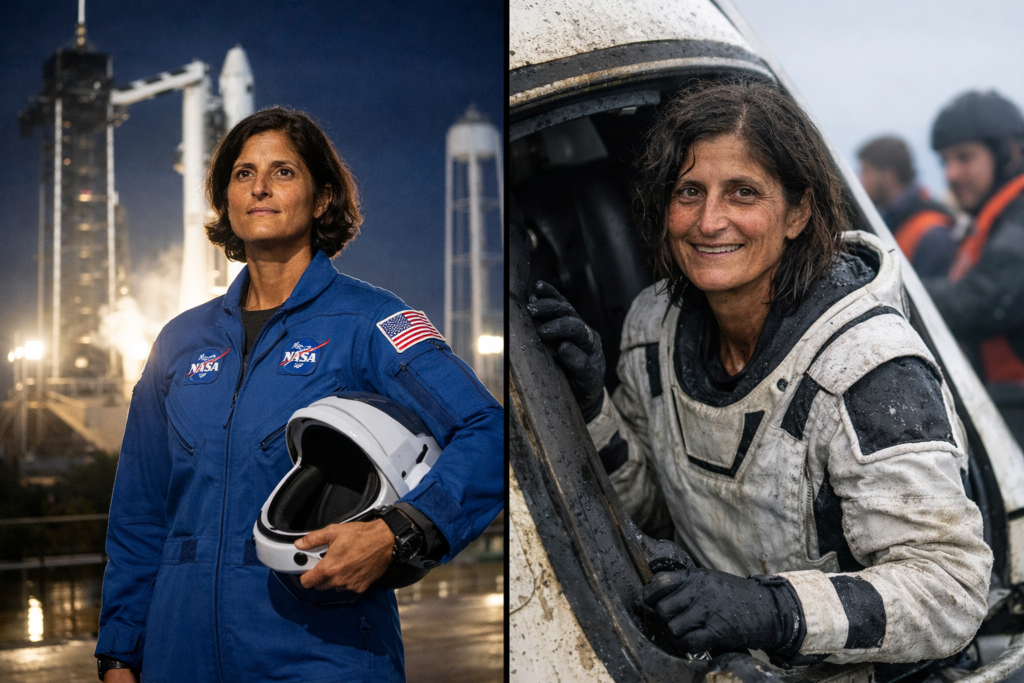
For the next six months, Williams demonstrated the “right stuff” that isn’t taught in flight simulators. She didn’t just wait for a ride home; she integrated into the station’s crew, taking over daily maintenance and scientific duties. She missed Christmas, New Year’s, and anniversaries, watching the Earth turn below her for 286 unplanned days. When she finally splashed down in March 2025 aboard a SpaceX Dragon, a rival capsule to the one she launched in, she emerged frail but smiling, having secured the second-highest cumulative time in space of any NASA astronaut in history.
The Homecoming
It is fitting, perhaps, that her final public act as an active astronaut is taking place in India. Williams has always straddled two worlds—the Ohio-born Naval officer and the daughter of Deepak Pandya, a neuroanatomist from Gujarat.
This week in New Delhi, the symbolism was palpable. Williams met with the family of Kalpana Chawla, the Indian-born astronaut lost in the Columbia disaster. In embracing Chawla’s 90-year-old mother, Sanyogita, Williams closed a circle of grief and ambition that has defined the Indian-American relationship with spaceflight for two decades. “I look for India from the window,” she told a rapt audience at the American Center, describing the view from 250 miles up. “It’s where my father’s story began, and in a way, where mine does too.”
The Torch Passes
As she steps down, the landscape of space is shifting. NASA Administrator Jared Isaacman, himself a commercial astronaut who recently took the agency’s helm, called Williams “the bridge between the Shuttle era and the commercial future.”
Her 608 days in space are more than a statistic; they are a receipt for the toll exacted on the human body to pave the way for Artemis. When the next generation of astronauts walks on the Moon, they will do so on legs that stayed strong because Sunita Williams ran a marathon in the sky to show them it was possible.
“I want to go to the Moon,” she joked to the crowd in Delhi yesterday, “but my husband will not allow me.” It was a laugh line, but for a woman who turned an eight-day trip into a nine-month odyssey, the truth is clear: Sunita Williams has already given enough. She has earned her gravity.
READ OUR OTHER ARTICLES
- Know the Real Reason Behind Tarun Kumar’s Death Over a Holi Balloon
 The Holi festival turned tragic in southwest Delhi this year. On Wednesday, March 4, 2026, the narrow lanes of a JJ Colony in Uttam Nagar became the center of a … Read more
 - T20 World Cup Final 2026: India vs New Zealand
 The cricket world is getting ready for its biggest event. On Sunday, March 8, 2026, the T20 World Cup 2026 final will take place. The stage is set for a … Read more
 - 1,000-Year-Old Kakatiya Vishnu Idol Found in Telangana
 The quiet forests of the Jayashankar Bhupalpally district in Telangana recently gave up a secret they had been keeping for a thousand years. In March 2026, as the summer heat … Read more
 - Kerala Set to Manufacture BrahMos Missile on 180-Acre
 India’s plan to become self-reliant in defense took a major leap forward on March 2, 2026. On this day, the Kerala Cabinet made a historic decision to give 180 acres … Read more
 - Why Aman Gupta Chose His Birthday to Reveal OFF/BEAT ?
 On March 3, 2026, the Indian startup world saw a digital shift that was as much about legacy as it was about the future. Aman Gupta, the famous co-founder of … Read more