

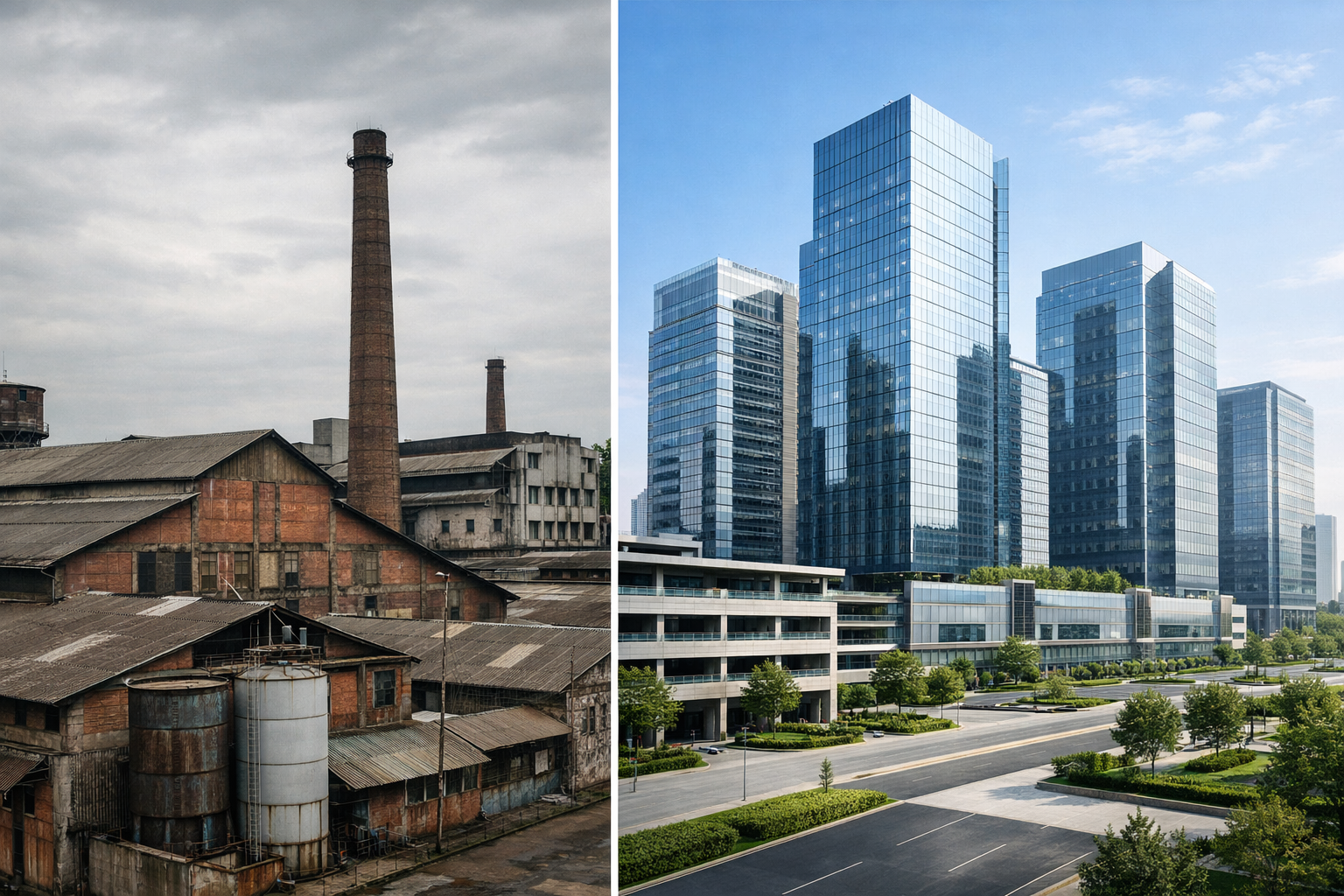
| Feature | The Industrial Past (1929–2016) | The Commercial Future (2026 Onward) |
| Identity | Birthplace of Parle-G; Global Biscuit Hub | Multi-use Commercial & Retail Hub |
| Structures | 21 Ageing Industrial Sheds | 4 Modern Buildings + 2 Parking Towers |
| Height | Low-slung sheds & Iconic Chimney | Capped at ~30m (Airport Funnel Zone) |
| Greenery | 508 Trees (Industrial Canopy) | 2,230 Trees (Miyawaki Mini-Forest) |
| Project Cost | Legacy Industrial Value | ₹3,961.39 Crore Redevelopment |
The January 2026 Reckoning
In the high-stakes theater of Mumbai real estate, rumors often precede reality by a decade, but for the 13.45-acre land parcel in Vile Parle East, the time for speculation has officially expired. On January 7, 2026, the State Environment Impact Assessment Authority (SEIAA) issued the final regulatory death warrant for the physical remnants of the Parle Products factory. This SEIAA Clearance Jan 2026 serves as the definitive trigger, authorizing the demolition of 21 ageing structures that have stood as a local landmark since 1929.
This is no longer a nostalgic conversation; it is a meticulously planned ₹3,961 Cr Redevelopment that aims to fundamentally alter the Santacruz-Vile Parle corridor. The scale is staggering: a total built-up area of 1,90,360.52 square meters. For a city that has spent decades purging its industrial core, the falling of the Parle gates represents the final surrender of the Western Suburbs’ industrial soul. The blueprints detail four commercial buildings and two parking towers, reaching heights restricted by the Airport Height Restrictions of the Mumbai Airport Funnel Zone.
The Ghost of Vile Parle East
For the urban historian, Mumbai is a city experienced primarily through the nose. Long before the GPS-guided era, a commuter traveling on the Western Line knew exactly when the train pulled into Vile Parle. It was an involuntary sensory recognition: a sudden, sweet, and comforting blanket of baking glucose that would waft through the open windows, momentarily drowning out the salt of the sea and the grime of the city. This “Smell of Biscuits” was the neighborhood’s auditory and olfactory signature for nearly nine decades.
That smell technically died in mid-2016 when production at the facility ceased due to declining productivity. For the past ten years, the factory has been a silent skeleton—a 13-acre ghost that continued to house staff quarters but had lost its productive pulse. Now, in 2026, the skeleton itself is to be razed. The chimneys that once exhaled the aroma of childhood will be dismantled, replaced by the neutral, filtered scent of climate-controlled lobbies and retail food courts.
The Chauhan Family Legacy
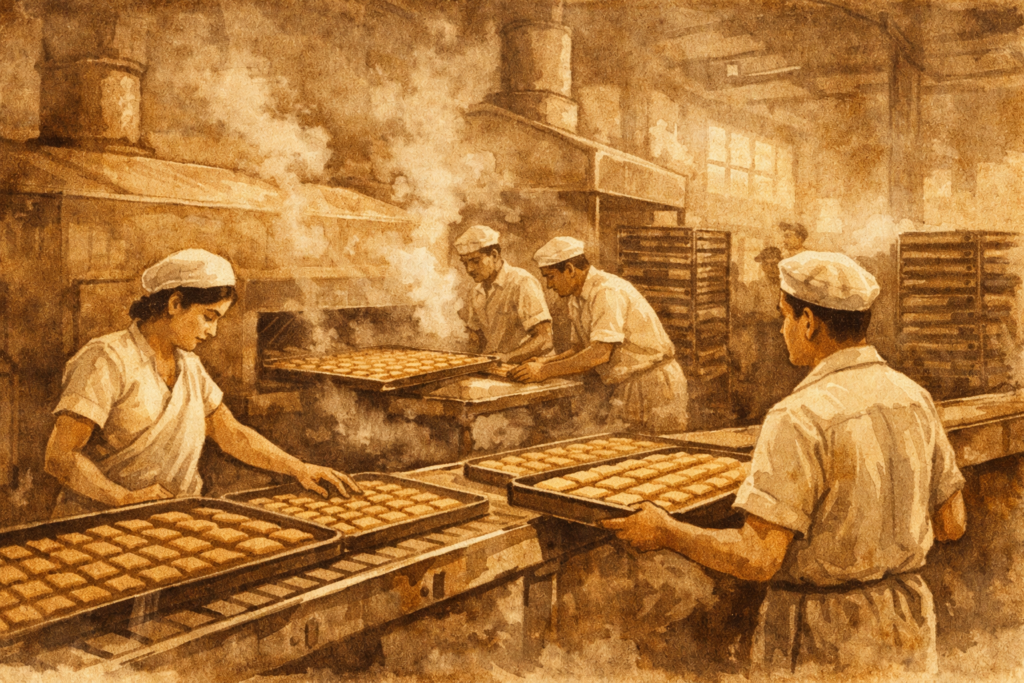
To understand the weight of this demolition, one must look back to the Chauhan Family Legacy and the foundational year of 1929. Mohanlal Dayal Chauhan, a visionary trader who initially struggled in the silk business, pivoted toward confectionery during the height of the Swadeshi movement. He saw the reliance on imported British biscuits as both a market opportunity and a nationalist affront.
Armed with knowledge from Germany and machinery worth ₹60,000, Chauhan set up shop with a mere 12 workers in what was then a cattle shed in the village of Parla. By 1939, the first “Parle Gluco” biscuit was baked, designed specifically to be an affordable source of nutrition for the common Indian. The factory’s role expanded during World War II, when it was licensed to supply biscuits to the British Army, an ironic turn of history where the “colonizer” was fueled by the Swadeshi entrepreneur’s product.
Correcting the Naming Myth
As a historian, one must frequently correct the popular myth that Vile Parle was named after the Parle-G factory. The truth is rooted in the geography of old Mumbai. In the late 19th century, before the Chauhans arrived, the area was composed of hamlets: Vidlai (or Padle) near Santacruz and Irle near Andheri. When the Western Railway established a station between these villages, it utilized a portmanteau of the names, recorded in early documents as “Vidlai Padlai”.
Alternative theories suggest the name is a homage to the twin deities of Virleshwar and Parleshwar, whose temples continue to serve as spiritual anchors. In a stroke of accidental branding, the Chauhan family was reportedly so preoccupied with the engineering hurdles of their new factory in 1929 that they forgot to name the enterprise. Locals simply called it the “Parle factory” after its location, and the name eventually became a global FMCG icon.
The Real Estate Logic
The question of “Why now?” is answered by the relentless shift from “Manufacturing Mumbai” to “Service Sector Mumbai”. A defunct factory on 13.45 acres of prime land—where values range from ₹28,000 to ₹35,000 per square foot—is too valuable to sit idle. As the city’s geography is finite, industrial operations have become an anachronism in the inner suburbs.
However, the primary reason why this ₹3,961.39 crore redevelopment will not result in a skyscraper is the unyielding Mumbai Airport Funnel Zone. Building heights on this plot are capped at roughly 30 meters to ensure aircraft safety. This constraint necessitates a high-density, mid-rise configuration: four “fat” buildings optimized for premium retail, offices, and restaurants.
Miyawaki Forests
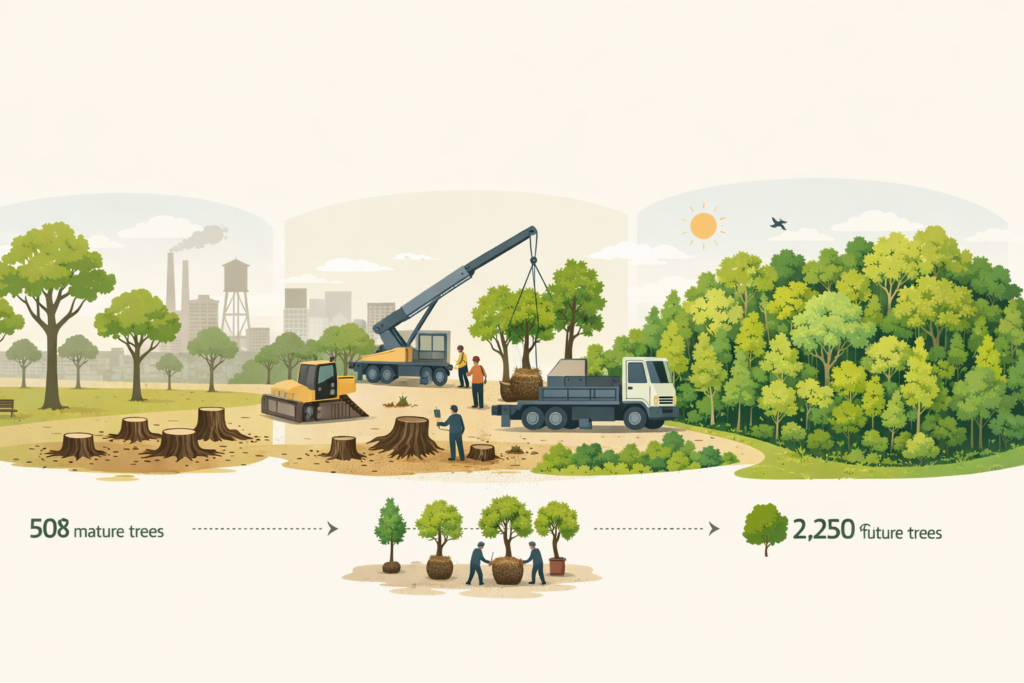
The demolition of 21 structures requires removing mature greenery that has grown for a century. Currently, the site houses 508 trees. The approved environmental plan reveals a complex compromise: 129 trees will be cut, and 68 transplanted. To offset this, the developers have proposed a Miyawaki Forest plan, promising to plant 1,203 new native saplings. This Japanese technique creates dense, self-sustaining mini-forests, projecting a total future tree count of 2,230. While the math favors the future, local residents mourn the loss of high-canopy giants that defined the old industrial landscape.
Conclusion
As the bulldozers enter the Parle gates, there is a palpable sense of bittersweet finality. The “G” once stood for Glucose, and later for Genius, but for Mumbaikars, it stands for a childhood that is being paved over by the unstoppable momentum of progress. The smell of biscuits is gone, the skeleton is being dismantled, and the skyline of Vile Parle East is finally being rewritten in the language of the service sector. We salute the factory that fed a nation and gave a suburb its name, even as we make way for the high-rises that will inevitably follow.
READ OUR OTHER ARTICLES
- Know the Real Reason Behind Tarun Kumar’s Death Over a Holi Balloon
 The Holi festival turned tragic in southwest Delhi this year. On Wednesday, March 4, 2026, the narrow lanes of a JJ Colony in Uttam Nagar became the center of a … Read more
 - T20 World Cup Final 2026: India vs New Zealand
 The cricket world is getting ready for its biggest event. On Sunday, March 8, 2026, the T20 World Cup 2026 final will take place. The stage is set for a … Read more
 - 1,000-Year-Old Kakatiya Vishnu Idol Found in Telangana
 The quiet forests of the Jayashankar Bhupalpally district in Telangana recently gave up a secret they had been keeping for a thousand years. In March 2026, as the summer heat … Read more
 - Kerala Set to Manufacture BrahMos Missile on 180-Acre
 India’s plan to become self-reliant in defense took a major leap forward on March 2, 2026. On this day, the Kerala Cabinet made a historic decision to give 180 acres … Read more
 - Why Aman Gupta Chose His Birthday to Reveal OFF/BEAT ?
 On March 3, 2026, the Indian startup world saw a digital shift that was as much about legacy as it was about the future. Aman Gupta, the famous co-founder of … Read more