

| Date | Event | Technical Mechanism |
| March 2022 | Meta Platforms Banned | IP Blocking and SNI Filtering of Facebook/Instagram. |
| August 2024 | YouTube Throttled | DPI-based Packet Dropping via TSPU equipment. |
| January 2025 | VPN Crackdown | AI-powered Protocol Fingerprinting of WireGuard. |
| August 2025 | Messenger Calls Blocked | Selective UDP Packet Dropping on WhatsApp/Telegram. |
| Feb 2026 | The Digital Blackout | NDNS Erasure (NSDI Record Removal). |
The Silence
The morning of February 11, 2026, was marked by a silence that resonated more deeply than any siren. For over a decade, WhatsApp had functioned as the last enduring bridge between the Russian Federation and the global digital ecosystem. While Facebook and Instagram were cast into the legal abyss in 2022, WhatsApp was spared due to its ubiquity among citizens and officials alike. That pragmatism has now been sacrificed for total digital sovereignty. The final bridge has been burned, and for 100 million Russians, the world has suddenly become much smaller.
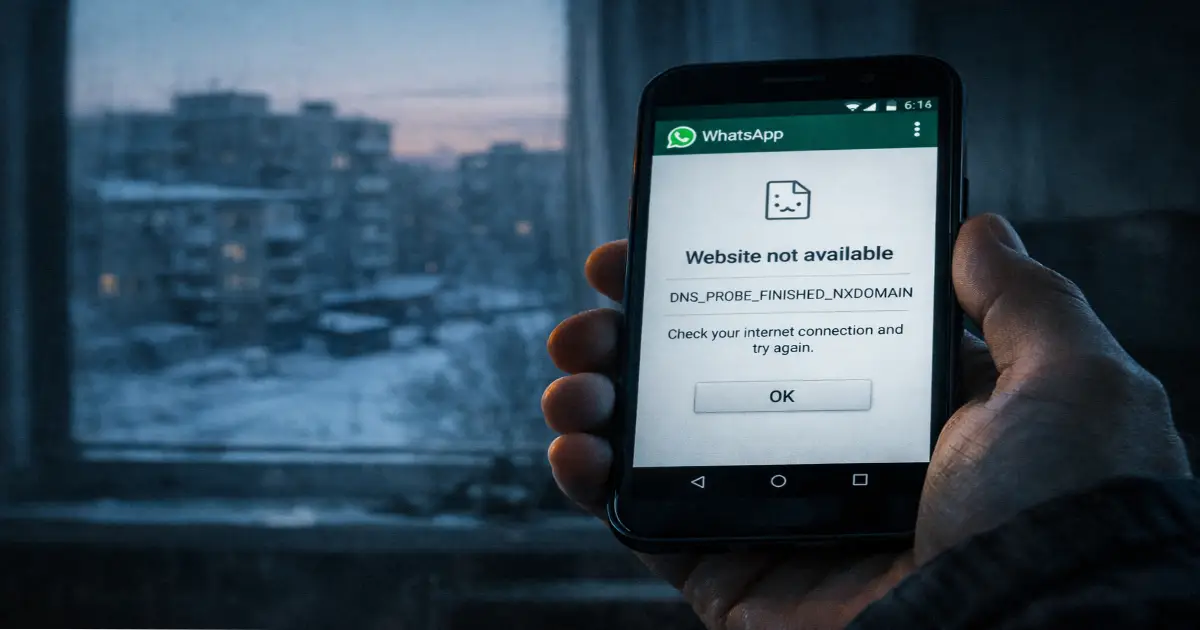
The immediate impact was a pervasive, sterile void. Across eleven time zones, users reaching for their devices were greeted by a chillingly final technical failure. The error message DNS_PROBE_FINISHED_NXDOMAIN became the new symbol of national isolation—a digital tombstone for the Western social web. This was not the erratic performance of a throttled connection; this was the systematic erasure of a destination from the map itself. To the Russian network, “whatsapp.com” and “youtube.com” no longer exist.
The Technical Architecture of NDNS Erasure
The execution of the February 2026 blackout was a masterclass in centralized network manipulation. Rather than relying on porous ISP firewalls, the regulator, Roskomnadzor, utilized the National Domain Name System (NDNS), or NSDI. This is a parallel directory of the internet mandated by the 2019 RuNet Isolation law, designed to replicate the global DNS while remaining entirely under Kremlin jurisdiction.
Under the global DNS framework, name resolution is a hierarchical process where root servers provide coordinates for websites. Russia’s NDNS functions as an alternative root—a sovereign phonebook that domestic operators are legally required to use. By manually removing the resource records for WhatsApp and YouTube from this directory, the state performed a NDNS Erasure. When a browser asks for an IP address, the system responds that the domain does not exist, preventing the device from even attempting a connection.
Enforcement is managed by “Technical Measures for Countering Threats” (TSPU), hardware-software complexes installed at nearly every ISP. These devices utilize Deep Packet Inspection (DPI) to analyse the Server Name Indication (SNI) and cryptographic handshakes of traffic in real-time. This granularity allowed the state to spend 2025 “training” its systems to identify and throttle specific features before moving to total erasure.

The Trap
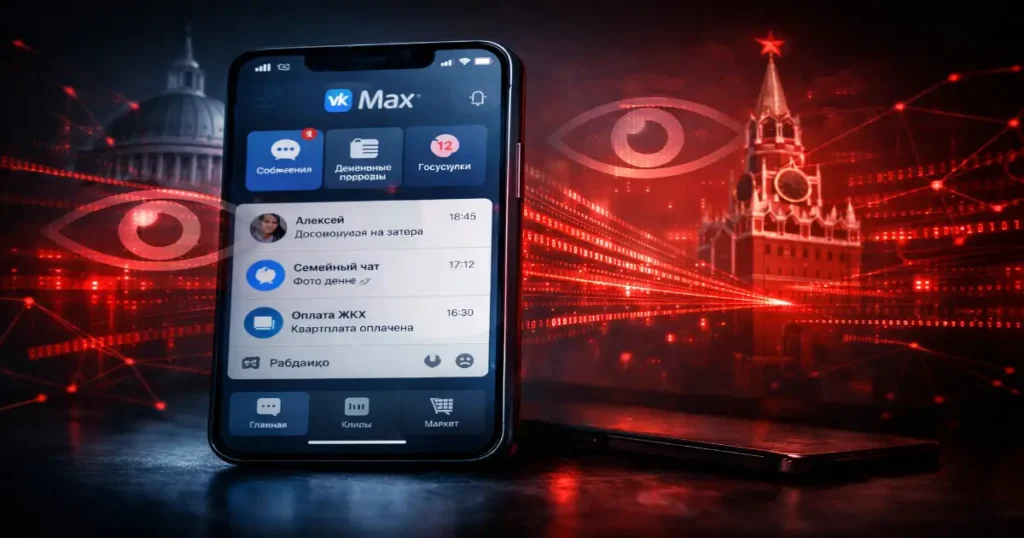
The disappearance of WhatsApp was a forced relocation. The Kremlin’s goal is to migrate the population into a “Golden Cage” where every interaction is visible to the security services. This cage is Max (or the VK Super App), which has been promoted with increasing desperation since its beta launch.
Max is modelled explicitly on China’s WeChat, merging messaging, financial services, and government functions. Since September 2025, the app has been mandatory pre-installed on every smartphone sold within the country. Unlike WhatsApp, which utilizes the Signal protocol for end-to-end encryption, Max is designed for interoperability with state systems. The app is integrated with Gosuslugi (the state services portal) via the Unified Identification and Authentication System (ESIA). This means a user’s private identity is permanently linked to their real-world passport data and tax records.
The Federal Security Service (FSB) initially delayed the rollout in early 2025 to ensure the backdoors were sufficiently robust. After a source code audit and the implementation of state-certified encryption, the FSB gave its approval. Today, Max acts as a digital panopticon; its privacy policy states that geolocation, contact lists, and message metadata are shared with government bodies.
The VPN War
For years, VPNs were the primary defense against censorship. However, by 2026, the “cat-and-mouse” game has reached a brutal endgame. The government has allocated over 60 billion rubbles to its VPN Crackdown 2026 infrastructure, transforming the TSPU from a filter into a hunter.
The current crackdown has shifted from blocking IP addresses to blocking protocols. Traditional standards like OpenVPN and WireGuard are now almost entirely ineffective. WireGuard’s 148-byte handshake packet is a “dead giveaway” for the TSPU’s AI models, which drop the connection before a tunnel can form. Beyond technical hurdles, the state has criminalized the promotion of circumvention tools. Since March 2024, sharing guides or technical reviews of functioning VPNs has been illegal, resulting in a total information blackout for the average user.
The Splinternet
The February 2026 blackout is the culmination of the RuNet Isolation trajectory that began in 2019. Framed as a defensive measure to protect against “external threats,” the law provided the foundation for an offensive move toward isolation. A 2026 decree finally gave the regulator power to unilaterally disconnect the Russian segment from external resources.
The removal of WhatsApp and YouTube is the most significant evidence that the era of a single, unified World Wide Web is over. The “Splinternet” is now a lived reality for 140 million people. Russia has successfully aligned its digital borders with its physical ones, regardless of the technological cost. As citizens migrate into the monitored confines of Max, the state has achieved the total nationalization of the digital experience. The world wide web has officially split in two, and for those behind the new Digital Iron Curtain, the global internet is now nothing more than a ghost on a deleted map.
READ OUR OTHER ARTICLES
- T20 World Cup Final 2026: India vs New Zealand
 The cricket world is getting ready for its biggest event. On Sunday, March 8, 2026, the T20 World Cup 2026 final will take place. The stage is set for a … Read more
 - 1,000-Year-Old Kakatiya Vishnu Idol Found in Telangana
 The quiet forests of the Jayashankar Bhupalpally district in Telangana recently gave up a secret they had been keeping for a thousand years. In March 2026, as the summer heat … Read more
 - Kerala Set to Manufacture BrahMos Missile on 180-Acre
 India’s plan to become self-reliant in defense took a major leap forward on March 2, 2026. On this day, the Kerala Cabinet made a historic decision to give 180 acres … Read more
 - Why Aman Gupta Chose His Birthday to Reveal OFF/BEAT ?
 On March 3, 2026, the Indian startup world saw a digital shift that was as much about legacy as it was about the future. Aman Gupta, the famous co-founder of … Read more
 - Who’s Behind ViRosh’s Wedding Jewelry & Outfits?
 For a long time, celebrity weddings in India seemed to follow a very specific script. We saw a sea of pastel colors, minimalist decor, and a focus on what would … Read more