

Speed Benchmark (2026)
| Category | Velocity Range (km/h) | Status and Context |
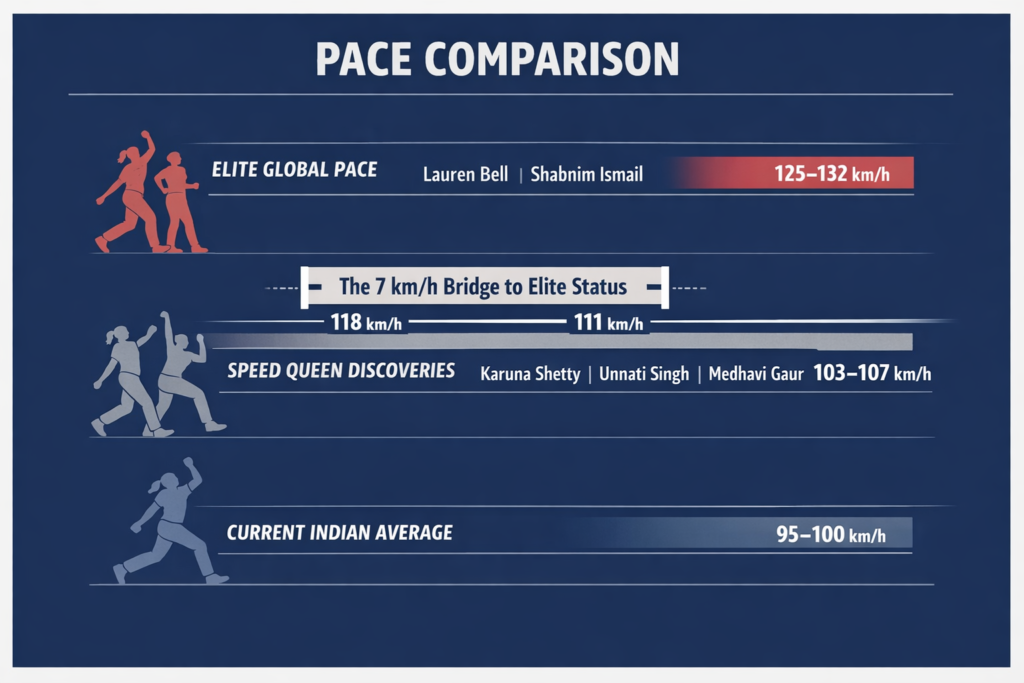
| Elite Global Standard | 125 – 132+ | Dominated by overseas pacers like Lauren Bell and Shabnim Ismail. |
| Current Indian Average | 95 – 100 | The “Medium-Pace” plateau prevalent in domestic age-group cricket. |
| Speed Queen Discovery | 103 – 107 | Raw, unpolished talent discovered in January 2026 trials. |
| The Target Benchmark | 110+ | Minimum entry point for high-performance fast-tracking. |
A Quieter Revolution
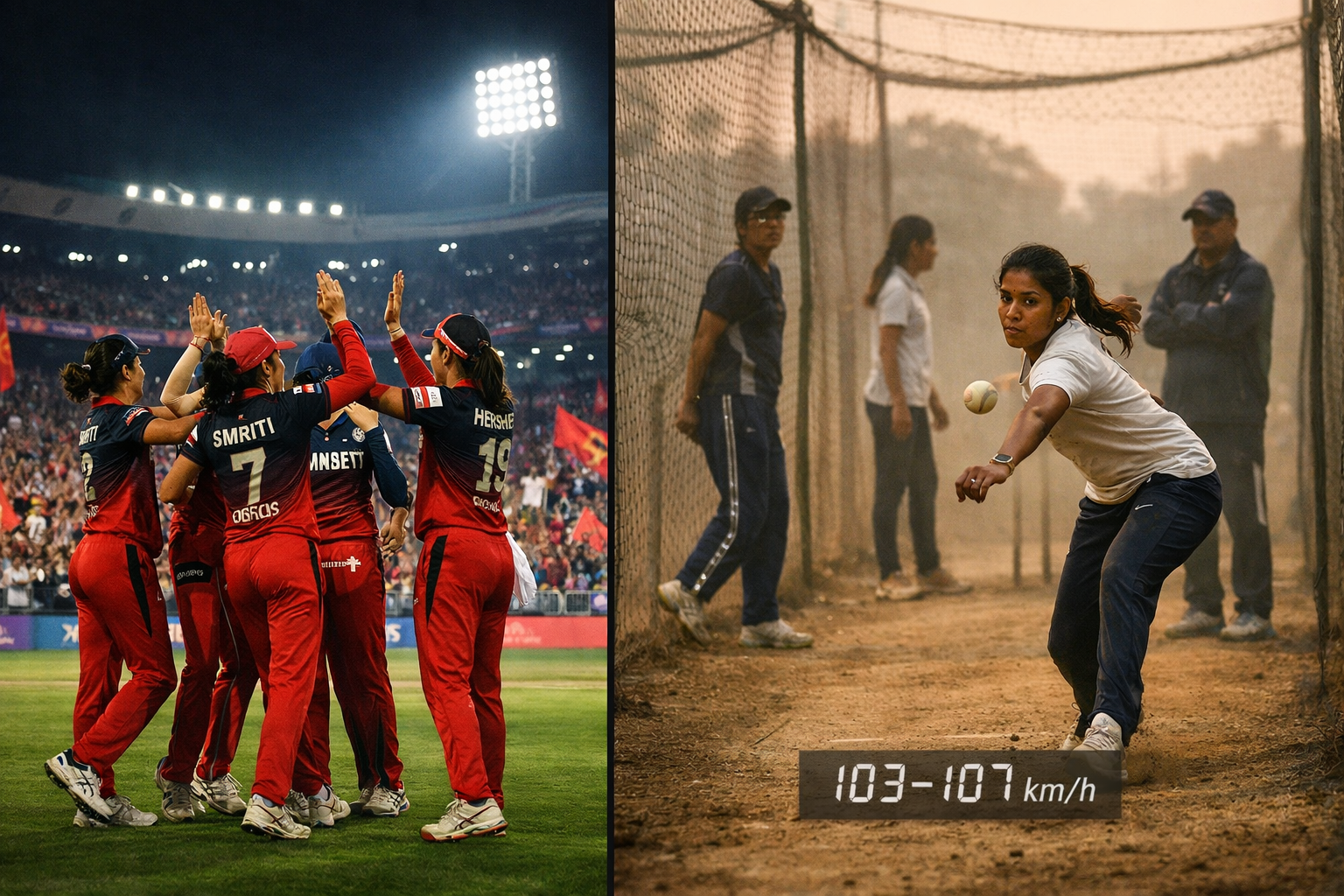
While the cricket world stood still on February 5 to watch Royal Challengers Bangalore lift the trophy, a quieter, more clinical revolution was reaching its crescendo. In the nets of Meerut and Mysore, far from the stadium lights, the BCCI Talent Hunt—formally known as WPL Speed Queen 2026—was concluding its search for the holy grail of Indian cricket: a genuine express pacer. For years, the Women’s Premier League has been a showcase of foreign firepower. In the 2026 season, RCB’s Lauren Bell and others continued to dominate the speed charts, leaving a glaring vacancy for an Indian name at the top of the 120 km/h bracket. This project wasn’t just another trial; it was a scientific attempt to rewrite the DNA of the Indian bowling attack.
Breaking the “Spin Addiction”
The hard truth of Indian Female Pacers is a matter of percentages. In the newly concluded WPL 2026, roughly 80% of the overs bowled by Indian players were delivered by spinners. This isn’t a lack of talent, but a systemic “spin addiction” born from necessity. In small towns, turf wickets are rare; most girls grow up on matting or concrete tracks where spinners are cheaper and easier to produce.
Fast bowling requires specialized infrastructure: high-performance footwear, advanced nutrition, and grass banks to preserve joints. Historically, these resources were reserved for the men’s game, leaving the women’s grassroots level under-resourced. The WPL Speed Queen 2026 initiative addressed this gap by targeting the Under-19 and Under-23 categories across 25 cities. It aimed to find girls who could clock 110 km/h and provide them a direct pipeline to the WPL ecosystem as net bowlers and developmental prospects.
The Findings
The zonal trials in January 2026 provided the first objective data set for Indian pace potential. The hunt didn’t find a 130 km/h bowler overnight, but it uncovered a “raw” tier of talent consistently clocking above the national average. In the Meerut and NCR trials, the numbers were particularly encouraging. Karuna Shetty (Meerut) and Unnati Singh (Haridwar) emerged as the pacesetters, both recording speeds of approximately 104.6 km/h.
Other notable discoveries included Medhavi Gaur (104.61 km/h) and Arshbani (104.6 km/h), proving that the talent is there, albeit in an “unrefined” state. These athletes are currently operating in the 103 – 107 km/h corridor. To the uninitiated, this might seem far from the elite 125 km/h mark, but to a scout, this represents a high ceiling. These speeds were achieved with minimal professional coaching, suggesting that with scientific “polishing,” the jump to 115 – 120 km/h is a realistic biomechanical goal.
The Shabnam Shakil Benchmark
In this landscape, Shabnam Shakil of the Gujarat Giants remains the gold standard. At just 16 years old during her debut, she became the youngest player in the WPL and the only Indian consistently hitting the 110 km/h mark. Her performance—notably her 3/11 against UP Warriorz—proved that an Indian pacer could lead an attack. The Speed Queen project is essentially looking for “more Shabnams.” By identifying girls like Karuna and Unnati who are already within 5 km/h of Shakil’s current operating speed, the BCCI has successfully widened the pool from which the next generation of spearheads will be drawn.
AI Scouting in the Districts
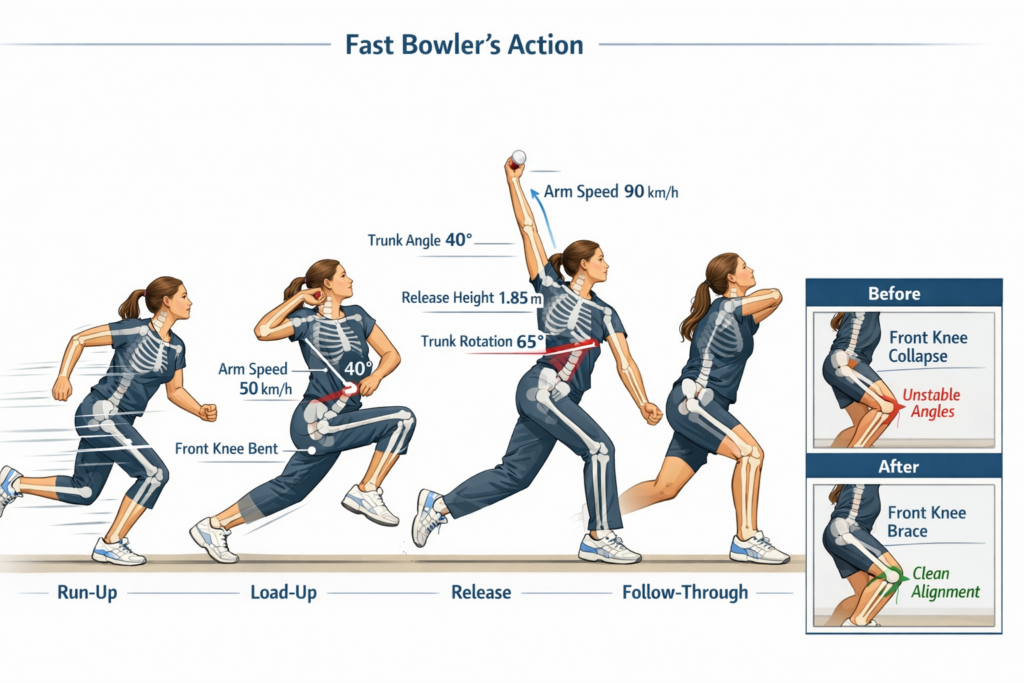
What made this hunt revolutionary was the integration of AI Scouting. The initiative utilized AI-based screening to democratize the selection process. Aspiring bowlers didn’t need to be in Mumbai to be seen; they uploaded side-on bowling videos that were analyzed for arm speed, release height, and run-up velocity.
This technological filter allowed scouts to analyze biomechanical parameters that the human eye might miss. Research shows that for female pacers, speed is less about trunk flexion (forward bending) and more about trunk rotation and “stiff” front-knee kinematics. The AI systems evaluated these specific metrics, identifying athletes with the “whip” effect in their action—the primary predictor of future velocity.
Potential vs. Polishing
The transition from 105 km/h to 120 km/h is where the real work begins. The Speed Queen discoveries possess the anthropometric advantages: height and long levers (arm length), which explain over 50 % of the variance in bowling speed. However, many of these young pacers suffer from “front-knee collapse” at the moment of delivery, which bleeds momentum.
The next phase of the project involves bringing these “Speed Queens” into franchise camps. Here, they will work on linear-to-angular momentum conversion—learning to use their front leg as a brace to accelerate the bowling shoulder. If Medhavi Gaur or Unnati Singh can stabilize their landing and increase their run-up velocity, the data suggests a 10 – 15 % increase in ball release speed is possible within a single high-performance cycle.
The Landscape of 2027
The WPL Speed Queen 2026 initiative has successfully moved the needle from subjective hope to objective strategy. We did not find a 130 km/h bowler in this first sweep, but we found something more valuable: a validated pool of 105 km/h athletes who are currently uncoached.
If these bowlers are integrated into WPL squads as developmental players for the 2027 season, the “spin addiction” of the Indian game will begin to fade. The road to 2027 is now paved with data and AI-driven insights. The hunt has proven that India’s next great fast bowler could come from a village in Meerut or a suburb in Haridwar. The talent is no longer hidden; it is identified, clocked, and ready to be polished into the express pace the WPL—and India—so desperately needs.
READ OUR OTHER ARTICLES
- Know the Real Reason Behind Tarun Kumar’s Death Over a Holi Balloon
 The Holi festival turned tragic in southwest Delhi this year. On Wednesday, March 4, 2026, the narrow lanes of a JJ Colony in Uttam Nagar became the center of a … Read more
 - T20 World Cup Final 2026: India vs New Zealand
 The cricket world is getting ready for its biggest event. On Sunday, March 8, 2026, the T20 World Cup 2026 final will take place. The stage is set for a … Read more
 - 1,000-Year-Old Kakatiya Vishnu Idol Found in Telangana
 The quiet forests of the Jayashankar Bhupalpally district in Telangana recently gave up a secret they had been keeping for a thousand years. In March 2026, as the summer heat … Read more
 - Kerala Set to Manufacture BrahMos Missile on 180-Acre
 India’s plan to become self-reliant in defense took a major leap forward on March 2, 2026. On this day, the Kerala Cabinet made a historic decision to give 180 acres … Read more
 - Why Aman Gupta Chose His Birthday to Reveal OFF/BEAT ?
 On March 3, 2026, the Indian startup world saw a digital shift that was as much about legacy as it was about the future. Aman Gupta, the famous co-founder of … Read more