

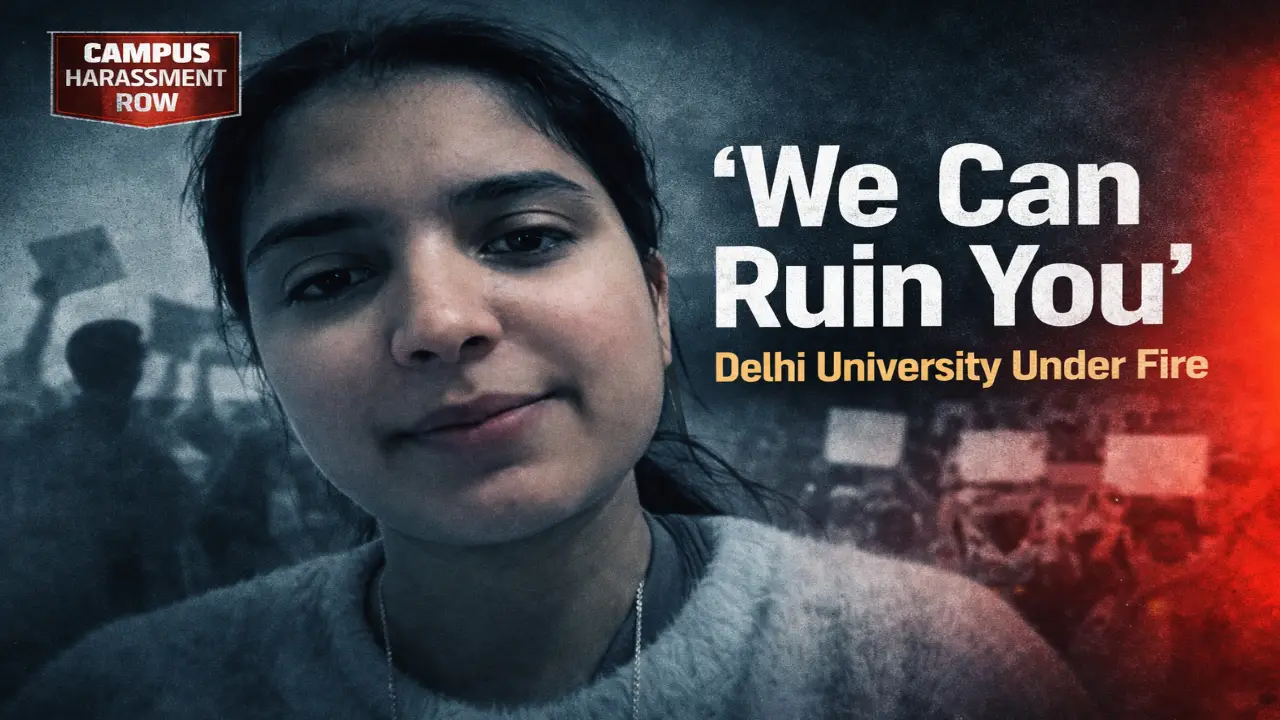
In the second week of December 2025, a series of heart-wrenching videos began circulating on social media, pulling back the curtain on a culture of fear and silence within the hallowed halls of Delhi University. Chitra Rajput, a postgraduate student in the Department of African Studies, posted several Instagram reels between December 11 and 14 that quickly went viral. In these videos, Rajput is seen breaking down in tears, alleging sustained mental harassment and misconduct by a university professor. Her digital cry for help was not a first choice but a last resort. It was the desperate act of a student who felt that the university’s internal safety nets had not only failed her but had been turned against her.
The Chitra Rajput viral video has since sparked a massive online storm, with thousands of netizens and student organizations demanding justice. The core of her allegation is not just the initial harassment but the chilling institutional response that followed. Rajput claims that when she tried to seek help, she was met with cold indifference and, eventually, open hostility from the leadership of her own department.
The Threat: “We Can Ruin a Lot for You”
The most disturbing aspect of this Delhi University harassment case is the alleged intimidation Rajput faced after speaking out. According to her account, she was summoned to the office of the Head of Department (HOD). Instead of offering support or initiating a fair probe into the professor’s conduct, the HOD reportedly issued a direct ultimatum. Rajput quoted the HOD as saying: “Delete all the reels you posted against the professor. You are just a small part of this university. We can ruin a lot for you”.
This statement, if true, exposes a deep-seated rot in the academic hierarchy. It suggests an environment where a student’s career and future are held hostage to protect the reputation of faculty members. The phrase “we can ruin a lot for you” is a clear example of DU HOD intimidation, serving as a warning to any student who dares to challenge the status quo. For Rajput, the “ruin” was not just a theoretical threat. She alleged that the university immediately began retaliating by withholding her semester-end examination admit card, effectively barring her from completing her degree.
The “40 Marks” Economy
Perhaps the most cynical part of the scandal involves the alleged manipulation of Rajput’s peers. In her videos, Rajput claimed that seven or eight of her classmates were pressured or bribed to side with the accused professor. She alleged that these students “sold themselves for 40 marks in the internal assessment,” testifying against her in the HOD’s office to secure their own academic standing.
This internal assessment weaponization points to a structural flaw in the new academic frameworks. Under the Postgraduate Curriculum Framework (PGCF) 2025, internal assessments and tutorials carry significant weight—often exactly 40 marks for a single credit. Because these marks are largely at the discretion of departmental faculty, they can be used as a powerful tool for coercion. When marks are linked to loyalty rather than learning, the classroom becomes a marketplace for silence. Rajput further alleged that professors in the department openly linked grades to how much time students spent in their private rooms, creating a toxic atmosphere of favoritism and exploitation.

The Institutional Response
As the public outcry grew, student groups like the ABVP took “serious note” of the situation, demanding an immediate and impartial inquiry to restore the university’s credibility. In response, the Delhi University administration formed a three-member inquiry committee to investigate the allegations. The Prof Rajni Abbi inquiry committee, led by the South Campus Director and University Proctor, is now tasked with determining the merit of Rajput’s claims.
However, the university’s early rhetoric has been focused as much on the student’s behavior as on the professor’s alleged misconduct. Prof. Rajni Abbi noted that Rajput had not filed a formal written complaint before going public and that the administration had heard reports of her having “quite poor” attendance. This focus on technicalities is a common institutional defense. While the university claims it is following “due process,” critics argue that a student who has been told the university will “ruin” her is unlikely to trust an internal committee with a written report.
The investigation has also been complicated by the professor’s own legal actions. He has reportedly filed a cybercrime complaint against the student for posting his photo online. Meanwhile, the student was eventually traced to Saharanpur, Uttar Pradesh, where her statement was recorded by local police.
The Broader Question: Safety vs. Power
This case raises a fundamental question about the safety of female students in Indian higher education. When the very people tasked with a student’s mentorship are the ones allegedly harassing them, and the administrative heads are the ones issuing threats, where does a victim turn? The fact that Rajput felt her only shield was a social media video is a damning indictment of the university’s Internal Complaints Committee (ICC).
Historically, Delhi University has a troubled record with harassment cases. In several past instances, even when professors were found guilty by internal bodies, the administration was accused of stalling their removal for months or even years. This history creates a “fear of academic ruin” that keeps many survivors quiet. They know that in a battle between a “Star Professor” and a “small part of the university,” the institution’s instinct is almost always to protect the former.
The findings of the Prof Rajni Abbi inquiry committee will be a litmus test for Delhi University. If the report merely dismisses Rajput’s claims based on attendance or procedural errors, it will send a message that the “underbelly of academic power” remains untouchable. But if the university chooses to address the alleged bribery of students with marks and the blatant intimidation by the HOD, it might begin the long process of making the campus truly safe.

Conclusion
For now, the status of DU feels diminished as Rajput claimed while breaking down in tears. A university cannot claim to be a center of excellence if its students are taught that their dignity is worth less than 40 internal marks.
READ OUR OTHER ARTICLES
- Know the Real Reason Behind Tarun Kumar’s Death Over a Holi Balloon
 The Holi festival turned tragic in southwest Delhi this year. On Wednesday, March 4, 2026, the narrow lanes of a JJ Colony in Uttam Nagar became the center of a … Read more
 - T20 World Cup Final 2026: India vs New Zealand
 The cricket world is getting ready for its biggest event. On Sunday, March 8, 2026, the T20 World Cup 2026 final will take place. The stage is set for a … Read more
 - 1,000-Year-Old Kakatiya Vishnu Idol Found in Telangana
 The quiet forests of the Jayashankar Bhupalpally district in Telangana recently gave up a secret they had been keeping for a thousand years. In March 2026, as the summer heat … Read more
 - Kerala Set to Manufacture BrahMos Missile on 180-Acre
 India’s plan to become self-reliant in defense took a major leap forward on March 2, 2026. On this day, the Kerala Cabinet made a historic decision to give 180 acres … Read more
 - Why Aman Gupta Chose His Birthday to Reveal OFF/BEAT ?
 On March 3, 2026, the Indian startup world saw a digital shift that was as much about legacy as it was about the future. Aman Gupta, the famous co-founder of … Read more