

The regulatory architecture of tobacco control in India operates within a dualistic legal framework that distinguishes between products based on their mode of consumption and their statutory classification. To understand the Odisha government’s 2026 notification, one must first delineate the Legal Distinction between chewing tobacco and inhalable products like cigarettes and beedis. Under the Food Safety and Standards Act, 2006 (FSSA), “food” is defined under Section 3(1)(j) as any substance intended for human consumption, which includes processed or unprocessed items like pan masala. Because products such as gutkha, pan masala, and zarda are ingested or kept in the mouth, they are legally categorized as food products. Consequently, Regulation 2.3.4 of the Food Safety and Standards Regulations, 2011, prohibits the use of tobacco and nicotine as ingredients in any food product.
In contrast, cigarettes and beedis are not “food” because they are intended for inhalation through combustion. These products fall exclusively under the jurisdiction of the Cigarettes and Other Tobacco Products Act, 2003 (COTPA), which is a specialized central legislation focusing on regulation rather than outright prohibition. While public health advocates argue for a total ban, state governments lack the constitutional authority to ban cigarettes and beedis under food safety laws; such attempts would be struck down for jurisdictional overreach. Instead, the state controls these through heavy taxation, such as the 40% GST effective February 2026, and stringent packaging requirements. The 2026 notification in Odisha is thus a surgical strike targeting “food” contaminants, specifically closing the Twin-Packet Loophole.
Closure of the Twin-Packet Loophole
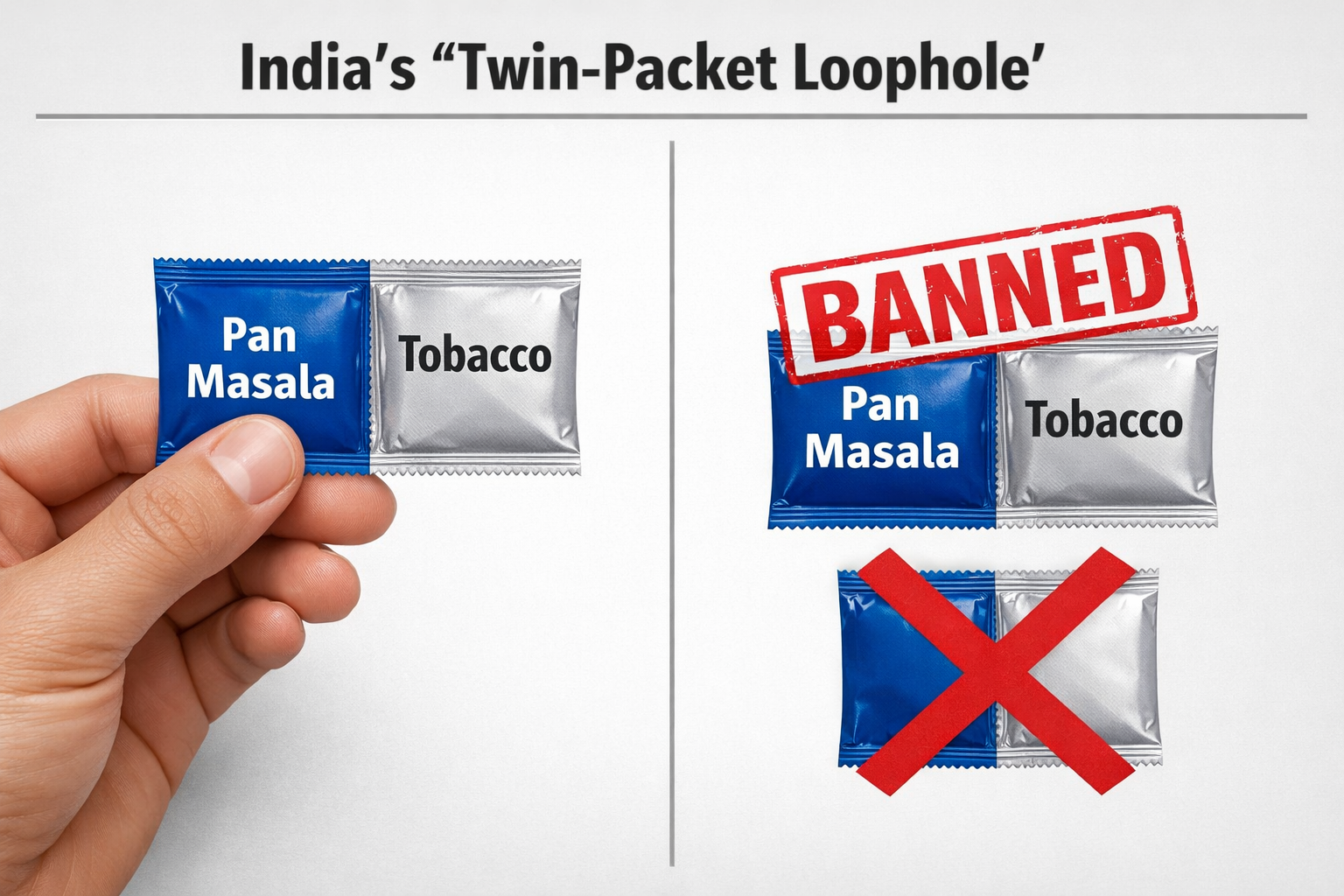
For over a decade, the tobacco industry in Odisha has engaged in a sophisticated game of regulatory cat-and-mouse. When Odisha first banned gutkha containing tobacco in 2013, manufacturers unbundled their products, selling flavored pan masala in one sachet and pure tobacco in another. These conjoined packets allowed consumers to mix the contents manually, successfully bypassing the FSSA prohibition by claiming the tobacco component was a COTPA product.
Notification No. 2065, issued on January 21, 2026, marks the end of this circumvention. The new order explicitly prohibits the manufacture, storage, sale, and distribution of these products regardless of whether they are sold as a single item or in separate components intended for mixing. This clause directly addresses a 2016 Supreme Court observation that the twin-packet system was a blatant attempt to violate the spirit of the law. By defining the final consumable mix as the target, Odisha has empowered enforcement agencies to seize even “tobacco-free” pan masala if found conjoined with tobacco sachets.
GATS Data and Public Health
The urgency of this notification is underscored by the dire epidemiological profile of the state. According to the Global Adult Tobacco Survey (GATS-2), Odisha faces a public health crisis markedly different from the national smoking epidemic. In Odisha, the primary driver of mortality is “smokeless tobacco” (SLT).
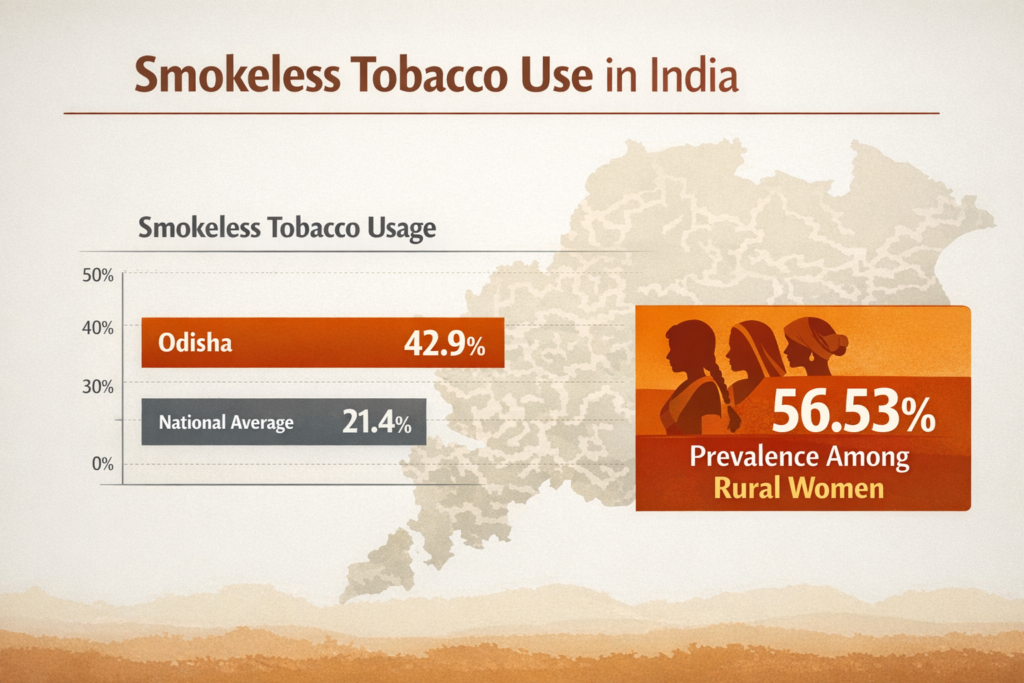
The GATS-2 data reveals that 42.9% of the adult population in Odisha uses smokeless tobacco, nearly double the national average of 21.4%. This disparity explains why the Health and Family Welfare Department has prioritized the crackdown on chewables. Furthermore, SLT use among rural women in Odisha is exceptionally high, with some studies indicating a prevalence as high as 56.53%. Unlike smoking, which carries a social stigma for women, chewing products like betel quid with tobacco are culturally integrated, making the 2026 ban a necessary social intervention to de-normalize a carcinogenic staple.
The public health rationale is rooted in the high incidence of Oral Cancer. The International Agency for Research on Cancer (IARC) has classified these products as Group 1 carcinogens. In Odisha, oral cancer is the leading malignancy among men. With 11% of Odisha’s youth aged 15–17 already using tobacco, the state is battling an entrenched addiction that threatens to overwhelm its future healthcare capacity.
The Economic Angle: Small Traders vs. Public Health Costs
The 2026 notification has reignited the debate between the economic interests of small-scale traders and the long-term fiscal health of the state. While groups like the Odisha Vyavasayee Mahasangha raise concerns about the livelihoods of lakhs of shopkeepers, the government points to the staggering costs of treating tobacco-related diseases.
A landmark study by the Tata Memorial Centre found that the unit cost of treating advanced-stage Oral Cancer is approximately Rs 2,02,892—found to be 42% greater than early-stage treatment at Rs 1,17,135. With 60-80% of patients in India presenting at advanced stages, the public health burden is immense. The 2025-26 Odisha Annual Budget reflects this, allocating Rs 23,635 crore for public healthcare, including Rs 211 crore specifically for the Odisha Comprehensive Cancer Care Plan.
Small vendors argue that chewable tobacco constitutes 40-60% of their daily revenue. However, economists argue that the loss in tax revenue—amounting to thousands of crores—is offset by the reduction in out-of-pocket medical expenses for citizens. To mitigate economic disruption, stakeholders have called for transitional assistance and alternative livelihood programs for those dependent on the tobacco supply chain.

Policing Public Health
The 2026 notification clarifies the enforcement protocol, moving away from a purely administrative approach to a coordinated inter-departmental crackdown. Food Safety Officers (FSOs) remain the primary authority, but are now bolstered by the local police and District Tobacco Control Cells (DTCCs).
Under the new order, special drives will be conducted to curb illegal circulation. Task forces are authorized to:
- Seizure of Products: Confiscate any food products found to contain tobacco or nicotine, including unbundled sachets.
- Cancellation of Licenses: Revoke the business licenses of any retailer or wholesaler found stocking prohibited items.
- Strict Penal Action: Initiate prosecution under the FSSA, which carries more stringent penalties than COTPA, including significant fines.
Health Secretary Aswathy S. and Minister Mukesh Mahaling have emphasized that enforcement will be uniform across all districts to prevent the rural markets from becoming “safe havens” for banned products.
The Road Ahead
The resilience of the 2026 notification will likely be tested in the High Court. Historically, the tobacco industry has argued that the Food Safety Commissioner’s power to prohibit a product under Section 30(2)(a) is intended to be temporary and cannot be used for a permanent prohibition.
However, the legal tide may be shifting. The Supreme Court has increasingly leaned toward Section 89 of the FSSA, which gives the Act “overriding effect” over all other laws, including COTPA, in matters of food safety. As Odisha enters this new era of prohibition, the success of the ban will depend not just on legal victories, but on the state’s ability to provide cessation support to its 42% user base and alternative incomes for its traders. For now, the 2026 notification stands as a definitive commitment to prioritizing the lives of citizens over the revenue of the sachet.
READ OUR OTHER ARTICLES
- Know the Real Reason Behind Tarun Kumar’s Death Over a Holi Balloon
 The Holi festival turned tragic in southwest Delhi this year. On Wednesday, March 4, 2026, the narrow lanes of a JJ Colony in Uttam Nagar became the center of a … Read more
 - T20 World Cup Final 2026: India vs New Zealand
 The cricket world is getting ready for its biggest event. On Sunday, March 8, 2026, the T20 World Cup 2026 final will take place. The stage is set for a … Read more
 - 1,000-Year-Old Kakatiya Vishnu Idol Found in Telangana
 The quiet forests of the Jayashankar Bhupalpally district in Telangana recently gave up a secret they had been keeping for a thousand years. In March 2026, as the summer heat … Read more
 - Kerala Set to Manufacture BrahMos Missile on 180-Acre
 India’s plan to become self-reliant in defense took a major leap forward on March 2, 2026. On this day, the Kerala Cabinet made a historic decision to give 180 acres … Read more
 - Why Aman Gupta Chose His Birthday to Reveal OFF/BEAT ?
 On March 3, 2026, the Indian startup world saw a digital shift that was as much about legacy as it was about the future. Aman Gupta, the famous co-founder of … Read more