

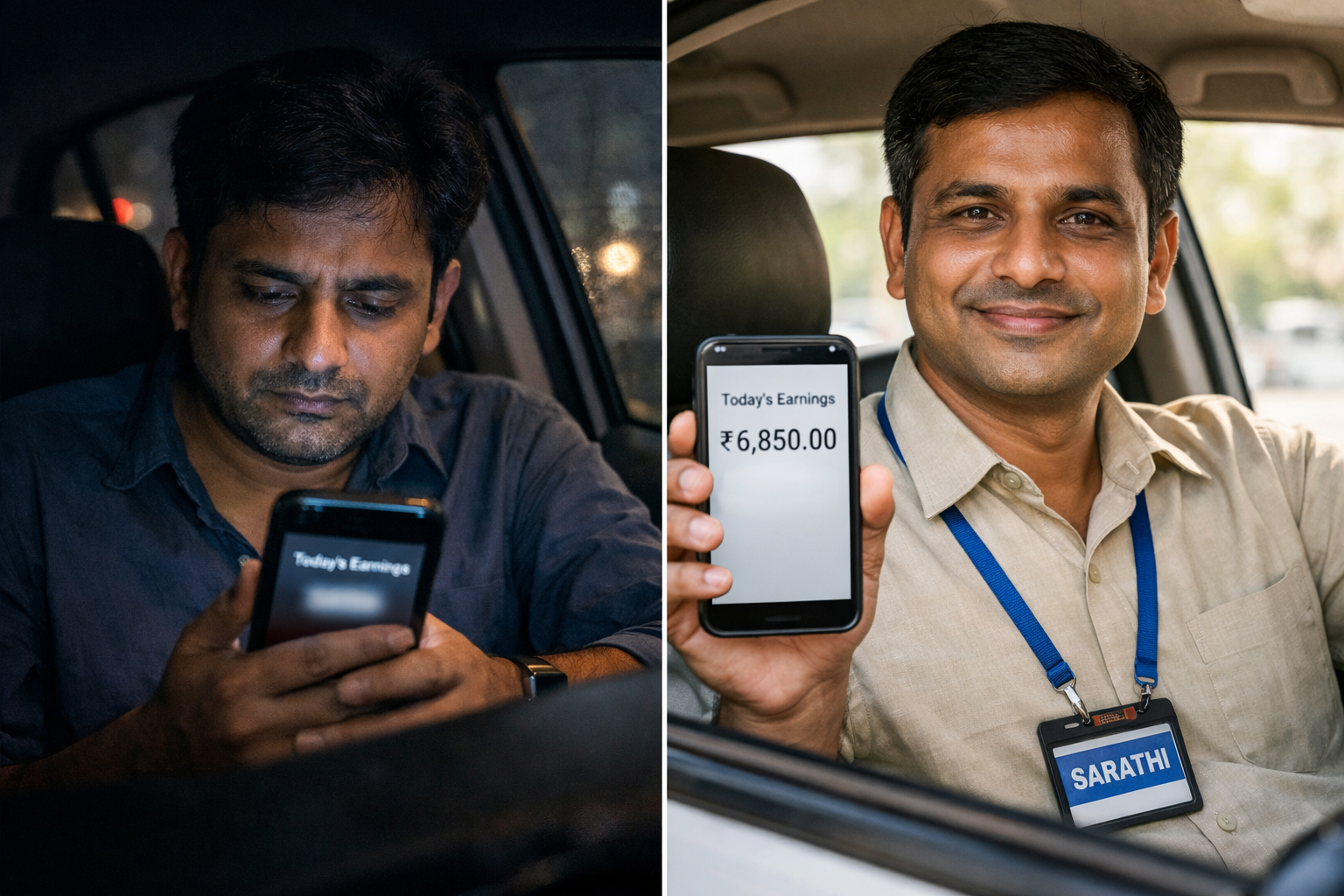
To understand the economic gravity of the Bharat Taxi launch, one must first look at the redistribution of capital from corporate commissions to driver earnings.
Fare Breakdown
| Feature | Uber/Ola (Private Aggregators) | Bharat Taxi (Sahakar Taxi Cooperative) |
| Total Ride Fare | ₹500 | ₹500 |
| Platform Commission | ₹150 (30% Commission) | ₹0 (Zero-Commission Model) |
| Driver Earnings (Gross) | ₹350 | ₹500 |
| Daily Subscription Fee | ₹0 (Variable %-based) | ₹30 (Flat Daily Fee) |
| Net Take-Home (1st Ride) | ₹350 | ₹470 |
| Net Take-Home (10th Ride) | ₹3,500 | ₹4,970 |
The Commuter’s Breaking Point
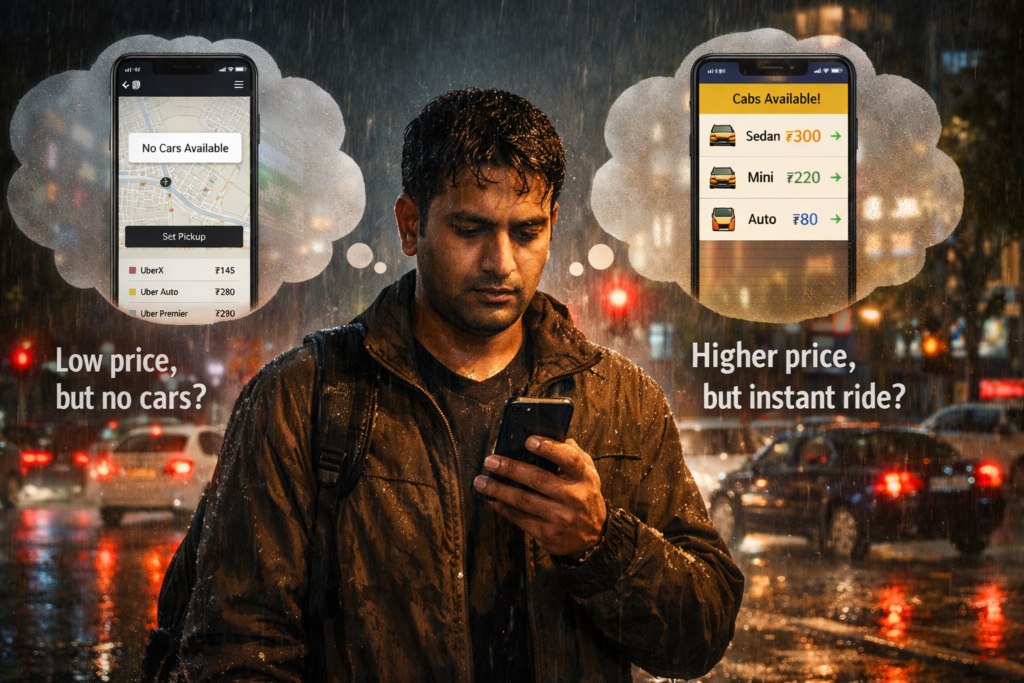
Every Indian commuter has lived through the same digital trauma: standing on a rain-slicked pavement in Delhi or a humid corner in Bengaluru, watching three consecutive drivers cancel a ride because it was “too close” or “cash only.” You open a second app, only to find the 1.2x surge has metastasized into a 3x multiplier. This is the friction of a broken duopoly. For a decade, Ola and Uber have operated on a “growth-at-all-costs” model that eventually squeezed both the driver’s margin and the rider’s patience.
Enter Bharat Taxi. Formally launched on February 5, 2026, at Vigyan Bhavan by Union Home and Cooperation Minister Amit Shah, the platform is being positioned not just as a “government app,” but as a policy-driven uprising. It promises to solve the “driver’s anger”—the root cause of cancellations—by making the driver the owner. If the platform finally aligns the incentive of the “Sarathi” with the arrival of the passenger, it might just achieve what no state-led app has: reliability at scale.
The Launch and the Model
The launch event in New Delhi was more than a ribbon-cutting; it was a demonstration of institutional muscle. Minister Amit Shah positioned Bharat Taxi as the world’s largest driver-owned mobility platform, conceptualized under the vision of “Sahkar se Samriddhi” (Prosperity through Cooperation). Operated by the Sahakar Taxi Cooperative Limited (STCL), the platform transitions drivers from “gig workers” into “Sarathis” or shareholders.
The economics are intentionally disruptive. While private aggregators typically siphon off 20% to 30% per ride in commissions, Bharat Taxi operates on a Zero-Commission Model. Instead of a percentage cut, drivers pay a flat daily subscription fee—approximately ₹30 for taxis and ₹18 for auto-rickshaws—to access the network. This fixed-cost model turns the platform into a utility rather than a profit-extracting middleman, theoretically allowing drivers to keep 100% of the fare.
The Consumer Promise vs. Driver Reality
For the rider, the appeal is clinical: No Surge Pricing. Fares are estimated to be up to 30% cheaper than private apps because the “middleman margin” is removed. In a market where price volatility is a major pain point, Bharat Taxi offers transparent, regulated rates that remain stable even during peak demand.
For the “Sarathis,” the benefits extend beyond the fare. Unlike previous failed attempts by state governments, Bharat Taxi has the backing of cooperative titans like Amul, IFFCO, NABARD, and NCDC. This provides a social security net previously unheard of in the gig economy: ₹5 lakh in personal accident insurance and ₹5 lakh in family health insurance for top performers. Following a successful pilot in Delhi-NCR and Gujarat—where 10,000 rides were completed daily—the rollout is now targeting the “Big Three”: Delhi, Mumbai, and Bengaluru.
The “Amul” Analogy
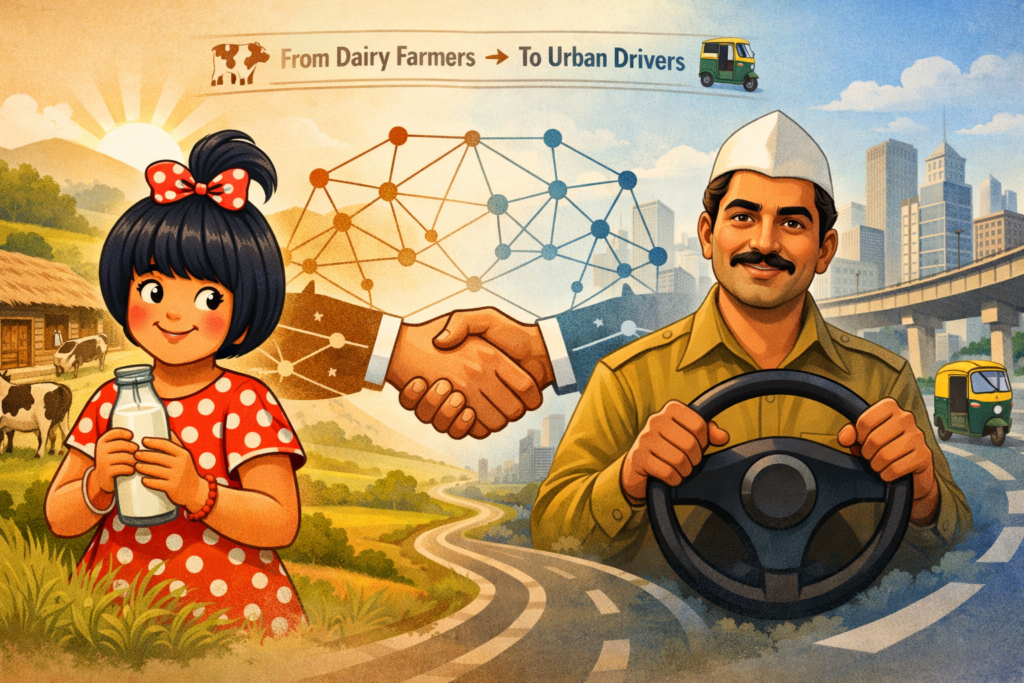
The most compelling aspect of Bharat Taxi is its attempt to apply the “Anand Pattern” to the digital age. Just as Amul transformed dairy farmers from price-takers into supply-chain owners, Bharat Taxi intends to do the same for urban drivers. In the Amul model, roughly 85% of the consumer’s price goes back to the producer. Bharat Taxi pushes this further, returning almost the entire fare to the Sarathi.
The logic is simple: if drivers own the platform, they have a vested interest in its reputation. This “Sarathi Hi Malik” (The Driver is the Owner) philosophy suggests that ownership will naturally reduce the “arbitrary behavior” associated with private apps. However, the transition from milk to mobility is non-trivial. Milk is a physical commodity; ride-hailing is a real-time service event. The question for 2026 is whether a cooperative can manage the hyper-local complexity of urban traffic as efficiently as it manages a dairy cold chain.
Tech Slickness vs. Government Glitches
As analysts, we must be skeptical of the “cooperative cure-all.” Historically, government-linked apps have suffered from abysmal UI/UX and glitchy mapping software. While private aggregators have spent billions on high-frequency matching algorithms, Bharat Taxi’s early beta versions were marred by crashes and bugs. Can a cooperative-backed app truly compete with the slick, data-optimized technology of Uber?
Customer support is another potential Achilles’ heel. Private giants use massive AI-driven infrastructures to handle millions of disputes. Bharat Taxi’s promise of 24/7 customer service will be tested by the sheer volume of urban chaos. Furthermore, without “surge pricing” to attract supply to high-demand areas during rain or strikes, Bharat Taxi risks a “supply drought” where the app shows low prices but has zero available cars.
Market Impact
The reaction from the incumbents has been swift. On February 7, 2026—just two days after the launch—major gig worker unions called for a nationwide “All India Breakdown,” demanding government intervention on minimum fares. This strike highlights the desperation Bharat Taxi is tapping into.
If even 20% of the 1.2 crore gig workers in India migrate to the cooperative model, Ola and Uber will be forced into a defensive price war. We may see private aggregators slashing commissions or offering extreme rider discounts to maintain market share. However, with investors demanding profitability over burn, the private giants have limited room to maneuver against a platform that has no “profit” requirement beyond its own sustainability.
Conclusion
Bharat Taxi is more than just another icon on a smartphone; it is a high-stakes policy experiment in Platform Cooperativism. If it succeeds, it marks the end of the “profit-extractive” gig economy and the beginning of a model where technology serves the laborer rather than the other way around.
The hype is significant, but the reality will be determined by the “Sarathis.” If the Sahakar Taxi Cooperative can deliver a glitch-free app and reliable pickups, the Ola-Uber duopoly may find its empire shrinking. By 2029, the government aims to make this the largest ride-hailing app in India. For the commuter tired of “Ride Cancelled,” the era of the driver-owner couldn’t come soon enough.
READ OUR OTHER ARTICLES
- Know the Real Reason Behind Tarun Kumar’s Death Over a Holi Balloon
 The Holi festival turned tragic in southwest Delhi this year. On Wednesday, March 4, 2026, the narrow lanes of a JJ Colony in Uttam Nagar became the center of a … Read more
 - T20 World Cup Final 2026: India vs New Zealand
 The cricket world is getting ready for its biggest event. On Sunday, March 8, 2026, the T20 World Cup 2026 final will take place. The stage is set for a … Read more
 - 1,000-Year-Old Kakatiya Vishnu Idol Found in Telangana
 The quiet forests of the Jayashankar Bhupalpally district in Telangana recently gave up a secret they had been keeping for a thousand years. In March 2026, as the summer heat … Read more
 - Kerala Set to Manufacture BrahMos Missile on 180-Acre
 India’s plan to become self-reliant in defense took a major leap forward on March 2, 2026. On this day, the Kerala Cabinet made a historic decision to give 180 acres … Read more
 - Why Aman Gupta Chose His Birthday to Reveal OFF/BEAT ?
 On March 3, 2026, the Indian startup world saw a digital shift that was as much about legacy as it was about the future. Aman Gupta, the famous co-founder of … Read more